
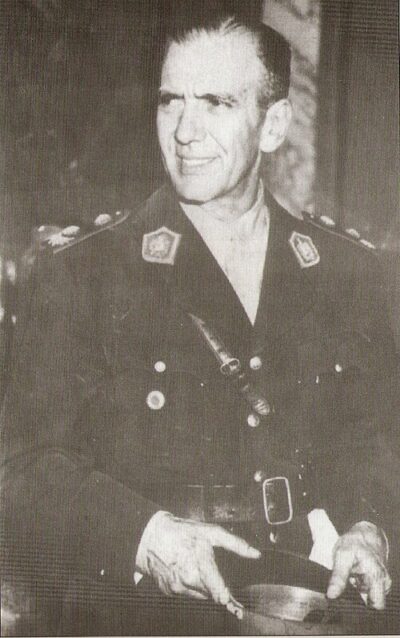
Eduardo Lonardi
Eduardo Lonardi was a Dictatorship of Argentina. Born September 15, 1896, in Buenos Aires. Died March 22, 1956, in Buenos Aires. Positions held include dictator (1955) and President of Argentina (1955). Educated at Nation Military College.
Facts
14 facts · 2 confirmed by two sources · 1 cited · 11 from one source
Where this comes from
Papalocal keeps its own record. It started from these sources; what each one said is kept here as it was copied, so a change on their side never changes this page by itself. Tap one to read its version.
What Wikidata says · copied November 17, 2026 · revision 2535056517
- Described as
- Dictatorship of Argentina (1896-1956)
- Other names
- Eduardo Ernesto Lonardi Doucet
- Born
- September 15, 1896 · 3 references
- Died
- March 22, 1956 · 2 references
- Born in
- Buenos Aires
- Died in
- Buenos Aires
- Buried in
- Recoleta Cemetery
- Citizen of
- Argentina
- Occupation
- military personnel · 1 reference
- Positions held
- dictator (1955); President of Argentina (1955)
- Political party
- independent politician · 1 reference
- Education
- Nation Military College · 1 reference
- Spouse
- Mercedes Villada Achával
- Military branch
- Argentine Army · 1 reference
- Military rank
- lieutenant general · 1 reference
- Wikipedias with a page
- 26
Wikidata item Q365431 (wikidata.org/wiki/Q365431), public domain (CC0). Copied November 17, 2026.
What Wikipedia says · copied November 17, 2026 · revision 1379534798
Eduardo Ernesto Lonardi Doucet (Spanish pronunciation: [eðuˈaɾðo loˈnaɾði]; September 15, 1896 – March 22, 1956) was an Argentine Lieutenant General and served as de facto president from September 23 to November 13, 1955.
- Born, in its opening lines
- September 15, 1896
- Died, in its opening lines
- March 22, 1956
From the Wikipedia article “Eduardo Lonardi” (en.wikipedia.org/wiki/Eduardo_Lonardi), by its contributors, under CC BY-SA 4.0 (creativecommons.org/licenses/by-sa/4.0/). Copied November 17, 2026; not changed.
Confirmed Two sources agree. Cited One source, and it names where it got it. One source One source, without a reference of its own. Sources disagree The sources disagree. We show the best-supported value and keep theirs below.
