
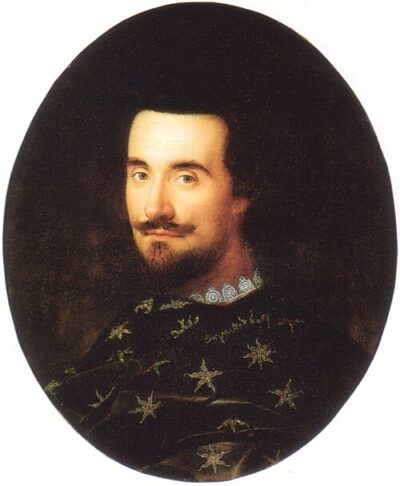
Edward Herbert, 1st Baron Herbert of Cherbury
Edward Herbert, 1st Baron Herbert of Cherbury was an English soldier and poet. Born March 3, 1583, in Eyton on Severn. Died August 5, 1648, in London. Positions held include Member of Parliament in the Parliament of England, Member of the 1601 Parliament and Member of the 1604-11 Parliament. Educated at University College, Oxford.
Facts
27 facts · 2 confirmed by two sources · 18 cited · 7 from one source
What’s different
- Died: we show August 5, 1648 (Confirmed). Wikidata also lists August 20, 1648
Where this comes from
Papalocal keeps its own record. It started from these sources; what each one said is kept here as it was copied, so a change on their side never changes this page by itself. Tap one to read its version.
What Wikidata says · copied November 17, 2026 · revision 2565196389
- Described as
- English soldier and poet (1583–1648)
- Other names
- Edward Herbert, 1st Baron Herbert of Castle Islands, Edward Herbert, Edward Herbert, 1st Baron Herbert of Chirbury, Edward, Lord Herbert, Lord Herbert of Cherbury
- Born
- March 3, 1583 · 3 references
- Died
- August 20, 1648 · 3 references; August 5, 1648 · 1 reference
- Born in
- Eyton on Severn · 1 reference
- Died in
- London · 1 reference
- Buried in
- St Giles in the Fields, Holborn
- Citizen of
- Kingdom of England
- Occupation
- philosopher · 1 reference; poet; diplomat · 1 reference; historian · 1 reference; soldier; politician; writer · 1 reference
- Positions held
- Member of Parliament in the Parliament of England; Member of the 1601 Parliament · 2 references; Member of the 1604-11 Parliament · 2 references
- Education
- University College, Oxford
- Spouse
- Mary Herbert · 1 reference
- Children
- Richard Herbert, 2nd Baron Herbert of Chirbury · 2 references; unknown Herbert · 1 reference; unknown Herbert · 1 reference; unknown daughter Herbert · 1 reference; unknown daughter Herbert · 1 reference
- Father
- Richard Herbert, Lord of Cherbury · 2 references
- Mother
- Magdalen Herbert · 2 references
- Siblings
- Henry Herbert · 1 reference; George Herbert · 1 reference
- Wikipedias with a page
- 27
Wikidata item Q713004 (wikidata.org/wiki/Q713004), public domain (CC0). Copied November 17, 2026.
What Wikipedia says · copied November 17, 2026 · revision 1380270233
Edward Herbert, 1st Baron Herbert of Cherbury (or Chirbury) KB (3 March 1583 – 5 August 1648) was an English soldier, diplomat, historian, poet and religious philosopher.
He studied multiple languages and disciplines at University College, Oxford, and began his political career in Parliament, representing the Welsh counties Montgomeryshire and Merioneth.
As a soldier, Herbert distinguished himself in the Low Countries, serving under the Prince of Orange. His diplomatic career was most active in Paris, where he aimed to arrange a marriage between Charles, Prince of Wales, and Henrietta Maria, which took place in 1625.
Herbert was granted an Irish peerage as the Baron Herbert of Castle Island in 1624, followed by an English barony in 1629. During the English Civil War, he took a neutral stance, retiring to Montgomery Castle which he surrendered to Parliament.
Herbert is most renowned for his work in philosophy, particularly his treatise De Veritate which positioned him as the "father of English Deism". This seminal work distinguishes truth from revelation, probability, possibility, and falsehood. Other significant works include the De religione gentilium, a pioneering work on comparative religion, and Expeditio Buckinghami ducis, a defence of the Duke of Buckingham's actions in 1627.
Herbert also produced a body of poems, showing his prowess as a faithful disciple of John Donne, and his autobiography provides a lively account of his life up until 1624.
- Born, in its opening lines
- March 3, 1583
- Died, in its opening lines
- August 5, 1648
From the Wikipedia article “Edward Herbert, 1st Baron Herbert of Cherbury” (en.wikipedia.org/wiki/Edward_Herbert,_1st_Baron_Herbert_of_Cherbury), by its contributors, under CC BY-SA 4.0 (creativecommons.org/licenses/by-sa/4.0/). Copied November 17, 2026; not changed.
Confirmed Two sources agree. Cited One source, and it names where it got it. One source One source, without a reference of its own. Sources disagree The sources disagree. We show the best-supported value and keep theirs below.
