
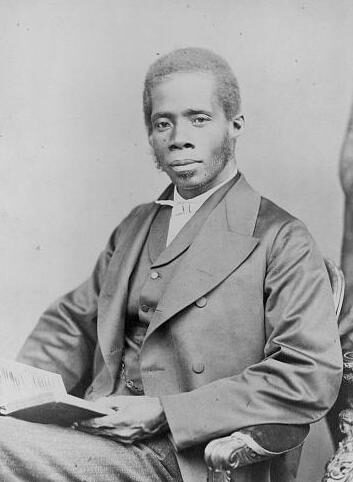
Edward Wilmot Blyden
Edward Wilmot Blyden was a Liberian politician. Born August 3, 1832, in Saint Thomas. Died February 7, 1912, in Freetown. Positions held include foreign minister and Minister of Foreign Affairs.
Facts
20 facts · 2 confirmed by two sources · 9 cited · 9 from one source
Where this comes from
Papalocal keeps its own record. It started from these sources; what each one said is kept here as it was copied, so a change on their side never changes this page by itself. Tap one to read its version.
What Wikidata says · copied November 17, 2026 · revision 2567491160
- Described as
- Liberian politician (1832-1912)
- Other names
- E.W. Blyden
- Born
- August 3, 1832 · 3 references
- Died
- February 7, 1912 · 4 references
- Born in
- Saint Thomas · 1 reference
- Died in
- Freetown · 1 reference
- Buried in
- Race Course Cemetery
- Citizen of
- Liberia
- Occupation
- diplomat; politician; writer · 1 reference; classical scholar; pedagogue · 1 reference; missionary · 1 reference
- Positions held
- foreign minister; Minister of Foreign Affairs
- Member of
- Society for Classical Studies
- Field
- pedagogy · 1 reference; literary activity · 1 reference; diplomacy · 1 reference; politics · 1 reference
- Religion
- Islam
- Wikipedias with a page
- 25
Wikidata item Q384338 (wikidata.org/wiki/Q384338), public domain (CC0). Copied November 17, 2026.
What Wikipedia says · copied November 17, 2026 · revision 1382440162
Edward Wilmot Blyden (3 August 1832 – 7 February 1912) was an Americo-Liberian educator, writer, diplomat, and politician who was primarily active in West Africa. Born in the Danish West Indies, he joined the waves of black immigrants from the Americas who migrated to Liberia. Blyden became a teacher for five years in the British West African colony of Sierra Leone in the early twentieth century. His major writings were on pan-Africanism, which later became influential throughout West Africa, attracting attention in countries such as the United States as well. His ideas went on to influence the likes of Marcus Garvey, George Padmore and Kwame Nkrumah.
Blyden was recognised in his youth for his talents and drive; he was educated and mentored by John P. Knox, an American Protestant minister in Sankt Thomas who encouraged him to continue his education in the United States. In 1850, Blyden was refused admission to three Northern theological seminaries because of his race. Knox encouraged him to go to Liberia, a colony set up for free people of color by the American Colonization Society. Blyden emigrated in 1850 and made his career and life there. He married into a prominent family and soon started working as a journalist. Blyden's ideas remain influential to this day.
- Born, in its opening lines
- August 3, 1832
- Died, in its opening lines
- February 7, 1912
From the Wikipedia article “Edward Wilmot Blyden” (en.wikipedia.org/wiki/Edward_Wilmot_Blyden), by its contributors, under CC BY-SA 4.0 (creativecommons.org/licenses/by-sa/4.0/). Copied November 17, 2026; not changed.
Confirmed Two sources agree. Cited One source, and it names where it got it. One source One source, without a reference of its own. Sources disagree The sources disagree. We show the best-supported value and keep theirs below.
