
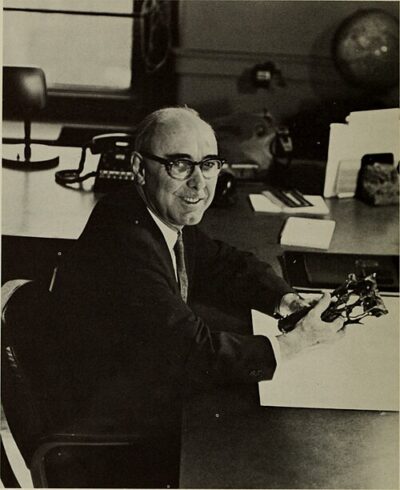
Edwin H. Colbert
Edwin H. Colbert was an American paleontologist. Born September 28, 1905, in Clarinda. Died November 15, 2001, in Flagstaff. Educated at Columbia University and University of Nebraska–Lincoln. Awards include Daniel Giraud Elliot Medal, Romer-Simpson Medal and Hayden Memorial Geological Award.
Facts
16 facts · 2 confirmed by two sources · 4 cited · 10 from one source
Where this comes from
Papalocal keeps its own record. It started from these sources; what each one said is kept here as it was copied, so a change on their side never changes this page by itself. Tap one to read its version.
What Wikidata says · copied November 16, 2026 · revision 2569846085
- Described as
- American paleontologist (1905-2001)
- Other names
- Colbert, Edwin Colbert, Edwin Harris Colbert
- Born
- September 28, 1905 · 3 references
- Died
- November 15, 2001 · 2 references
- Born in
- Clarinda · 1 reference
- Died in
- Flagstaff · 1 reference
- Citizen of
- United States
- Occupation
- paleontologist · 1 reference
- Worked for
- Columbia University
- Education
- Columbia University; University of Nebraska–Lincoln; Maryville High School · 1 reference
- Member of
- National Academy of Sciences
- Awards
- Daniel Giraud Elliot Medal (1935) · 1 reference; Romer-Simpson Medal (1989); Hayden Memorial Geological Award (1997)
- Field
- paleontology · 1 reference
- Spouse
- Margaret Matthew Colbert · 1 reference
- Wikipedias with a page
- 20
Wikidata item Q580301 (wikidata.org/wiki/Q580301), public domain (CC0). Copied November 16, 2026.
What Wikipedia says · copied November 16, 2026 · revision 1371989687
Edwin Harris "Ned" Colbert (September 28, 1905 – November 15, 2001) was a distinguished American vertebrate paleontologist and prolific researcher and author.
Born in Clarinda, Iowa, he grew up in Maryville, Missouri and graduated from Maryville High School. He received his A.B. from the University of Nebraska, then his Masters and Ph.D. from Columbia University, finishing in 1935. He married Margaret Matthew, daughter of the eminent paleontologist William Diller Matthew, in 1933. She became a noted artist, illustrator, and sculptor who specialized in visualizing extinct species.
Among the positions Colbert held was Curator of Vertebrate Paleontology at the American Museum of Natural History for 40 years, and Professor Emeritus of Vertebrate Paleontology at Columbia University. He was a protégé of Henry Fairfield Osborn, and a foremost authority on the Dinosauria.
For his thesis, Siwalik Mammals in the American Museum of Natural History, Colbert was awarded the Daniel Giraud Elliot Medal from the National Academy of Sciences in 1935. He described dozens of new taxa and authored major systematic reviews, including the discovery of more than a dozen complete skeletons of a primitive small Triassic dinosaur, Coelophysis at Ghost Ranch, New Mexico, in 1947 (one of the largest concentrations of dinosaur deposits ever recorded), publication of their description, and a review of ceratopsian phylogeny.
His fieldwork in Antarctica in 1969 helped solidify the acceptance of continental drift with the discovery of a 220-million-year-old fossil of a Lystrosaurus. He was also the first person to name the Staurikosaurus. His popularity and his textbooks on dinosaurs, paleontology, and stratigraphy (with Marshall Kay) introduced a new generation of scientists and amateur enthusiasts to the subject. He was the recipient of numerous prizes and awards commemorating his many achievements in the field of science.
He retired from the AMNH in 1970 and became a curator of vertebrate paleontology at the Museum of Northern Arizona in Flagstaff, Arizona. He died at his home in Flagstaff in 2001.
- Born, in its opening lines
- September 28, 1905
- Died, in its opening lines
- November 15, 2001
From the Wikipedia article “Edwin H. Colbert” (en.wikipedia.org/wiki/Edwin_H._Colbert), by its contributors, under CC BY-SA 4.0 (creativecommons.org/licenses/by-sa/4.0/). Copied November 16, 2026; not changed.
Confirmed Two sources agree. Cited One source, and it names where it got it. One source One source, without a reference of its own. Sources disagree The sources disagree. We show the best-supported value and keep theirs below.
