
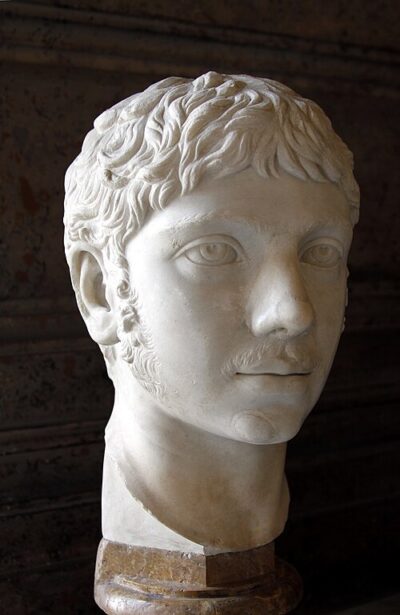
Elagabalus
Elagabalus was a Roman Emperor. Born March 20, 203, in Rome. Died March 11, 222, in Rome. Positions held include Roman emperor (218–222), ancient Roman senator and High priest of Elagabalus (–222).
Facts
18 facts · 0 confirmed by two sources · 5 cited · 9 from one source · 4 where the sources disagree
What’s different
- Born: we show March 20, 203 (Sources disagree). Wikipedia says c. 204
- Died: we show March 11, 222 (Sources disagree). Wikipedia says March 13, 222
- Born in: we show Rome (Sources disagree). Wikidata also lists Emesa and Velletri
- Father: we show Sextus Varius Marcellus (Sources disagree). Wikidata also lists Caracalla
Where this comes from
Papalocal keeps its own record. It started from these sources; what each one said is kept here as it was copied, so a change on their side never changes this page by itself. Tap one to read its version.
What Wikidata says · copied November 16, 2026 · revision 2568845059
- Described as
- Roman Emperor (218-222)
- Other names
- Marcus Aurelius Antoninus Augustus, Marcus Aurelius Antoninus Heliogabalus, Varius Avitus, Tiberinus, Heliogabalus, Sextus Varius Avitus Bassianus, Varius Avitus Bassianus
- Born
- March 20, 203
- Died
- March 11, 222 · 1 reference
- Born in
- Rome · 1 reference; Emesa · 1 reference; Velletri · 1 reference
- Died in
- Rome
- Buried in
- Tiber · 1 reference
- Citizen of
- Ancient Rome
- Occupation
- politician
- Positions held
- Roman emperor (218–222); ancient Roman senator; High priest of Elagabalus (–222)
- Spouse
- Julia Cornelia Paula (219–220) · 1 reference; Aquilia Severa (220–222) · 1 reference; Annia Faustina (221–222) · 1 reference
- Children
- Severus Alexander · 2 references
- Father
- Sextus Varius Marcellus; Caracalla
- Mother
- Julia Soaemias · 1 reference
- Siblings
- Aurelia Antonina; Severus Alexander
- Wikipedias with a page
- 85
Wikidata item Q1762 (wikidata.org/wiki/Q1762), public domain (CC0). Copied November 16, 2026.
What Wikipedia says · copied November 16, 2026 · revision 1385648035
Marcus Aurelius Antoninus (born Varius Avitus Bassianus; c. 204 – 13 March 222), known as Elagabalus ( EL-ə-GAB-ə-ləs), was Roman emperor from 218 to 222, while he was still a teenager. His short reign was notorious for religious controversy and alleged sexual debauchery. A close relative to the Severan dynasty, he came from a prominent Syrian Arab family in Emesa (Homs), Syria, where he served as the head priest of the sun god Elagabal from a young age. After the death of his cousin, the emperor Caracalla, Elagabalus was raised to the Principate at 14 years of age in an army revolt instigated by his grandmother Julia Maesa against Caracalla's short-lived successor, Macrinus. He only posthumously became known by the Latinised name of his god.
Elagabalus is largely known from accounts by the contemporary senator Cassius Dio who was hostile to him, Herodian, who likely relied extensively on Dio, and the much later Historia Augusta. The reliability of the accounts of Cassius Dio and the Historia Augusta, particularly their most salacious elements, has been questioned. Elagabalus showed a disregard for Roman religious traditions. He brought the cult of Elagabal (including the large baetyl stone that represented the god) to Rome, making it a prominent part of religious life in the city. He forced leading members of Rome's government to participate in religious rites celebrating this deity, presiding over them in person. According to the accounts of Cassius Dio and the Augusta, he married four women, including a Vestal Virgin, in addition to lavishing favours on male courtiers they suggested to have been his lovers, and prostituted himself. His behaviour estranged the Praetorian Guard, the Senate, and the common people alike. Amidst growing opposition, at just 18 years of age he was assassinated and replaced by his cousin Severus Alexander in March 222. The assassination plot against Elagabalus was devised by Julia Maesa and carried out by disaffected members of the Praetorian Guard.
Elagabalus developed a posthumous reputation for extreme eccentricity, decadence, zealotry, and sexual promiscuity. Among writers of the early modern age, he endured one of the worst reputations among Roman emperors. Edward Gibbon, notably, wrote that Elagabalus "abandoned himself to the grossest pleasures with ungoverned fury". According to Barthold Georg Niebuhr, "the name of Elagabalus is branded in history above all others; […] "Elagabalus had nothing at all to make up for his vices, which are of such a kind that it is too disgusting even to allude to them". An example of a modern historian's assessment is Adrian Goldsworthy's: "Elagabalus was not a tyrant, but he was an incompetent, probably the least able emperor Rome had ever had". Despite near-universal condemnation of his reign, some scholars write warmly about his religious innovations, including the 6th-century Byzantine chronicler John Malalas, as well as Warwick Ball, a modern historian who described him as "a tragic enigma lost behind centuries of prejudice".
Modern scholars have questioned the accuracy of Roman accounts of his reign, with suggestions that the reports of his salacious behaviour and sexual excess likely reflected a desire to politically discredit him in the immediate aftermath of his death, as well as reflecting Roman stereotypes regarding people from the Orient as effeminate.
- Born, in its opening lines
- c. 204
- Died, in its opening lines
- March 13, 222
From the Wikipedia article “Elagabalus” (en.wikipedia.org/wiki/Elagabalus), by its contributors, under CC BY-SA 4.0 (creativecommons.org/licenses/by-sa/4.0/). Copied November 16, 2026; not changed.
Confirmed Two sources agree. Cited One source, and it names where it got it. One source One source, without a reference of its own. Sources disagree The sources disagree. We show the best-supported value and keep theirs below.
