
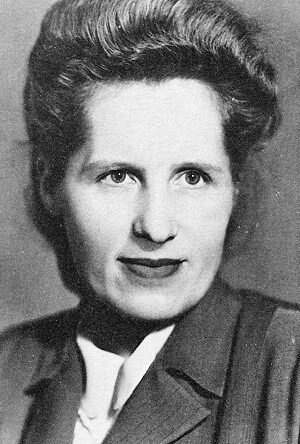
Elisabeth Bykova
Elisabeth Bykova was a Soviet chess player. Born November 4, 1913, in Bogolyubovo. Died March 8, 1989, in Moscow. Awards include Order of the Badge of Honour and Honoured Master of Sports of the USSR.
Facts
12 facts · 2 confirmed by two sources · 0 cited · 10 from one source
Where this comes from
Papalocal keeps its own record. It started from these sources; what each one said is kept here as it was copied, so a change on their side never changes this page by itself. Tap one to read its version.
What Wikidata says · copied November 16, 2026 · revision 2553833752
- Described as
- Soviet chess player (1913-1989)
- Other names
- Elisaveta Ivanovna Bykova
- Born
- November 4, 1913 · 2 references
- Died
- March 8, 1989 · 2 references
- Born in
- Bogolyubovo
- Died in
- Moscow
- Buried in
- Khovanskoye Cemetery
- Name at birth
- Елизаве́та Ива́новна Бы́кова
- Citizen of
- Soviet Union
- Occupation
- chess player; non-fiction writer
- Sport
- chess
- Awards
- Order of the Badge of Honour; Honoured Master of Sports of the USSR
- Wikipedias with a page
- 39
Wikidata item Q253772 (wikidata.org/wiki/Q253772), public domain (CC0). Copied November 16, 2026.
What Wikipedia says · copied November 16, 2026 · revision 1363817063
Elisaveta Ivanovna Bykova (or Elisabeth Bykova, Russian: Елизаве́та Ива́новна Бы́кова; 4 November 1913 – 8 March 1989) was a Soviet chess player and twice Women's World Chess Champion, from 1953 until 1956, and again from 1958 to 1962. She was awarded the titles of Woman International Master in 1950, International Master in 1953, and Woman Grandmaster in 1976. In 2013, she was inducted into the World Chess Hall of Fame.
- Born, in its opening lines
- November 4, 1913
- Died, in its opening lines
- March 8, 1989
From the Wikipedia article “Elisaveta Bykova” (en.wikipedia.org/wiki/Elisaveta_Bykova), by its contributors, under CC BY-SA 4.0 (creativecommons.org/licenses/by-sa/4.0/). Copied November 16, 2026; not changed.
Confirmed Two sources agree. Cited One source, and it names where it got it. One source One source, without a reference of its own. Sources disagree The sources disagree. We show the best-supported value and keep theirs below.
