
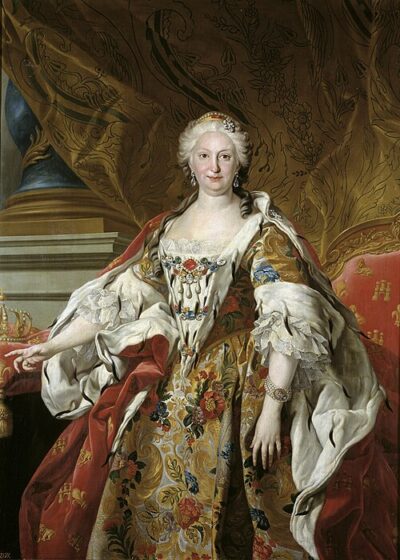
Elisabeth Farnese
Elisabeth Farnese was a Queen consort of Spain. Born October 25, 1692, in Palazzo della Pilotta. Died July 11, 1766, in Royal Palace of Aranjuez. Positions held include Queen Consort of Spain (1714–1746).
Facts
19 facts · 2 confirmed by two sources · 8 cited · 9 from one source
Where this comes from
Papalocal keeps its own record. It started from these sources; what each one said is kept here as it was copied, so a change on their side never changes this page by itself. Tap one to read its version.
What Wikidata says · copied November 16, 2026 · revision 2567675722
- Described as
- Queen consort of Spain (1692-1766)
- Other names
- Elisabetta Farnese, Reina Isabel de Farnesio España, Elisabetta Regina di Spagna, regina consorte di Felipe V, re di Spagna Isabel Farnese, Queen of Spain Elisabetta Farnese, Elizabeth, consort of Philip V, King of Spain Farnese, Elisabetta, Queen of Spain Farnese, consort of Philip V, King of Spain Elisabeth Farnese, Isabel, consort of Philip V, King of Spain Farnese, Isabella of Parma, Doña Isabella Farnese, Isabella Farnese Reina de España
- Born
- October 25, 1692 · 8 references
- Died
- July 11, 1766 · 9 references
- Born in
- Palazzo della Pilotta · 1 reference
- Died in
- Royal Palace of Aranjuez · 1 reference
- Buried in
- Tomb of Philip V of Spain
- Citizen of
- Spain
- Occupation
- aristocrat
- Positions held
- Queen Consort of Spain (1714–1746)
- Spouse
- Philip V of Spain (1714–) · 2 references
- Children
- Charles III of Spain · 1 reference; Mariana Victoria of Spain · 1 reference; Filippo I, Duke of Parma; Maria Teresa Rafaela of Spain · 1 reference; Infante Luis, Count of Chinchón · 1 reference; María Antonia of Spain; Francisco of Spain · 2 references
- Father
- Odoardo Farnese, Hereditary Prince of Parma
- Mother
- Countess Palatine Dorothea Sophie of Neuburg
- Religion
- Catholic Church
- Wikipedias with a page
- 42
Wikidata item Q229867 (wikidata.org/wiki/Q229867), public domain (CC0). Copied November 16, 2026.
What Wikipedia says · copied November 16, 2026 · revision 1372046033
Elisabeth Farnese (Italian: Elisabetta Farnese, Spanish: Isabel de Farnesio; 25 October 1692 – 11 July 1766) was Queen of Spain by marriage to King Philip V. She was the de facto ruler of Spain from 1714 until 1746, since she managed the affairs of state with the approval of her spouse. She is particularly known for her great influence over Spain's foreign policy. From 1759 to 1760, she governed as regent.
Elisabeth was born in 1692 in Parma, the daughter of Odoardo Farnese, Hereditary Prince of Parma and his wife, Countess Palatine Dorothea Sophie of Neuburg. Elisabeth would be their only child to survive into adulthood, her siblings all dying in infancy. Her father died in 1693, and her mother later remarried to his younger brother (Elisabeth's uncle), Francesco, in hopes for another heir. This never happened, and Elisabeth remained sole heiress. Elisabeth's marriage was considered of great political importance, and she received many proposals, notably from Piedmontese and Modenese princes, ultimately being married to the Spanish king, Philip V, whose first wife, Queen Maria Luisa, had died earlier that year.
Soon after her arrival at the Spanish court, Elisabeth proved to be dominant and strong-willed. With the help of her Italian courtiers, she eliminated the French party at court and capitalized on her husband's frequent mental incapacity to enforce her own will. She pursued an aggressive international policy, attempting to place her husband and children in various European thrones, which granted her the contempt of her subjects and provoked the failed War of the Quadruple Alliance. With the wars of the Polish and Austrian Succession, however, she succeeded in enthroning her sons in Naples, Sicily and her native Parma, recovering most of the historical Italian territories of the Spanish royal house, while her daughters also married prominently into the French and Portuguese royal families.
She was scorned and admired at the same time by her contemporaries, who regarded her as an authoritarian, scheming and unscrupulous monarch. At times she came to the extent of personally heading divisions of the Spanish Army in her war efforts. Frederick the Great would state about her: "she walks boldly towards the fulfillment of her designs; there is nothing that can surprise her, nothing that can stop her."
Her son Charles (later King Charles III of Spain) would go on to inherit the Duchy of Parma, with Elisabeth's mother as regent. Following multiple transfers of power, including rulers from the House of Habsburg, her son Philip was made Duke. Thus, all further dukes of Parma have descended from Elisabeth.
- Born, in its opening lines
- October 25, 1692
- Died, in its opening lines
- July 11, 1766
From the Wikipedia article “Elisabeth Farnese” (en.wikipedia.org/wiki/Elisabeth_Farnese), by its contributors, under CC BY-SA 4.0 (creativecommons.org/licenses/by-sa/4.0/). Copied November 16, 2026; not changed.
Confirmed Two sources agree. Cited One source, and it names where it got it. One source One source, without a reference of its own. Sources disagree The sources disagree. We show the best-supported value and keep theirs below.
