
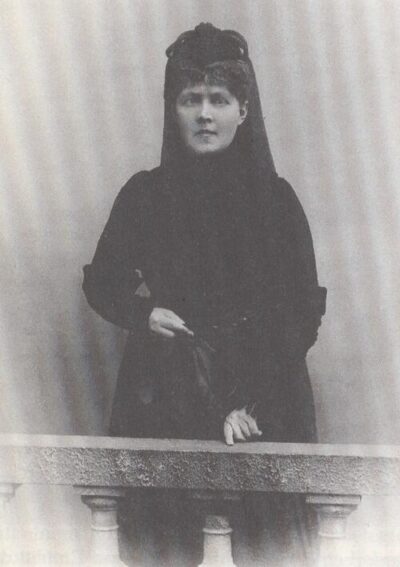
Elisabeth Förster-Nietzsche
Elisabeth Förster-Nietzsche was a Sister of Friedrich Nietzsche. Born July 10, 1846, in Röcken. Died November 8, 1935, in Weimar.
Facts
17 facts · 2 confirmed by two sources · 7 cited · 8 from one source
Where this comes from
Papalocal keeps its own record. It started from these sources; what each one said is kept here as it was copied, so a change on their side never changes this page by itself. Tap one to read its version.
What Wikidata says · copied November 16, 2026 · revision 2568847869
- Described as
- Sister of Friedrich Nietzsche (1846-1935)
- Other names
- Elisabeth Nietzsche
- Born
- July 10, 1846 · 9 references
- Died
- November 8, 1935 · 8 references
- Born in
- Röcken · 1 reference
- Died in
- Weimar · 2 references
- Name at birth
- Therese Elisabeth Alexandra Nietzsche
- Citizen of
- Kingdom of Prussia · 1 reference; German Empire · 1 reference; Nazi Germany · 1 reference
- Occupation
- archivist; literary executor · 1 reference; politician · 1 reference; writer · 1 reference
- Political party
- German National People's Party
- Spouse
- Bernhard Förster (1885–) · 1 reference
- Father
- Carl Ludwig Nietzsche · 1 reference
- Mother
- Franziska Nietzsche · 1 reference
- Siblings
- Friedrich Nietzsche · 1 reference
- Wikipedias with a page
- 34
Wikidata item Q77377 (wikidata.org/wiki/Q77377), public domain (CC0). Copied November 16, 2026.
What Wikipedia says · copied November 16, 2026 · revision 1385247667
Therese Elisabeth Alexandra Förster-Nietzsche (10 July 1846 – 8 November 1935) was the sister of philosopher Friedrich Nietzsche and the creator of the Nietzsche Archive in 1894.
Förster-Nietzsche was two years younger than her brother. Their father was a Lutheran pastor in the German village of Röcken bei Lützen. The two children were close during their childhood and early adult years. However, they grew apart in 1885, when Förster-Nietzsche married Bernhard Förster, a former high school teacher who had become a prominent German nationalist and antisemite. Nietzsche did not attend their wedding.
Förster-Nietzsche and her husband created an unsuccessful colony, Nueva Germania, in Paraguay in 1887. Her husband committed suicide in 1889. Förster-Nietzsche continued to run the colony until she returned to Germany in 1893 where she found her brother to be an invalid whose published writings were beginning to be read and discussed throughout Europe. Adolf Hitler attended her funeral in 1935.
In the 1950s, it was claimed by Nietzsche's new editors and translators such as Walter Kaufmann that Nietzsche's work had been edited by Förster-Nietzsche to highlight racist and eugenicist themes, but this account has been the subject of debate in recent scholarship. An alternative theory exonerates Förster-Nietzsche and places the distortion of Nietzsche's works in the hands of the Nazis themselves.
- Born, in its opening lines
- July 10, 1846
- Died, in its opening lines
- November 8, 1935
From the Wikipedia article “Elisabeth Förster-Nietzsche” (en.wikipedia.org/wiki/Elisabeth_Förster-Nietzsche), by its contributors, under CC BY-SA 4.0 (creativecommons.org/licenses/by-sa/4.0/). Copied November 16, 2026; not changed.
Confirmed Two sources agree. Cited One source, and it names where it got it. One source One source, without a reference of its own. Sources disagree The sources disagree. We show the best-supported value and keep theirs below.
