
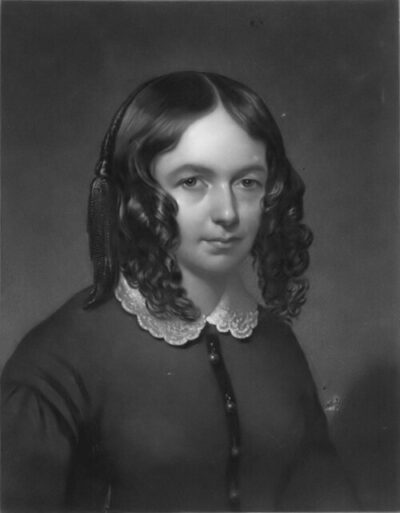
Elizabeth Barrett Browning
Elizabeth Barrett Browning was an English poet. Born March 6, 1806, in Coxhoe Hall. Died June 29, 1861, in Florence. Known for The Battle of Marathon: A Poem, Aurora Leigh and Sonnets from the Portuguese.
Facts
29 facts · 2 confirmed by two sources · 9 cited · 17 from one source · 1 where the sources disagree
What’s different
- Born in: we show Coxhoe Hall (Sources disagree). Wikidata also lists Durham
Where this comes from
Papalocal keeps its own record. It started from these sources; what each one said is kept here as it was copied, so a change on their side never changes this page by itself. Tap one to read its version.
What Wikidata says · copied November 16, 2026 · revision 2570009764
- Described as
- English poet (1806–1861)
- Other names
- Elisabeth Barrett Browning, Elizabeth Barrett-Browning, Mrs. Browning, Elizabeth Barrett Browning, née Barrett, Elizaveta Barrett Brauning, Elizabeth Barrett Barrett, Elizabeth Moulton-Barrett
- Born
- March 6, 1806 · 16 references
- Died
- June 29, 1861 · 5 references
- Born in
- Coxhoe Hall · 2 references; Durham · 1 reference
- Died in
- Florence · 4 references
- Buried in
- English Cemetery, Florence · 2 references
- Name at birth
- Elizabeth Moulton-Barrett
- Citizen of
- United Kingdom of Great Britain and Ireland
- Occupation
- poet · 2 references; screenwriter; essayist; pamphleteer; translator; writer · 3 references; abolitionist
- Known for
- The Battle of Marathon: A Poem; Aurora Leigh; Sonnets from the Portuguese · 1 reference
- Field
- poetry · 1 reference; essay; English poetry · 1 reference
- Spouse
- Robert Browning (1846–1861) · 2 references
- Children
- Robert Barrett Browning
- Father
- Edward Moulton-Barrett · 1 reference
- Mother
- Mary Graham-Clarke · 1 reference
- Siblings
- Arabella Moulton Barrett; Henrietta Moulton Barrett; Alfred Price Moulton Barrett; Octavius Moulton Barrett; George Goodin Moulton-Barrett
- Wikipedias with a page
- 90
Wikidata item Q228494 (wikidata.org/wiki/Q228494), public domain (CC0). Copied November 16, 2026.
What Wikipedia says · copied November 16, 2026 · revision 1385096231
Elizabeth Barrett Browning (née Moulton-Barrett; 6 March 1806 – 29 June 1861) was an English poet of the Victorian era, popular in Britain and the United States during her lifetime and frequently anthologised after her death. Her work received renewed attention following the feminist scholarship of the 1970s and 1980s, and greater recognition of women writers in English. Born in County Durham, the eldest of 12 children, Elizabeth Barrett wrote poetry from the age of eleven. Her mother's collection of her poems forms one of the largest extant collections of juvenilia by any English writer. At 15, she became ill, suffering intense head and spinal pain for the rest of her life. Later in life, she also developed lung problems, possibly tuberculosis. She took laudanum for the pain from an early age, which is likely to have contributed to her frail health.
In the 1840s, Elizabeth was introduced to literary society through her distant cousin and patron John Kenyon. Her first adult collection of poems was published in 1838, and she wrote prolifically from 1841 to 1844, producing poetry, translation, and prose. She campaigned for the abolition of slavery, and her work helped influence reform in child labour legislation. Her prolific output made her a rival to Tennyson as a candidate for poet laureate on the death of Wordsworth. Elizabeth's volume Poems (1844) brought her great success, attracting the admiration of the writer Robert Browning. Their correspondence, courtship, and marriage were carried out in secret, for fear of her father's disapproval. Following the wedding, she was indeed disinherited by her father. In 1846, the couple moved to Italy, where she lived for the rest of her life. Elizabeth died in Florence in 1861. A collection of her later poems was published by her husband shortly after her death.
They had a son, known as "Pen" (Robert Barrett, 1849–1912). Pen devoted himself to painting until his eyesight began to fail later in life. He also built a large collection of manuscripts and memorabilia of his parents, but because he died intestate, it was sold by public auction to various bidders and then scattered upon his death. The Armstrong Browning Library in Waco, Texas has recovered some of his collection, and it houses the world's largest collection of Browning memorabilia. Elizabeth's work had a major influence on prominent writers of the day, including the American poets Edgar Allan Poe and Emily Dickinson. She is remembered for such poems as "How Do I Love Thee?" (Sonnet 43, 1845) and Aurora Leigh (1856).
- Born, in its opening lines
- March 6, 1806
- Died, in its opening lines
- June 29, 1861
From the Wikipedia article “Elizabeth Barrett Browning” (en.wikipedia.org/wiki/Elizabeth_Barrett_Browning), by its contributors, under CC BY-SA 4.0 (creativecommons.org/licenses/by-sa/4.0/). Copied November 16, 2026; not changed.
Confirmed Two sources agree. Cited One source, and it names where it got it. One source One source, without a reference of its own. Sources disagree The sources disagree. We show the best-supported value and keep theirs below.
