Aurora Leigh
Aurora Leigh is an epic novel/poem by Elizabeth Barrett Browning. It came out in 1856.
- Published
- 1856
- Written by
- Elizabeth Barrett Browning
All 4 facts, and where they come from
Facts
4 facts · 0 confirmed by two sources · 0 cited · 4 from one source
Where this comes from
Papalocal keeps its own record. It started from these sources; what each one said is kept here as it was copied, so a change on their side never changes this page by itself. Tap one to read its version.
What Wikidata says · copied November 17, 2026 · revision 2452080347
- Described as
- epic novel/poem by Elizabeth Barrett Browning
- What it is
- written work
- Written by
- Elizabeth Barrett Browning
- Published
- 1856
- Language
- English
- Wikipedias with a page
- 6
Wikidata item Q3629872 (wikidata.org/wiki/Q3629872), public domain (CC0). Copied 2026-11-17.
What Wikipedia says · copied November 17, 2026 · revision 1383796916
Aurora Leigh is an 1856 verse novel by Elizabeth Barrett Browning. The poem is written in blank verse and encompasses nine books (the woman's number, the number of the Sibylline Books). It is a first-person narration, from the point of view of Aurora; its other heroine, Marian Erle, is an abused self-taught child of itinerant parents. The poem is set in Florence, Malvern, London and Paris. The work references Biblical and classical history and mythology, as well as modern novels, such as Corinne ou l'Italie by Anne Louise Germaine de Staël and the novels of George Sand. In Books 1–5, Aurora narrates her past, from her childhood to the age of about 27; in Books 6–9, the narrative has caught up with her, and she reports events in diary form. The author styled the poem "a novel in verse", and referred to it as "the most mature of my works, and the one into which my highest convictions upon Life and Art have entered". The scholar Deirdre David asserts that Barrett Browning's work in Aurora Leigh renders her "a major figure in any consideration of the nineteenth-century woman writer and of Victorian poetry in general". John Ruskin called it the greatest long poem of the nineteenth century.
From the Wikipedia article “Aurora Leigh” (en.wikipedia.org/wiki/Aurora_Leigh), by its contributors, under CC BY-SA 4.0 (creativecommons.org/licenses/by-sa/4.0/). Copied 2026-11-17; not changed.
Confirmed Two sources agree. Cited One source, and it names where it got it. One source One source, without a reference of its own. Sources disagree The sources disagree. We show the best-supported value and keep theirs below.
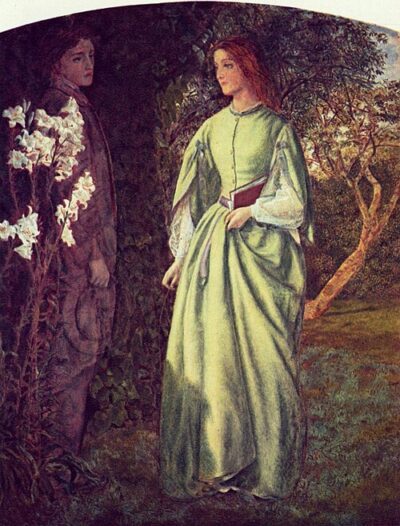
Picture: Arthur Hughes, via Wikimedia Commons · Public domain