
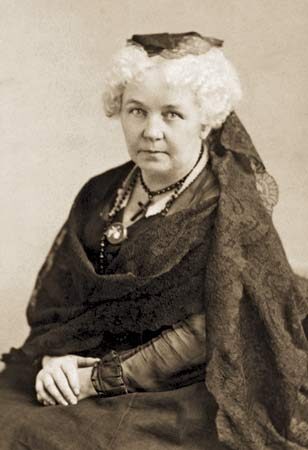
Elizabeth Cady Stanton
Elizabeth Cady Stanton was an American writer, suffragist and Women's Rights activist. Born November 12, 1815, in Johnstown. Died October 26, 1902, in New York City. Positions held include president. Known for The Revolution. Educated at Emma Willard School. Awards include National Women's Hall of Fame and New Jersey Hall of Fame.
Facts
24 facts · 2 confirmed by two sources · 9 cited · 13 from one source
Where this comes from
Papalocal keeps its own record. It started from these sources; what each one said is kept here as it was copied, so a change on their side never changes this page by itself. Tap one to read its version.
What Wikidata says · copied November 13, 2026 · revision 2557866933
- Described as
- American writer, suffragist and Women's Rights activist (1815–1902)
- Other names
- Elizabeth Cady
- Born
- November 12, 1815 · 5 references
- Died
- October 26, 1902 · 9 references
- Born in
- Johnstown · 1 reference
- Died in
- New York City · 1 reference
- Buried in
- Woodlawn Cemetery · 1 reference
- Cause of death
- heart failure
- Citizen of
- United States
- Occupation
- writer · 3 references; actor; women's rights activist; abolitionist · 1 reference
- Positions held
- president · 1 reference
- Political party
- Republican Party
- Education
- Emma Willard School
- Known for
- The Revolution
- Awards
- National Women's Hall of Fame (1973) · 1 reference; New Jersey Hall of Fame (2014) · 1 reference
- Field
- abolitionism; feminism
- Spouse
- Henry Brewster Stanton (1840–1887)
- Children
- Theodore Stanton; Harriot Eaton Stanton Blatch
- Father
- Daniel Cady
- Mother
- Margaret Livingston · 1 reference
- Wikipedias with a page
- 79
Wikidata item Q465335 (wikidata.org/wiki/Q465335), public domain (CC0). Copied November 13, 2026.
What Wikipedia says · copied November 13, 2026 · revision 1383757340
Elizabeth Cady Stanton (née Cady; November 12, 1815 – October 26, 1902) was an American writer and activist who was a leader of the women's rights movement in the U.S. during the mid- to late-19th century. She was the main force behind the 1848 Seneca Falls Convention, the first convention to be called for the sole purpose of discussing women's rights, and was the primary author of its Declaration of Sentiments. Her demand for women's right to vote generated a controversy at the convention but quickly became a central tenet of the women's movement. She was also active in other social reform activities, especially abolitionism.
In 1851, she met Susan B. Anthony and formed a decades-long partnership that was crucial to the development of the women's rights movement. During the American Civil War, they established the Women's Loyal National League to campaign for the abolition of slavery, and they led it in the largest petition drive in U.S. history up to that time. They started a newspaper called The Revolution in 1868 to work for women's rights.
After the war, Stanton and Anthony were the main organizers of the American Equal Rights Association, which campaigned for equal rights for both African Americans and women, especially the right of suffrage. When the Fifteenth Amendment to the U.S. Constitution was introduced that would provide suffrage for black men only, they opposed it, insisting that suffrage should be extended to all African Americans and all women at the same time. Others in the movement supported the amendment, resulting in a split. During the bitter arguments that led up to the split, Stanton sometimes expressed her ideas in elitist and racially condescending language. In her opposition to the voting rights of African Americans, Stanton was quoted to have said, "It becomes a serious question whether we had better stand aside and let 'Sambo' walk into the kingdom first." Frederick Douglass, an abolitionist friend who had escaped from slavery, reproached her for such remarks.
Stanton became the first president of the National Woman Suffrage Association, which she and Anthony created to represent their wing of the movement. When the split was healed more than twenty years later, Stanton became the first president of the united organization, the National American Woman Suffrage Association. This was largely an honorary position; Stanton continued to work on a wide range of women's rights issues despite the organization's increasingly tight focus on women's right to vote.
Stanton was the primary author of the first three volumes of the History of Woman Suffrage, a massive effort to record the history of the movement, focusing largely on her wing of it. She was also the primary author of The Woman's Bible, a redaction criticism of the Bible that is based on the premise that its attitude toward women reflects prejudice from a less civilized age.
- Born, in its opening lines
- November 12, 1815
- Died, in its opening lines
- October 26, 1902
From the Wikipedia article “Elizabeth Cady Stanton” (en.wikipedia.org/wiki/Elizabeth_Cady_Stanton), by its contributors, under CC BY-SA 4.0 (creativecommons.org/licenses/by-sa/4.0/). Copied November 13, 2026; not changed.
Confirmed Two sources agree. Cited One source, and it names where it got it. One source One source, without a reference of its own. Sources disagree The sources disagree. We show the best-supported value and keep theirs below.
