
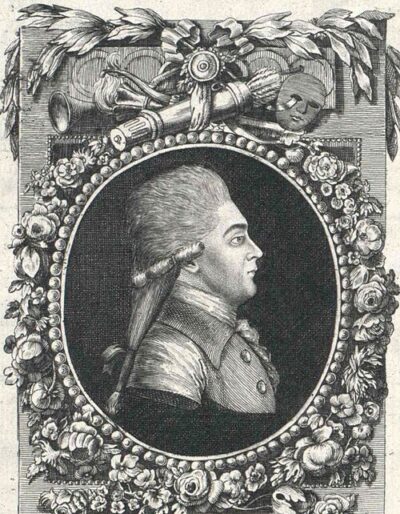
Emanuel Schikaneder
Emanuel Schikaneder was a German actor and singer. Born September 1, 1751, in Straubing. Died September 21, 1812, in Vienna.
Facts
17 facts · 2 confirmed by two sources · 10 cited · 5 from one source
Where this comes from
Papalocal keeps its own record. It started from these sources; what each one said is kept here as it was copied, so a change on their side never changes this page by itself. Tap one to read its version.
What Wikidata says · copied November 16, 2026 · revision 2567323169
- Described as
- German actor and singer
- Born
- September 1, 1751 · 9 references
- Died
- September 21, 1812 · 11 references
- Born in
- Straubing · 3 references
- Died in
- Vienna · 5 references
- Citizen of
- Holy Roman Empire
- Occupation
- librettist · 3 references; singer · 2 references; opera singer · 1 reference; actor · 4 references; playwright; stage actor; writer; composer · 3 references
- Instrument
- voice
- Spouse
- Eleonore Schikaneder · 1 reference
- Children
- Anna Schikaneder · 1 reference
- Siblings
- Urban Schikaneder · 1 reference
- Wikipedias with a page
- 34
Wikidata item Q213547 (wikidata.org/wiki/Q213547), public domain (CC0). Copied November 16, 2026.
What Wikipedia says · copied November 16, 2026 · revision 1382351802
Emanuel Schikaneder (born Johann Joseph Schickeneder; 1 September 1751 – 21 September 1812) was a German–Austrian impresario, dramatist, actor, singer, and composer. He wrote the libretto of Mozart's opera Die Zauberflöte and was the builder of the Theater an der Wien. Peter Branscombe called him "one of the most talented theatre men of his era". Aside from Mozart, he knew and worked with Salieri, Haydn and Beethoven.
- Born, in its opening lines
- September 1, 1751
- Died, in its opening lines
- September 21, 1812
From the Wikipedia article “Emanuel Schikaneder” (en.wikipedia.org/wiki/Emanuel_Schikaneder), by its contributors, under CC BY-SA 4.0 (creativecommons.org/licenses/by-sa/4.0/). Copied November 16, 2026; not changed.
Confirmed Two sources agree. Cited One source, and it names where it got it. One source One source, without a reference of its own. Sources disagree The sources disagree. We show the best-supported value and keep theirs below.
