
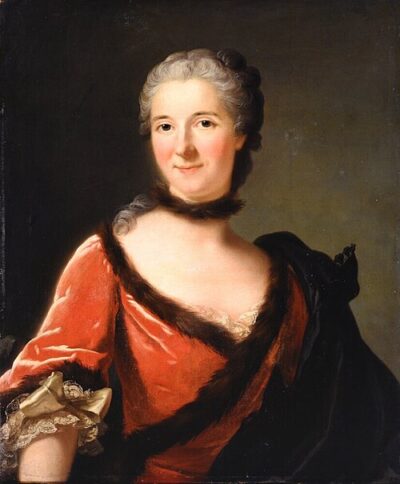
Émilie du Châtelet
Émilie du Châtelet was a French mathematician, physicist, and author. Born December 17, 1706, in Paris. Died September 10, 1749, in Lunéville. Known for Institutions de Physique.
Facts
25 facts · 2 confirmed by two sources · 15 cited · 8 from one source
Where this comes from
Papalocal keeps its own record. It started from these sources; what each one said is kept here as it was copied, so a change on their side never changes this page by itself. Tap one to read its version.
What Wikidata says · copied November 16, 2026 · revision 2568283927
- Described as
- French mathematician, physicist, and author (1706-1749)
- Other names
- Emilie du Chatelet, Marquise de Du Châtelet, Gabrielle-Émilie Le Tonnelier de Breteuil du Châtelet, Gabrielle-Emilie du Châtelet-Lomont, Gabrielle-Emilie de Breteuil Marchioness du Chatelet, Marquise de Châtelet, Émilie Le Tonnelier de Breteuil, marquise du Châtelet
- Born
- December 17, 1706 · 6 references
- Died
- September 10, 1749 · 6 references
- Born in
- Paris · 1 reference
- Died in
- Lunéville · 1 reference
- Buried in
- Eglise Saint Jacques Lunéville · 1 reference
- Cause of death
- pulmonary embolism · 1 reference
- Name at birth
- Gabrielle-Émilie Le Tonnelier de Breteuil · 1 reference
- Citizen of
- France · 1 reference
- Occupation
- mathematician · 1 reference; physicist; philosopher of language · 1 reference; essayist · 1 reference; salonnière · 1 reference; translator · 2 references; philosopher · 1 reference
- Member of
- Académie de Stanislas (Nancy, France); Academy of Sciences of the Institute of Bologna (1746–)
- Known for
- Institutions de Physique
- Field
- physics; philosophy; mathematics · 1 reference
- Spouse
- Florent-Claude du Chastelet (1725–) · 1 reference
- Children
- Louis Marie Florent du Châtelet · 1 reference
- Father
- Louis Nicolas le Tonnelier de Breteuil
- Mother
- Gabrielle-Anne de Froulay · 1 reference
- Wikipedias with a page
- 64
Wikidata item Q7286 (wikidata.org/wiki/Q7286), public domain (CC0). Copied November 16, 2026.
What Wikipedia says · copied November 16, 2026 · revision 1384056935
Gabrielle Émilie Le Tonnelier de Breteuil, Marquise du Châtelet (French: [emili dy ʃɑtlɛ] ; 17 December 1706 – 10 September 1749) was a French mathematician and physicist.
Her most recognized achievement is her philosophical magnum opus, Institutions de Physique (Paris, 1740, first edition; Foundations of Physics). She then revised the text substantially for a second edition with the slightly modified title Institutions physiques (Paris, 1742). It circulated widely, generated heated debates, and was translated into German and Italian in 1743. The Institutions covers a wide range of topics, including the principles of knowledge, the existence of God, hypotheses, space, time, matter and the forces of nature. Several chapters treat Newton's theory of universal gravity and associated phenomena. Later in life, she translated into French, and wrote an extensive commentary on, Isaac Newton's Philosophiæ Naturalis Principia Mathematica. The text, published posthumously in 1756, is still considered the standard French translation to this day.
Du Châtelet participated in the famous vis viva debate, concerning the best way to measure the force of a body and the best means of thinking about conservation principles. Posthumously, her ideas were represented prominently in the most famous text of the French Enlightenment, the Encyclopédie of Denis Diderot and Jean le Rond d'Alembert, first published shortly after du Châtelet's death.
She is also known as the intellectual collaborator with and romantic partner of Voltaire. In the two centuries since her death, numerous biographies, books, and plays have been written about her life and work. In the early twenty-first century, her life and ideas have generated renewed interest.
- Born, in its opening lines
- December 17, 1706
- Died, in its opening lines
- September 10, 1749
From the Wikipedia article “Émilie du Châtelet” (en.wikipedia.org/wiki/Émilie_du_Châtelet), by its contributors, under CC BY-SA 4.0 (creativecommons.org/licenses/by-sa/4.0/). Copied November 16, 2026; not changed.
Confirmed Two sources agree. Cited One source, and it names where it got it. One source One source, without a reference of its own. Sources disagree The sources disagree. We show the best-supported value and keep theirs below.
