
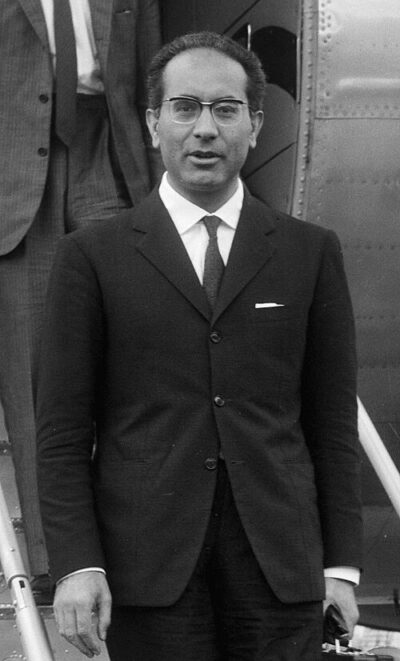
Emilio Colombo
Emilio Colombo was an Italian Prime Minister, politician. Born April 11, 1920, in Potenza. Died June 24, 2013, in Rome. Positions held include Italian senator for life (2003–2013), Prime Minister of Italy (1970–1972) and member of the Chamber of Deputies of the Italian Republic (1948–1992). Awards include Grand Officer of the Legion of Honour, Charlemagne Prize and Robert Schuman Medal.
Facts
40 facts · 2 confirmed by two sources · 10 cited · 28 from one source
Where this comes from
Papalocal keeps its own record. It started from these sources; what each one said is kept here as it was copied, so a change on their side never changes this page by itself. Tap one to read its version.
What Wikidata says · copied November 16, 2026 · revision 2566753885
- Described as
- Italian Prime Minister, politician (1920-2013)
- Born
- April 11, 1920
- Died
- June 24, 2013 · 8 references
- Born in
- Potenza · 1 reference
- Died in
- Rome · 1 reference
- Name at birth
- Emilio Colombo
- Citizen of
- Italy (1946–); Kingdom of Italy (–1946)
- Occupation
- politician · 1 reference; diplomat · 1 reference; lawyer; head of government · 1 reference; foreign minister · 1 reference
- Positions held
- Italian senator for life (2003–2013); Prime Minister of Italy (1970–1972); member of the Chamber of Deputies of the Italian Republic (1948–1992) · 1 reference; member of the Senate of the Italian Republic (2013) · 1 reference; Italian Minister of Foreign Affairs (2 times) (1980–1993); Italian Minister of Justice (1971–1972); Italian Minister of Agriculture (1955–1958); Italian Minister of Economic Development (1959–1963); Italian Finance Minister (2 times) (1973–1989); Minister of Budget (2 times) (1968–1988); Minister of the Treasury of Italy (3 times) (1963–1976); Italian Minister for Parliamentary Relations (1972–1973); Minister of Foreign Trade (1958–1959); member of the Constituent Assembly of Italy; Member of the European Parliament (2 times) (1979–1992) · 1 reference
- Political party
- Christian Democracy
- Awards
- Grand Officer of the Legion of Honour; Charlemagne Prize (1979) · 1 reference; Robert Schuman Medal (1986); Grand Cross of Honor for Services to the Republic of Austria; anniversary medal at the occasion of the 2500th anniversary of the founding of the Iranian Empire; Knight Grand Cross of the Order of Merit of the Italian Republic; Grand Officer of the Order of Merit of the Italian Republic; Grand Cross 1st class of the Order of Merit of the Federal Republic of Germany; honorary doctor of the Moscow State Institute of International Relations · 1 reference; Grand Cross of the Order of Isabella the Catholic (1981) · 1 reference
- Siblings
- Pasquale Colombo
- Website
- http://www.emiliocolombo.it
- Wikipedias with a page
- 51
Wikidata item Q312058 (wikidata.org/wiki/Q312058), public domain (CC0). Copied November 16, 2026.
What Wikipedia says · copied November 16, 2026 · revision 1383998640
Emilio Colombo (Italian: [eˈmiːljo koˈlombo]; 11 April 1920 – 24 June 2013) was an Italian politician. A member of the Christian Democracy party, he served as Prime Minister of Italy from August 1970 to February 1972. In 2003, he was appointed senator for life, a seat he held until his death.
During his long political career, Colombo held many offices in several governments. He served as Minister of Agriculture from 1955 to 1958; Minister of Foreign Trade from 1958 to 1959; Minister of Grace and Justice from 1970 to 1972; Minister of Treasury from 1963 to 1970, in 1962 and from 1974 to 1976; Minister of Budget in 1968 and from 1987 to 1988; Minister of Finance from 1988 to 1989; and Minister of Foreign Affairs from 1980 to 1983 and from 1992 to 1993. A fervent Europeanist, he also served as president of the European Parliament from 1977 to 1979.
- Born, in its opening lines
- April 11, 1920
- Died, in its opening lines
- June 24, 2013
From the Wikipedia article “Emilio Colombo” (en.wikipedia.org/wiki/Emilio_Colombo), by its contributors, under CC BY-SA 4.0 (creativecommons.org/licenses/by-sa/4.0/). Copied November 16, 2026; not changed.
Confirmed Two sources agree. Cited One source, and it names where it got it. One source One source, without a reference of its own. Sources disagree The sources disagree. We show the best-supported value and keep theirs below.
