
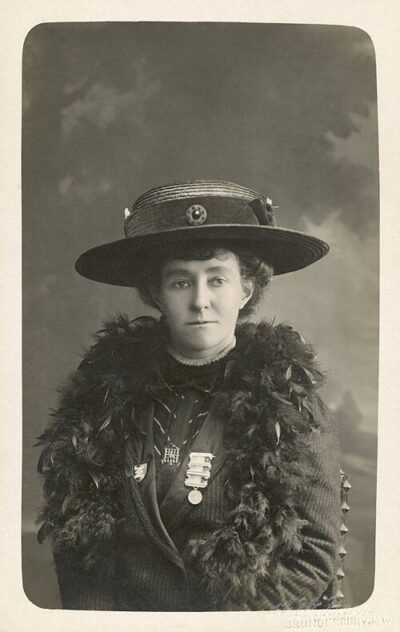
Emily Davison
Emily Davison was a British activist who fought for women's suffrage. Born October 11, 1867, in Blackheath. Died June 8, 1913, in Epsom. Educated at Royal Holloway, University of London and University of London. Awards include Hunger Strike Medal.
Facts
17 facts · 1 confirmed by two sources · 3 cited · 12 from one source · 1 where the sources disagree
What’s different
- Born: we show October 11, 1867 (Sources disagree). Wikipedia says October 11, 1872
Where this comes from
Papalocal keeps its own record. It started from these sources; what each one said is kept here as it was copied, so a change on their side never changes this page by itself. Tap one to read its version.
What Wikidata says · copied November 16, 2026 · revision 2503477688
- Described as
- British activist who fought for women's suffrage
- Other names
- Emily Wilding Davison, Mary Brown
- Born
- October 11, 1867 · 5 references
- Died
- June 8, 1913 · 5 references
- Born in
- Blackheath · 1 reference
- Died in
- Epsom
- Buried in
- Grave Of Emily Davison Approx 100 Yards North-West Of Church Of St Mary · 1 reference
- Citizen of
- United Kingdom of Great Britain and Ireland
- Occupation
- suffragist; women's rights activist; suffragette; teacher; feminist · 1 reference
- Education
- Royal Holloway, University of London; University of London; Kensington Prep School
- Member of
- Women's Social and Political Union
- Awards
- Hunger Strike Medal
- Field
- women's suffrage movement
- Wikipedias with a page
- 41
Wikidata item Q254858 (wikidata.org/wiki/Q254858), public domain (CC0). Copied November 16, 2026.
What Wikipedia says · copied November 16, 2026 · revision 1380069329
Emily Wilding Davison (11 October 1872 – 8 June 1913) was an English suffragette who fought for votes for women in Britain in the early twentieth century. A member of the Women's Social and Political Union (WSPU) and a militant fighter for her cause, she was arrested on nine occasions, went on hunger strike seven times and was force-fed on forty-nine occasions. She died after being hit by King George V's horse Anmer at the 1913 Derby when she walked onto the track during the race.
Davison grew up in a middle-class family, and studied at Royal Holloway College, London, and St Hugh's College, Oxford, before taking jobs as a teacher and governess. She joined the WSPU in November 1906 and became an officer of the organisation and a chief steward during marches. She soon became known in the organisation for her militant action; her tactics included breaking windows, throwing stones, setting fire to postboxes, planting bombs and, on three occasions, hiding overnight in the Palace of Westminster—including on the night of the 1911 census. Her funeral on 14 June 1913 was organised by the WSPU. A procession of 5,000 suffragettes and their supporters accompanied her coffin and 50,000 people lined the route through London; her coffin was then taken by train to the family plot in Morpeth, Northumberland.
Davison was a staunch feminist and passionate Christian, and considered that socialism was a moral and political force for good. Much of her life has been interpreted through the manner of her death. She gave no prior explanation for what she planned to do at the Derby and the uncertainty of her motives and intentions has affected how she has been judged by history. Several theories have been put forward, including accident, suicide or an attempt to pin a suffragette flag to the king's horse.
- Born, in its opening lines
- October 11, 1872
- Died, in its opening lines
- June 8, 1913
From the Wikipedia article “Emily Davison” (en.wikipedia.org/wiki/Emily_Davison), by its contributors, under CC BY-SA 4.0 (creativecommons.org/licenses/by-sa/4.0/). Copied November 16, 2026; not changed.
Confirmed Two sources agree. Cited One source, and it names where it got it. One source One source, without a reference of its own. Sources disagree The sources disagree. We show the best-supported value and keep theirs below.
