
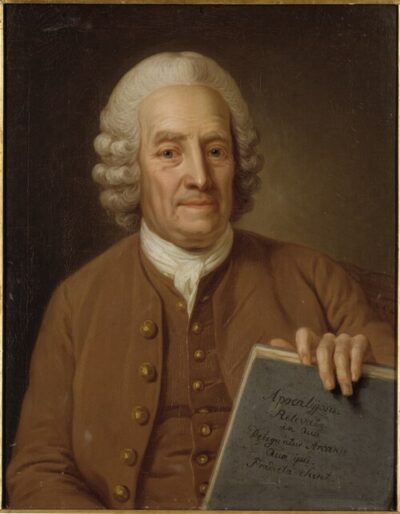
Emmanuel Swedenborg
Emmanuel Swedenborg was a Swedish 18th century scientist and theologian. Born January 29, 1688, in Jakob and Johannes parish. Died March 29, 1772, in London. Known for Arcana Cœlestia, Heaven and Hell and True Christian Religion. Educated at Uppsala University.
Facts
35 facts · 2 confirmed by two sources · 12 cited · 21 from one source
Where this comes from
Papalocal keeps its own record. It started from these sources; what each one said is kept here as it was copied, so a change on their side never changes this page by itself. Tap one to read its version.
What Wikidata says · copied November 16, 2026 · revision 2567486899
- Described as
- Swedish 18th century scientist and theologian (1688-1772)
- Other names
- Swedenborg, Emanuel Swedenborg, Immanuel Swedenborg
- Born
- January 29, 1688 · 1 reference
- Died
- March 29, 1772 · 12 references
- Born in
- Jakob and Johannes parish · 1 reference
- Died in
- London · 3 references
- Buried in
- Uppsala Cathedral · 2 references
- Cause of death
- stroke · 1 reference
- Citizen of
- Sweden
- Occupation
- physicist · 1 reference; philosopher; theologian · 1 reference; mathematician · 1 reference; mystic · 1 reference; writer · 3 references; scientist · 1 reference; inventor · 1 reference
- Worked for
- Uppsala University
- Education
- Uppsala University · 1 reference
- Member of
- Royal Swedish Academy of Sciences
- Known for
- Arcana Cœlestia; Heaven and Hell; True Christian Religion; Opera philosophica et mineralis
- Field
- Theosophy; natural science · 1 reference; philosophy · 1 reference; mysticism · 1 reference; science · 1 reference; discoveries and inventions · 1 reference
- Father
- Jesper Swedberg · 2 references
- Mother
- Sara Behm · 1 reference
- Siblings
- Anna Swedenborg · 1 reference; Hedvig Swedenborg · 1 reference; Katarina af Svedenborg; Jesper Swedenborg
- Religion
- Christianity
- Wikipedias with a page
- 88
Wikidata item Q185832 (wikidata.org/wiki/Q185832), public domain (CC0). Copied November 16, 2026.
What Wikipedia says · copied November 16, 2026 · revision 1385567481
Emanuel Swedenborg (; Swedish: [ɛˈmɑ̂ːnʉɛl ˈsvêːdɛnˌbɔrj] ; born Emanuel Swedberg; 29 January 1688 – 29 March 1772) was a Swedish polymath; a scientist, engineer, astronomer, anatomist, Christian theologian, philosopher, and mystic. He became best known for his book on the afterlife, Heaven and Hell (1758).
Swedenborg had a prolific career as an inventor and scientist. In 1741, at 53, he entered into a spiritual phase in which he began to experience dreams and visions, notably on Easter Weekend, on 6 April
1744.
His experiences culminated in a "spiritual awakening" in which he received a revelation that Jesus Christ had appointed him to write The Heavenly Doctrine to reform Christianity. According to The Heavenly Doctrine, the Lord had opened Swedenborg's spiritual eyes so that from then on, he could freely visit heaven and hell to converse with angels, demons, and other spirits and that the Last Judgment had already occurred in 1757, the year before the 1758 publication of De Nova Hierosolyma et ejus doctrina coelesti (English: Concerning the New Jerusalem and its Heavenly Doctrine).
Over the last 28 years of his life, Swedenborg wrote 18 published theological works—and several more that remained unpublished. He termed himself a "Servant of the Lord Jesus Christ" in True Christian Religion, which he published himself. Some followers of The Heavenly Doctrine believe that of his theological works, only those that were published by Swedenborg himself are fully divinely inspired. Others have regarded all Swedenborg's theological works as equally inspired, saying for example that the fact that some works were "not written out in a final edited form for publication does not make a single statement less trustworthy than the statements in any of the other works". The New Church, also known as Swedenborgianism, is a Restorationist denomination of Christianity originally founded in 1787 and comprising several historically related Christian churches that revere Swedenborg's writings as revelation.
- Born, in its opening lines
- January 29, 1688
- Died, in its opening lines
- March 29, 1772
From the Wikipedia article “Emanuel Swedenborg” (en.wikipedia.org/wiki/Emanuel_Swedenborg), by its contributors, under CC BY-SA 4.0 (creativecommons.org/licenses/by-sa/4.0/). Copied November 16, 2026; not changed.
Confirmed Two sources agree. Cited One source, and it names where it got it. One source One source, without a reference of its own. Sources disagree The sources disagree. We show the best-supported value and keep theirs below.
