
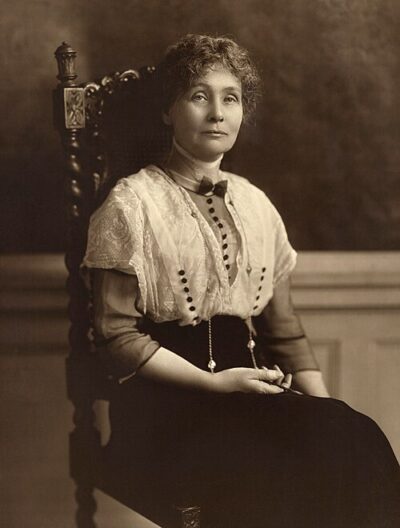
Emmeline Pankhurst
Emmeline Pankhurst was an English suffragist. Born July 15, 1858, in Moss Side. Died June 14, 1928, in Hampstead. Positions held include poor-law guardian and registrar (1898–). Known for My Own Story. Educated at École Normale Supérieure. Awards include Hunger Strike Medal.
Facts
42 facts · 2 confirmed by two sources · 27 cited · 12 from one source · 1 where the sources disagree
What’s different
- Born in: we show Moss Side (Sources disagree). Wikidata also lists Manchester
Where this comes from
Papalocal keeps its own record. It started from these sources; what each one said is kept here as it was copied, so a change on their side never changes this page by itself. Tap one to read its version.
What Wikidata says · copied November 16, 2026 · revision 2568194002
- Described as
- English suffragist
- Other names
- Emmeline Goulden
- Born
- July 15, 1858 · 5 references
- Died
- June 14, 1928 · 9 references
- Born in
- Moss Side · 1 reference; Manchester · 1 reference
- Died in
- Hampstead · 2 references
- Buried in
- Brompton Cemetery
- Citizen of
- United Kingdom of Great Britain and Ireland; United Kingdom · 1 reference
- Occupation
- suffragette · 3 references; politician; women's rights activist; human rights defender · 1 reference; writer; feminist · 2 references
- Positions held
- poor-law guardian · 1 reference; registrar (1898–) · 1 reference
- Political party
- Women's Party (1917–1919); Independent Labour Party; Conservative Party (1926–) · 1 reference
- Education
- École Normale Supérieure · 1 reference
- Member of
- Women's Social and Political Union · 1 reference; Women's Franchise League · 1 reference; Women's Liberal Federation · 1 reference; Fabian Society · 1 reference
- Known for
- My Own Story
- Awards
- Hunger Strike Medal (1912) · 3 references
- Field
- women's suffrage
- Spouse
- Richard Pankhurst (1879–) · 2 references
- Children
- Sylvia Pankhurst · 2 references; Christabel Pankhurst · 2 references; Adela Pankhurst · 2 references; Henry Francis R. Pankhurst · 2 references; Henry Francis Pankhurst · 2 references; Mary Hodgson · 1 reference; Joan Pembridge · 1 reference; Elizabeth Tudor · 1 reference
- Father
- Robert Goulden · 1 reference
- Mother
- Sophia Jane Craine · 1 reference
- Siblings
- Mary Jane Clarke; Ada Sophia Goulden
- Lived in
- Manchester · 1 reference; London · 1 reference; French Riviera (1925–1926) · 1 reference
- Wikipedias with a page
- 86
Wikidata item Q211519 (wikidata.org/wiki/Q211519), public domain (CC0). Copied November 16, 2026.
What Wikipedia says · copied November 16, 2026 · revision 1384416450
Emmeline Pankhurst (; née Goulden; 15 July 1858 – 14 June 1928) was a British political activist who organised the British suffragette movement and helped women to win the right to vote in Great Britain and Ireland in 1918. In 1999, Time named her as one of the 100 Most Important People of the 20th Century, stating that "she shaped an idea of women for our time" and "shook society into a new pattern from which there could be no going back". She was widely criticised for her militant tactics, and historians disagree about their effectiveness, but her work is recognised as a crucial element in achieving women's suffrage in the United Kingdom.
Born in the Moss Side district of Manchester to politically active parents, Pankhurst was 14 when she was introduced to the women's suffrage movement. She founded and became involved with the Women's Franchise League, which advocated suffrage for both married and unmarried women. When that organisation broke apart, she tried to join the left-leaning Independent Labour Party through her friendship with socialist Keir Hardie but was initially refused membership by the local branch on account of her sex. While working as a Poor Law Guardian, she was shocked at the harsh conditions she encountered in Manchester's workhouses.
In 1903, Pankhurst founded the Women's Social and Political Union (WSPU), an all-women suffrage advocacy organisation dedicated to "deeds, not words". The group identified as independent from – and often in opposition to – political parties. It became known for physical confrontations: Its members smashed windows and assaulted police officers. Pankhurst, her daughters, and other WSPU activists received repeated prison sentences, where they staged hunger strikes to secure better conditions, and were often force-fed. As Pankhurst's eldest daughter Christabel took leadership of the WSPU, antagonism between the group and the government grew. Eventually, the group adopted bombings and arson as a tactic, and more moderate organisations spoke out against the Pankhurst family. In 1913, several prominent individuals left the WSPU, among them Pankhurst's younger daughters, Adela and Sylvia. Emmeline was so furious that she "gave [Adela] a ticket, £20, and a letter of introduction to a suffragette in Australia, and firmly insisted that she emigrate." Adela complied and the family rift was never healed. Sylvia became a socialist.
With the advent of the First World War, Emmeline and Christabel called an immediate halt to the freedom fighting in support of the British government's stand against the "German Peril". Emmeline organised and led a massive procession called the Women's Right to Serve demonstration to illustrate women's contribution to the war effort. Emmeline and Christabel urged women to aid industrial production and encouraged young men to fight.
In 1918, the Representation of the People Act granted votes to all men over the age of 21 and women over the age of 30. This discrepancy was intended to ensure that men did not become minority voters as a consequence of the huge number of deaths suffered during the First World War.
Pankhurst transformed the WSPU machinery into the Women's Party, which was dedicated to promoting women's equality in public life. In her later years, she became concerned with what she perceived as the menace posed by Bolshevism and joined the Conservative Party. She was selected as the Conservative candidate for Whitechapel and St Georges in 1927. She died on 14 June 1928, only weeks before the Conservative government's Representation of the People (Equal Franchise) Act 1928 extended the vote to all women over 21 years of age on 2 July 1928. Pankhurst was commemorated two years later with a statue in Victoria Tower Gardens, next to the Houses of Parliament.
- Born, in its opening lines
- July 15, 1858
- Died, in its opening lines
- June 14, 1928
From the Wikipedia article “Emmeline Pankhurst” (en.wikipedia.org/wiki/Emmeline_Pankhurst), by its contributors, under CC BY-SA 4.0 (creativecommons.org/licenses/by-sa/4.0/). Copied November 16, 2026; not changed.
Confirmed Two sources agree. Cited One source, and it names where it got it. One source One source, without a reference of its own. Sources disagree The sources disagree. We show the best-supported value and keep theirs below.
