
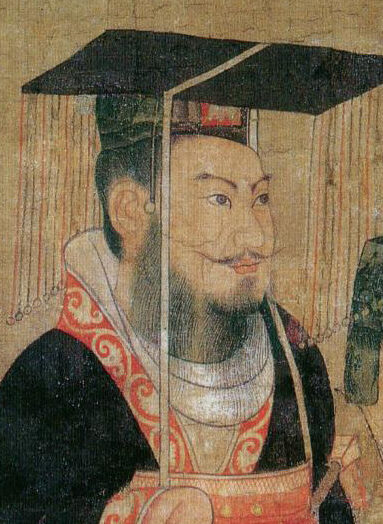
Emperor Guangwu of Han
Emperor Guangwu of Han was an emperor and founder of the Eastern Han Dynasty (5 BC - AD 57) (r. AD 25 - AD 57). Born January 15, 5 BC, in Zaoyang City. Died March 29, 57, in Luoyang. Positions held include Emperor of China (25–57).
Facts
27 facts · 0 confirmed by two sources · 2 cited · 25 from one source
Where this comes from
Papalocal keeps its own record. It started from these sources; what each one said is kept here as it was copied, so a change on their side never changes this page by itself. Tap one to read its version.
What Wikidata says · copied November 16, 2026 · revision 2569107032
- Described as
- emperor and founder of the Eastern Han Dynasty (5 BC - AD 57) (r. AD 25 - AD 57)
- Other names
- Shi Zu, Liu Xiu, Guangwu Di
- Born
- January 15, 5 BC
- Died
- March 29, 57
- Born in
- Zaoyang City
- Died in
- Luoyang
- Citizen of
- Han dynasty
- Occupation
- sovereign
- Positions held
- Emperor of China (25–57)
- Spouse
- Empress Guo Shengtong; Yin Lihua
- Children
- Liu Jiang; Liu Fu · 1 reference; Liu Kang; Liu Yan; Liu Yan; Liu Ying · 1 reference; Emperor Ming of Han · 1 reference; Liu Cang; Liu Jing; Liu Heng; Liu Jing; Liu Yiwang
- Father
- Liu Qin
- Mother
- Fan Xiandou
- Siblings
- Liu Yan; Liu Boji; Liu Huang; Liu Yuan
- Wikipedias with a page
- 38
Wikidata item Q7268 (wikidata.org/wiki/Q7268), public domain (CC0). Copied November 16, 2026.
What Wikipedia says · copied November 16, 2026 · revision 1385996219
Emperor Guangwu of Han (Chinese: 漢光武帝; 15 January 5 BC – 29 March AD 57), personal name Liu Xiu (劉秀), courtesy name Wenshu (文叔), was the 17th emperor of the Han dynasty and the founding emperor of the Chinese Eastern Han dynasty. Through the Eastern Han's suppression and conquest of regional warlords, the dynasty's rule over the whole of China proper was consolidated by the time of Emperor Guangwu's death in AD 57.
Liu Xiu was one of the many descendants of the Western Han imperial family. Following the usurpation of the throne by Wang Mang and the ensuing civil war during the disintegration of Wang's Xin dynasty, he emerged as one of several descendants of the fallen dynasty claiming the imperial throne. After assembling forces and proclaiming himself emperor in the face of competitors, he was able to defeat his rivals, destroy the peasant army of the Chimei, known for their disorganization and marauding, and finally reunify China in AD 36.
He established his capital in Luoyang, 335 kilometers (208 mi) east of the former capital Chang'an (modern Xi'an), ushering in the Eastern Han (Later Han) dynasty. He implemented some reforms (notably land reform, albeit not very successfully) aimed at correcting some of the structural imbalances responsible for the downfall of the Former/Western Han. His reforms gave a new 200-year lease of life to the Han dynasty. His reign was sometimes referred to as the "resurgence of Guangwu" (光武中兴); the capable rule of his son Emperor Ming and grandson Emperor Zhang was referred to as the Rule of Ming and Zhang.
Emperor Guangwu's campaigns featured many able generals, but he lacked major strategists. That may very well be because he himself appeared to be a brilliant strategist; he often instructed his generals on strategy from afar, and his predictions generally would be accurate. This was often emulated by later emperors who fancied themselves great strategists but who actually lacked Emperor Guangwu's brilliance—usually to disastrous results.
Also unique among emperors in Chinese history was Emperor Guangwu's combination of decisiveness and mercy. He often sought out peaceful means rather than bellicose means of putting areas under his control. He was, in particular, one rare example of a founding emperor of a dynasty who did not kill, out of jealousy or paranoia, any of the generals or officials who contributed to his victories after his rule was secure.
From the Wikipedia article “Emperor Guangwu of Han” (en.wikipedia.org/wiki/Emperor_Guangwu_of_Han), by its contributors, under CC BY-SA 4.0 (creativecommons.org/licenses/by-sa/4.0/). Copied November 16, 2026; not changed.
Confirmed Two sources agree. Cited One source, and it names where it got it. One source One source, without a reference of its own. Sources disagree The sources disagree. We show the best-supported value and keep theirs below.
