
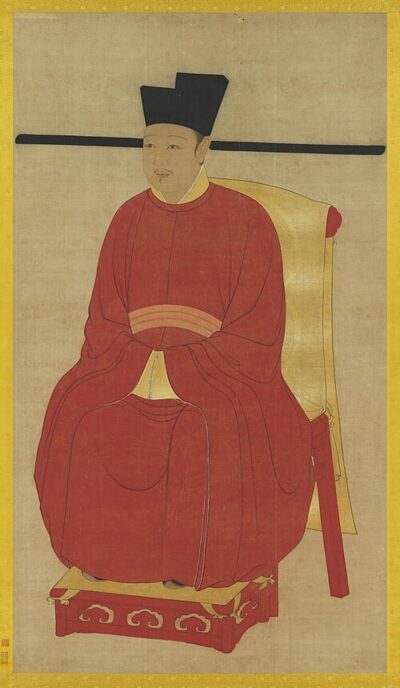
Emperor Huizong of Song
Emperor Huizong of Song was an emperor of the Song Dynasty. Born November 2, 1082, in Kaifeng. Died June 4, 1135, in Yilan County. Positions held include Emperor of China (1100–1126) and Taishang Huang (1126–1127).
Facts
44 facts · 2 confirmed by two sources · 16 cited · 25 from one source · 1 where the sources disagree
What’s different
- Mother: we show Qinci (Sources disagree). Wikidata also lists Chen Shi
Where this comes from
Papalocal keeps its own record. It started from these sources; what each one said is kept here as it was copied, so a change on their side never changes this page by itself. Tap one to read its version.
What Wikidata says · copied November 16, 2026 · revision 2569028123
- Described as
- emperor of the Song Dynasty (1082-1135)
- Other names
- Emperor Hui-tsung of Sung, Zhao Ji, Hui-tsung, Huizong, Hui Zong, Emperor Huizong, Song Huizong
- Born
- November 2, 1082
- Died
- June 4, 1135 · 1 reference
- Born in
- Kaifeng
- Died in
- Yilan County
- Citizen of
- Song dynasty · 1 reference
- Occupation
- painter · 1 reference; poet · 1 reference; ruler; musician · 1 reference; calligrapher · 1 reference; emperor · 1 reference
- Positions held
- Emperor of China (1100–1126); Taishang Huang (1126–1127)
- Spouse
- Empress Xiangong · 1 reference; Empress Xiansu · 1 reference; Empress Xianren · 1 reference; Empress Mingjie; Empress Mingda; Guifei, of the Wang clan · 1 reference
- Children
- Emperor Qinzong of Song · 2 references; Zhao Cheng · 1 reference; Zhao Kai · 3 references; Zhao Ji; Zhao Shu · 1 reference; Zhao Qi · 1 reference; Zhao Xu · 1 reference; Zhao Yu; Emperor Gaozong of Song · 2 references; Zhao Cai; Zhao Mu; Zhao Zhi
- Father
- Emperor Shenzong of Song · 2 references
- Mother
- Qinci · 2 references; Chen Shi · 1 reference
- Siblings
- Princess Shushou; Princesse Tanguo; Princess Yanguo; Princess Luguo; Princess Xingguo; Princess Binguo; Princess Yunguo; Princess Zhouguozhang; Princess Xuguozhang; Princess Chuguo
- Religion
- Taoism · 1 reference
- Wikipedias with a page
- 40
Wikidata item Q7486 (wikidata.org/wiki/Q7486), public domain (CC0). Copied November 16, 2026.
What Wikipedia says · copied November 16, 2026 · revision 1380976306
Emperor Huizong of Song (2 November 1082 – 4 June 1135), personal name Zhao Ji, was the eighth emperor of the Song dynasty of China. The 11th son of Emperor Shenzong, he ascended the throne in 1100 following the death of his elder brother, Emperor Zhezong. His court was marked by the dominance of Cai Jing, Wang Fu, Zhu Mian, and the eunuchs Li Yan, Tong Guan, and Liang Shicheng, collectively denounced by Chen Dong as the "Six Thieves". He expanded social welfare programs but also pursued a lavish lifestyle, notably through the "flower-and-stone fleet", which transported rarities requisitioned from Jiangnan to the capital Bianjing, contributing to the Fang La uprising. Huizong promoted Taoism while suppressing Buddhism. He allied with the Jin dynasty against the Liao dynasty, but after the Jin conquered the Liao and invaded Song territory, Huizong abdicated in favor of his eldest son, Emperor Qinzong, in 1126. The following year, Jin forces captured Bianjing and took Huizong, Qinzong, and much of the imperial family captive in the Jingkang Incident, marking the end of the Northern Song dynasty. The Emperor Taizong of Jin gave Huizong a title, Duke Hunde (literally "Besotted Duke"), to humiliate him. Huizong died in Wuguocheng after nearly a decade in captivity.
Despite his political failures, Huizong was an accomplished painter, poet, calligrapher, and musician, as well as a major patron of the arts. His imperial collection included more than 6,000 paintings.
- Born, in its opening lines
- November 2, 1082
- Died, in its opening lines
- June 4, 1135
From the Wikipedia article “Emperor Huizong of Song” (en.wikipedia.org/wiki/Emperor_Huizong_of_Song), by its contributors, under CC BY-SA 4.0 (creativecommons.org/licenses/by-sa/4.0/). Copied November 16, 2026; not changed.
Confirmed Two sources agree. Cited One source, and it names where it got it. One source One source, without a reference of its own. Sources disagree The sources disagree. We show the best-supported value and keep theirs below.
