
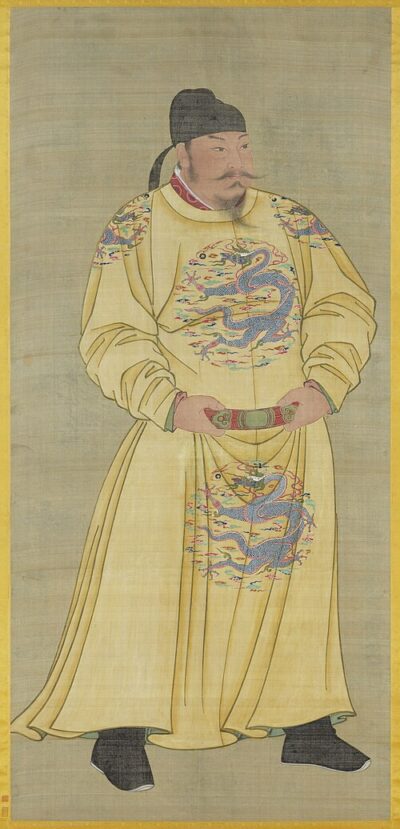
Emperor Taizong of Tang
Emperor Taizong of Tang was a Chinese emperor of the Tang Dynasty (598-649) (r. 626-649). Born January 28, 598, in Wugong County. Died July 10, 649, in Hangfeng Hall. Positions held include Emperor of China (626–649) and Khan of Heaven (630–649).
Facts
42 facts · 2 confirmed by two sources · 10 cited · 30 from one source
Where this comes from
Papalocal keeps its own record. It started from these sources; what each one said is kept here as it was copied, so a change on their side never changes this page by itself. Tap one to read its version.
What Wikidata says · copied November 16, 2026 · revision 2561592210
- Described as
- Chinese emperor of the Tang Dynasty (598-649) (r. 626-649)
- Other names
- Wen, Tang Tai-tsung, Wenwu dasheng daguang xiao huangdi, Tang Taizong, Li Shimin, Taizong, Li Huangdi, Tengri Qaghan
- Born
- January 28, 598 · 1 reference
- Died
- July 10, 649 · 1 reference
- Born in
- Wugong County · 1 reference
- Died in
- Hangfeng Hall
- Buried in
- Zhao Mausoleum
- Cause of death
- dysentery
- Citizen of
- Tang dynasty · 1 reference; Sui dynasty
- Occupation
- poet; emperor
- Positions held
- Emperor of China (626–649); Khan of Heaven (630–649)
- Spouse
- Empress Zhangsun · 1 reference; Wei Guifei; Consort Yang; Yan Defei; Consort Yang; Yin Fei
- Children
- Li Chengqian · 1 reference; Li Kuan; Li Ke · 1 reference; Li Tai · 1 reference; Li You; Li Yin; Li Yun · 1 reference; Li Zhen · 1 reference; Emperor Gaozong of Tang · 1 reference; Li Shen; Li Xiao; Li Jian
- Father
- Emperor Gaozu of Tang · 1 reference
- Mother
- Dou
- Siblings
- Guiyang; Danyang; Zhending; Linhai; Xiangyang; Changsha; Guantao; Jiujiang; Li Chengxia; Fangling
- Wikipedias with a page
- 57
Wikidata item Q9701 (wikidata.org/wiki/Q9701), public domain (CC0). Copied November 16, 2026.
What Wikipedia says · copied November 16, 2026 · revision 1379996127
Emperor Taizong of Tang (28 January 598 – 10 July 649), previously Prince of Qin, personal name Li Shimin, was the second emperor of the Tang dynasty of China, ruling from 626 to 649. He is traditionally regarded as a co-founder of the dynasty for his role in encouraging his father Li Yuan (Emperor Gaozu) to rebel against the Sui dynasty at Jinyang in 617. Taizong subsequently played a pivotal role in defeating several of the dynasty's most dangerous opponents and solidifying its rule over China proper.
Taizong is considered to be one of the greatest emperors in China's history, and henceforth his reign became regarded as the exemplary model by which all future emperors were measured. His era, the "Reign of Zhenguan" (Chinese: 貞觀之治; pinyin: Zhēnguàn Zhī Zhì) is considered a golden age in ancient Chinese history and was treated as required studying material for future crown princes. Taizong continued to develop imperial examination systems. He asked his officials to be loyal to policies, not people, in order to eliminate corruption. Under the Zhenguan era, Tang China flourished economically and militarily. For more than a century after his death, China enjoyed prosperity and peace brought about by the solidification of imperial protection over the Chinese regions. In territorial extent, it covered most of the territories previously held by the Han dynasty as well as parts of modern-day Korea, Vietnam, Russia, Mongolia, Xinjiang, and Central Asia. This era of consolidation and conquest laid the foundation for Xuanzong's reign, which is considered to be the height of the Tang dynasty.
In 630, Emperor Taizong sent his general Li Jing against the Eastern Turks, defeating and capturing their Jiali Khan Ashina Duobi and destroying their power. This made Tang the dominant power in East and Central Asia, and Emperor Taizong subsequently took the title Khan of Heaven. He also launched a series of campaigns against the oasis states of the Tarim Basin, and against their main ally, the Western Turks. During his reign, Tang armies annexed Karakhoja in 640, Karasahr in 644, and Kucha in 648. Eventually, the Tang defeated and annexed the Western Turkic Khaganate after Su Dingfang defeated Qaghan Ashina Helu in 657.
Unlike much of the nobility in his time, Emperor Taizong was a frank rationalist and scholar of logic and scientific reason, openly scorning superstitions and claims of signs from the heavens. He also modified important rites in order to ease the burden of agricultural labour. The modern Chinese historian Bo Yang opined that Emperor Taizong achieved greatness by enduring criticism which others would find difficult to accept whilst trying hard not to abuse his absolute power (using Emperor Yang of Sui as a negative example), as well as by employing capable chancellors such as Fang Xuanling, Du Ruhui, and Wei Zheng. Emperor Taizong's wife Empress Zhangsun also proved to be a capable assistant.
- Born, in its opening lines
- January 28, 598
- Died, in its opening lines
- July 10, 649
From the Wikipedia article “Emperor Taizong of Tang” (en.wikipedia.org/wiki/Emperor_Taizong_of_Tang), by its contributors, under CC BY-SA 4.0 (creativecommons.org/licenses/by-sa/4.0/). Copied November 16, 2026; not changed.
Confirmed Two sources agree. Cited One source, and it names where it got it. One source One source, without a reference of its own. Sources disagree The sources disagree. We show the best-supported value and keep theirs below.
