
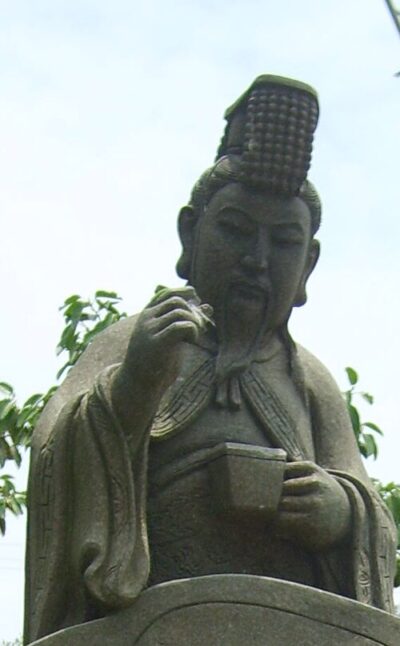
Emperor Wen of Han
Emperor Wen of Han was an emperor of the Han dynasty. Born 203 BC, in Chang'an. Died July 6, 157 BC. Positions held include Emperor of China (-180–-157) and Chinese king (-196–-180).
Facts
25 facts · 0 confirmed by two sources · 3 cited · 22 from one source
Where this comes from
Papalocal keeps its own record. It started from these sources; what each one said is kept here as it was copied, so a change on their side never changes this page by itself. Tap one to read its version.
What Wikidata says · copied November 16, 2026 · revision 2568951707
- Described as
- emperor of the Han dynasty
- Other names
- Liu Heng, Wen of Han, Taizong, Han Wendi, Han Taizong, T'ai-tsung, Tai-tsung, Han Wen-ti, Han T'ai-tsung, Han Tai-tsung, Han-wen-ti, Han-t'ai-tsung
- Born
- 203 BC
- Died
- July 6, 157 BC
- Born in
- Chang'an
- Buried in
- Baling
- Citizen of
- Western Han · 1 reference
- Occupation
- Confucian scholar
- Positions held
- Emperor of China (-180–-157); Chinese king (-196–-180)
- Spouse
- Empress Dou
- Children
- Emperor Jing of Han · 1 reference; Liu Piao; Liu Wu, Prince of Liang; Liu Can · 1 reference; Liu Yi · 1 reference
- Father
- Emperor Gaozu of Han · 1 reference
- Mother
- Empress Dowager Bo
- Siblings
- Princess Yuan of Lu; Liu Ruyi; Liu Jian; Liu Hui; Liu Zhang; Liu You; Emperor Hui of Han; Liu Fei
- Religion
- Taoism
- Wikipedias with a page
- 36
Wikidata item Q7221 (wikidata.org/wiki/Q7221), public domain (CC0). Copied November 16, 2026.
What Wikipedia says · copied November 16, 2026 · revision 1358908872
Emperor Wen of Han (Chinese: 漢文帝; 203/02 – 6 July 157 BC), personal name Liu Heng (劉恆), was the fifth emperor of the Han dynasty from 180 until his death in 157 BC. The son of Emperor Gao and Consort Bo, his reign provided a much needed stability within the ruling Liu clan after the unstable and violent regency of Empress Lü, who went after numerous members of the clan. The prosperous reigns of Emperor Wen and his son Emperor Jing are highly regarded by historians, being referred to as the Rule of Wen and Jing. He was one only four Western Han emperors to receive a temple name, along with Emperor Gaozu, Emperor Wu, and Emperor Xuan of Han.
When Emperor Gaozu suppressed the rebellion of Dai (代), he made Liu Heng Prince of Dai. Since Emperor Gaozu's death, power had been in the hands of his wife, Empress Lü, the empress dowager. After Empress Lü's death, the officials eliminated the powerful Lü clan, and deliberately chose the Prince of Dai as the emperor, since his mother, Consort Bo, had no powerful relatives, and her family was known for its humility and thoughtfulness.
Emperor Wen's reign brought a much needed political stability that laid the groundwork for prosperity under his grandson Emperor Wu. According to historians, Emperor Wen trusted and consulted with ministers on state affairs. Under the influence of his Taoist wife, Empress Dou, the emperor also sought to avoid wasteful expenditures. Historians note that the tax rates were at a ratio of "1 out of 30" and "1 out of 60", corresponding to 3.33% and 1.67%, respectively. (These rates are not for income taxes, but property taxes, as the only ancient Chinese attempt to levy an income tax would come in the time of Wang Mang.) Warehouses were so full of grain that some of it was left to decay.
From the Wikipedia article “Emperor Wen of Han” (en.wikipedia.org/wiki/Emperor_Wen_of_Han), by its contributors, under CC BY-SA 4.0 (creativecommons.org/licenses/by-sa/4.0/). Copied November 16, 2026; not changed.
Confirmed Two sources agree. Cited One source, and it names where it got it. One source One source, without a reference of its own. Sources disagree The sources disagree. We show the best-supported value and keep theirs below.
