
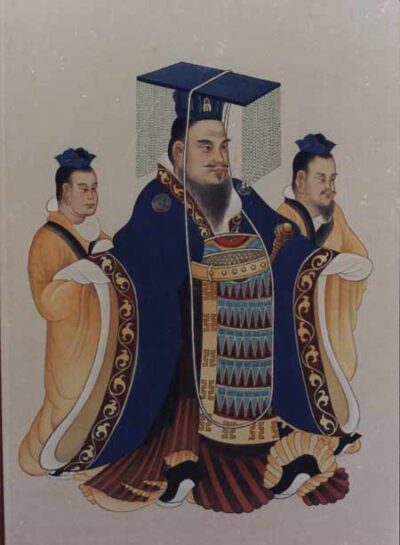
Emperor Wu of Han
Emperor Wu of Han was a seventh emperor of the Han dynasty of China. Born June 7, 156 BC, in Chang'an. Died March 29, 87 BC, in Chang'an. Positions held include Emperor of China (-141–-87) and crown prince (-150–-141).
Facts
40 facts · 0 confirmed by two sources · 5 cited · 34 from one source · 1 where the sources disagree
What’s different
- Mother: we show Empress Wang (Sources disagree). Wikidata also lists Empress Wang Zhi
Where this comes from
Papalocal keeps its own record. It started from these sources; what each one said is kept here as it was copied, so a change on their side never changes this page by itself. Tap one to read its version.
What Wikidata says · copied November 16, 2026 · revision 2526684988
- Described as
- seventh emperor of the Han dynasty of China (157 BC–87 BC)
- Other names
- Liu Che, Wu Di, Shi Zong, Han Wudi, Shizong, Han Shizong, Liu Ch'e, Han Wu-ti, Han-wu-ti, Shih Tsung, Shih-tsung, Han Shih-tsung
- Born
- June 7, 156 BC
- Died
- March 29, 87 BC
- Born in
- Chang'an
- Died in
- Chang'an
- Buried in
- Maoling
- Name at birth
- 劉徹
- Citizen of
- Western Han · 1 reference
- Occupation
- poet
- Positions held
- Emperor of China (-141–-87); crown prince (-150–-141)
- Spouse
- Empress Chen Jiao; Empress Wei Zifu; Lady Wang; Li Ji; Li Furen; Lady Yin
- Children
- Liu Ju · 1 reference; Emperor Zhao of Han · 1 reference; Liu Hong; Liu Dan · 1 reference; Liu Xu; Liu Bo; Princess Weichang; Princess Zhuyi; Princess Shiyi; Princess Eyi; princess Yangshi; Princess Yian
- Father
- Emperor Jing of Han · 1 reference
- Mother
- Empress Wang Zhi; Empress Wang · 1 reference
- Siblings
- Princess Pingyang; Princess Nangong; Princess Longlü; Jin Su; Liu Rong; Liu Pengzu; Liu Cheng; Liu Ji; Liu De; Liu Fa
- Wikipedias with a page
- 72
Wikidata item Q7225 (wikidata.org/wiki/Q7225), public domain (CC0). Copied November 16, 2026.
What Wikipedia says · copied November 16, 2026 · revision 1384672986
Emperor Wu of Han (156 – 29 March 87 BC; Chinese: 漢武帝; pinyin: Hàn Wŭdì), personal name Liu Che (Chinese: 劉徹; pinyin: Liú Chè) and courtesy name Tong (Chinese: 通; pinyin: Tōng), was the seventh emperor of the Han dynasty from 141 to 87 BC. His reign lasted 54 years – a record not broken until the reign of the Kangxi Emperor more than 1,800 years later – and remains the record for ethnic Han emperors. His reign resulted in a vast expansion of geopolitical influence for the Chinese civilization, and the development of a strong centralized state via governmental policies, economical reorganization and promotion of a hybrid Legalist–Confucian doctrine. In the field of historical social and cultural studies, Emperor Wu is known for his religious innovations and patronage of the poetic and musical arts, including the development of the Imperial Music Bureau into a prestigious entity. It was also during his reign that cultural contact with western Eurasia was greatly increased, directly and indirectly.
During his reign, Emperor Wu led the Han dynasty through its greatest territorial expansion. At its height, the Empire's borders spanned from the Fergana Valley in the west, to northern Korea in the east, and to northern Vietnam in the south. Emperor Wu successfully repelled the nomadic Xiongnu from systematically raiding northern China, and dispatched his envoy Zhang Qian into the Western Regions in 139 BC to seek an alliance with the Greater Yuezhi and Kangju, which resulted in further diplomatic missions to Central Asia. Although historical records do not describe him as being aware of Buddhism, the cultural exchanges that occurred as a consequence of these embassies suggest that he received Buddhist statues from Central Asia, as depicted in the murals found in the Mogao Caves.
Emperor Wu is considered one of the greatest emperors in Chinese history due to his strong leadership and effective governance, which made China, under the Han dynasty, one of the most powerful nations in the world. Michael Loewe called his reign the "high point" of "Modernist" (classically justified Legalist) policies, looking back to "adapt ideas from the pre-Han period." Especially later in his life, some of his most trusted advisers were proponents of Shang Yang, but did not necessarily support Shang Yang's harsh punishments. Emperor Wu adopted the principles of Confucianism as the state philosophy and code of ethics for his empire and started a school to teach future administrators the Confucian classics. These reforms had an enduring effect throughout the existence of imperial China and an enormous influence on neighbouring civilizations.
From the Wikipedia article “Emperor Wu of Han” (en.wikipedia.org/wiki/Emperor_Wu_of_Han), by its contributors, under CC BY-SA 4.0 (creativecommons.org/licenses/by-sa/4.0/). Copied November 16, 2026; not changed.
Confirmed Two sources agree. Cited One source, and it names where it got it. One source One source, without a reference of its own. Sources disagree The sources disagree. We show the best-supported value and keep theirs below.
