
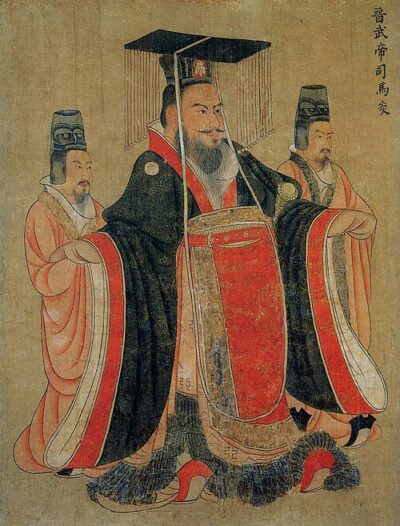
Emperor Wu of Jin was an Emperor of the Jin Dynasty from 266 to 290. Born 236. Died May 16, 290, in Luoyang. Positions held include Emperor of China (266–290).
Facts
33 facts · 2 confirmed by two sources · 5 cited · 26 from one source
Where this comes from
Papalocal keeps its own record. It started from these sources; what each one said is kept here as it was copied, so a change on their side never changes this page by itself. Tap one to read its version.
What Wikidata says · copied November 16, 2026 · revision 2569107135
- Described as
- Emperor of the Jin Dynasty from 266 to 290
- Other names
- Sima Yan, Shi Zu, Sima Yim, Anshi, Wu Di, Sima Yan (2), Emperor Wu of Jìn
- Born
- 236 · 3 references
- Died
- May 16, 290
- Died in
- Luoyang
- Citizen of
- Western Jin dynasty · 1 reference
- Occupation
- ruler
- Positions held
- Emperor of China (266–290)
- Spouse
- Empress Yang Yan; Empress Yang Zhi; Wang Yuanji; Zuo Fen · 1 reference; Yang Shi · 1 reference
- Children
- Emperor Hui of Jin · 1 reference; Sima Ai; Sima Yun; Sima Hui; Sima Xian; Sima Yan; Sima Jing; Sima Jian; Sima Yan; Sima Zhi; Sima Yu; Sima Gai
- Father
- Sima Zhao · 1 reference
- Mother
- Wang Yuanji
- Siblings
- Sima Zhao; Sima Dingguo; Sima Guangde; Sima Yanzuo; Sima You; Sima Ji; Sima Yongzuo; Sima Jian
- Wikipedias with a page
- 36
Wikidata item Q7356 (wikidata.org/wiki/Q7356), public domain (CC0). Copied November 16, 2026.
What Wikipedia says · copied November 16, 2026 · revision 1383813216
Emperor Wu of Jin (simplified Chinese: 晋武帝; traditional Chinese: 晉武帝; pinyin: Jìn Wǔ Dì; Wade–Giles: Chin Wu-Ti; 236 – 16 May 290), personal name Sima Yan, courtesy name Anshi, was the first emperor of the Jin dynasty after forcing Cao Huan, the last emperor of the state of Cao Wei, to abdicate in his favor. He reigned from 266 to 290, and after conquering the state of Eastern Wu in 280, was the emperor of a reunified China. He was a grandson of Sima Yi, nephew of Sima Shi and son of Sima Zhao. Emperor Wu was also known for his lust, especially after the unification of China; legends boasted of his incredible potency among ten thousand concubines.
Emperor Wu was commonly viewed as benevolent, but also wasteful. His generosity and kindness undermined his rule, as he became overly tolerant of the aristocratic clans' (世族 or 士族; a political/bureaucratic landlord class from Eastern Han to the Tang dynasty) corruption and extravagance, which drained the people's resources. Further, when Emperor Wu established the Jin dynasty, he was concerned about his regime's stability, and, believing that the predecessor state, Cao Wei, had been doomed by its policy of constraining the princes of the imperial clan, he delegated great authority to his uncles, cousins and sons, including independent military power. This ironically caused to the destabilization of the Western Jin, as the princes engaged in an internecine struggle known as the War of the Eight Princes soon after his death. This conflict led to the uprisings of the Five Barbarians that destroyed the Western Jin and forced its successor, Eastern Jin, to relocate to the region south of the Huai River.
- Born, in its opening lines
- 236
- Died, in its opening lines
- May 16, 290
From the Wikipedia article “Emperor Wu of Jin” (en.wikipedia.org/wiki/Emperor_Wu_of_Jin), by its contributors, under CC BY-SA 4.0 (creativecommons.org/licenses/by-sa/4.0/). Copied November 16, 2026; not changed.
Confirmed Two sources agree. Cited One source, and it names where it got it. One source One source, without a reference of its own. Sources disagree The sources disagree. We show the best-supported value and keep theirs below.
