
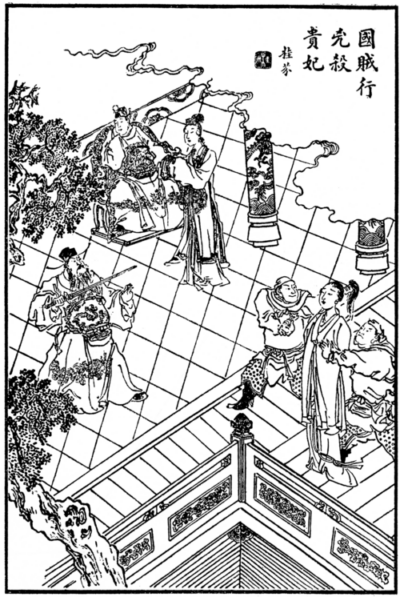
Emperor Xian of Han
Emperor Xian of Han was an Emperor of the Han dynasty from 189 to 220. Born April 2, 181, in Luoyang. Died April 21, 234. Positions held include Emperor of China (189–220).
Facts
23 facts · 2 confirmed by two sources · 4 cited · 17 from one source
Where this comes from
Papalocal keeps its own record. It started from these sources; what each one said is kept here as it was copied, so a change on their side never changes this page by itself. Tap one to read its version.
What Wikidata says · copied November 16, 2026 · revision 2569107112
- Described as
- Emperor of the Han dynasty from 189 to 220
- Other names
- Min Di, Xian Di, Liu Xie, Emperor Xian, Emperor Xian of the Han, Han Xiandi, Han Xian Di, Han Hsien-ti, Han Hsien Ti, Xiandi, Hsien-ti, Hsien Ti
- Born
- April 2, 181 · 1 reference
- Died
- April 21, 234
- Born in
- Luoyang · 1 reference
- Buried in
- Emperor Xian of Han's Shanling Mausoleum
- Citizen of
- Eastern Han · 1 reference
- Occupation
- monarch
- Positions held
- Emperor of China (189–220)
- Spouse
- Empress Fu Shou · 1 reference; Empress Cao Jie · 1 reference; Lady Dong; Cao Hua
- Children
- Liu Feng; Liu Xi; Liu Yi; Liu Miao; Liu Dun; Liu Man; datter av keiser Xian; Crown Prince
- Father
- Emperor Ling of Han · 1 reference
- Mother
- Empress Linghuai
- Siblings
- Prince of Hongnong; Princess Wannian
- Wikipedias with a page
- 34
Wikidata item Q7316 (wikidata.org/wiki/Q7316), public domain (CC0). Copied November 16, 2026.
What Wikipedia says · copied November 16, 2026 · revision 1385998530
Emperor Xian of Han (2 April 181 – 21 April 234), personal name Liu Xie (劉協), courtesy name Bohe, was the 30th and last emperor of the Han dynasty. He was also the 14th emperor of the Eastern Han dynasty of China. He reigned from 28 September 189 until his abdication and subsequent end of the dynasty on 11 December 220.
Liu Xie was a son of Liu Hong (Emperor Ling) and was a younger half-brother of his predecessor, Liu Bian (Emperor Shao). In 189, at the age of eight, he became emperor after the warlord Dong Zhuo, who had seized control of the Han central government, deposed Emperor Shao and replaced him with Liu Xie. The newly enthroned Liu Xie, historically known as Emperor Xian, was in fact a puppet ruler under Dong Zhuo's control. In 190, when a coalition of regional warlords launched a punitive campaign against Dong Zhuo in the name of freeing Emperor Xian, Dong Zhuo ordered the destruction of the imperial capital, Luoyang, and forcefully relocated the imperial capital along with its residents to Chang'an. After Dong Zhuo's assassination in 192, Emperor Xian fell under the control of Li Jue and Guo Si, two former subordinates of Dong Zhuo. The various regional warlords formally acknowledged Emperor Xian's legitimacy but never took action to save him from being held hostage.
In 195, Emperor Xian managed to escape from Chang'an and return to the ruins of Luoyang during a feud between Li Jue and Guo Si, where he soon became stranded. A year later, the warlord Cao Cao led his forces into Luoyang, received Emperor Xian, took him under his protection, and escorted him to Xu, where the new imperial capital was established. Although Cao Cao paid nominal allegiance to Emperor Xian, he was actually the de facto head of the central government. He skillfully used Emperor Xian as a "trump card" to bolster his legitimacy when he attacked and eliminated rival warlords in his quest to reunify the Han Empire under the central government's rule. Cao Cao's success seemed inevitable until the winter of 208–209, when he lost the decisive Battle of Red Cliffs against the southern warlords Sun Quan and Liu Bei. The battle paved the way for the subsequent emergence of the Three Kingdoms of Wei, Shu, and Wu.
In late 220, some months after Cao Cao's death, Cao Cao's successor, Cao Pi, forced Emperor Xian to abdicate the throne to him. He then established the state of Cao Wei with himself as the new emperor – an event marking the formal end of the Han dynasty and the beginning of the Three Kingdoms period in China. The dethroned Emperor Xian received the noble title Duke of Shanyang (Chinese: 山陽公) from Cao Pi and spent the rest of his life in comfort and enjoyed preferential treatment. He died on 21 April 234, about 14 years after the fall of the Han dynasty.
- Born, in its opening lines
- April 2, 181
- Died, in its opening lines
- April 21, 234
From the Wikipedia article “Emperor Xian of Han” (en.wikipedia.org/wiki/Emperor_Xian_of_Han), by its contributors, under CC BY-SA 4.0 (creativecommons.org/licenses/by-sa/4.0/). Copied November 16, 2026; not changed.
Confirmed Two sources agree. Cited One source, and it names where it got it. One source One source, without a reference of its own. Sources disagree The sources disagree. We show the best-supported value and keep theirs below.
