
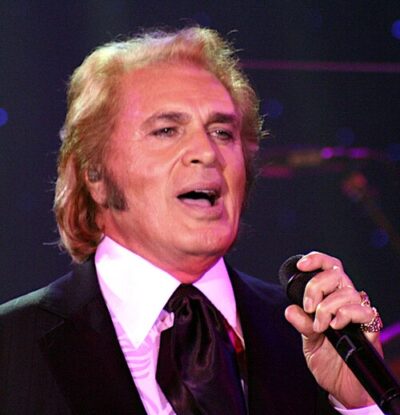
Engelbert Humperdinck is a British singer. Born May 2, 1936, in Chennai. Awards include star on Hollywood Walk of Fame.
Facts
16 facts · 1 confirmed by two sources · 2 cited · 13 from one source
Where this comes from
Papalocal keeps its own record. It started from these sources; what each one said is kept here as it was copied, so a change on their side never changes this page by itself. Tap one to read its version.
What Wikidata says · copied November 16, 2026 · revision 2567101064
- Described as
- British singer
- Other names
- Arnold George Dorsey, Gerry Dorsey, Engelbert
- Born
- May 2, 1936 · 3 references
- Born in
- Chennai
- Name at birth
- Arnold George Dorsey
- Citizen of
- United Kingdom
- Occupation
- singer · 1 reference
- Genre
- easy listening
- Instrument
- piano; voice; saxophone · 1 reference
- Record label
- Decca; Epic Records
- Awards
- star on Hollywood Walk of Fame · 1 reference
- Spouse
- Patricia Healey (1964–2021) · 1 reference
- Military branch
- British Army
- Lived in
- Beverly Hills
- Website
- http://www.engelbert.com
- Wikipedias with a page
- 47
Wikidata item Q221289 (wikidata.org/wiki/Q221289), public domain (CC0). Copied November 16, 2026.
What Wikipedia says · copied November 16, 2026 · revision 1383598624
Arnold George Dorsey (born 2 May 1936), known professionally as Engelbert Humperdinck, is a British singer. He achieved international success in 1967 with his recording of "Release Me".
Humperdinck began his performing career in the late 1950s under the name "Gerry Dorsey", but found success after 1965 when he partnered with manager Gordon Mills, who advised him to adopt the name of German composer Engelbert Humperdinck as a stage name. His recordings of the ballads "Release Me" and "The Last Waltz" topped the UK singles chart in 1967, selling more than a million copies each. Humperdinck scored further major hits in rapid succession, including "There Goes My Everything" (1967), "Am I That Easy to Forget" (1968), and "A Man Without Love" (1968). He attained a large following, with some of his most devoted fans calling themselves "Humperdinckers". Two of his singles were among the best-selling of the 1960s in the UK.
During the 1970s Humperdinck had significant American chart successes with "After the Lovin'" (1976) and "This Moment in Time" (1979). He garnered a reputation as a concert performer, and received renewed attention during the 1990s lounge revival with his recordings of "Lesbian Seagull" for the soundtrack of Beavis and Butt-Head Do America (1996) and a dance album (1998). The new millennium brought a range of musical projects, including the Grammy-nominated gospel album Always Hear the Harmony: The Gospel Sessions (2003) and the double album of duets Engelbert Calling (2014). Humperdinck represented the United Kingdom at the Eurovision Song Contest 2012 in Baku, Azerbaijan, with the song "Love Will Set You Free", placing 25th out of 26. Humperdinck continues to record and tour, having sold more than 140 million records worldwide.
- Born, in its opening lines
- May 2, 1936
From the Wikipedia article “Engelbert Humperdinck (singer)” (en.wikipedia.org/wiki/Engelbert_Humperdinck_(singer)), by its contributors, under CC BY-SA 4.0 (creativecommons.org/licenses/by-sa/4.0/). Copied November 16, 2026; not changed.
Confirmed Two sources agree. Cited One source, and it names where it got it. One source One source, without a reference of its own. Sources disagree The sources disagree. We show the best-supported value and keep theirs below.
