
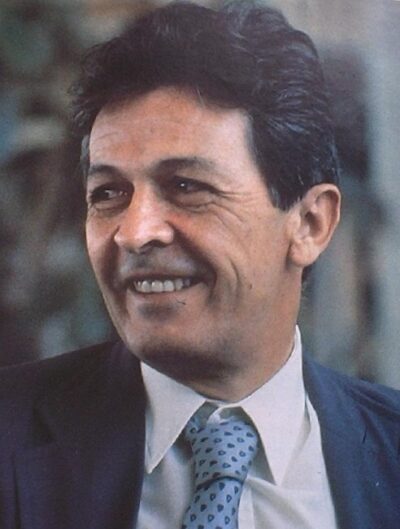
Enrico Berlinguer
Enrico Berlinguer was an Italian politician. Born May 25, 1922, in Sassari. Died June 11, 1984, in Padua. Positions held include Member of the European Parliament (1979–1984) and member of the Chamber of Deputies of the Italian Republic (1968–1984). Educated at University of Sassari.
Facts
19 facts · 2 confirmed by two sources · 5 cited · 12 from one source
Where this comes from
Papalocal keeps its own record. It started from these sources; what each one said is kept here as it was copied, so a change on their side never changes this page by itself. Tap one to read its version.
What Wikidata says · copied November 16, 2026 · revision 2567491079
- Described as
- Italian politician (1922–1984)
- Born
- May 25, 1922 · 8 references
- Died
- June 11, 1984 · 7 references
- Born in
- Sassari · 3 references
- Died in
- Padua · 2 references
- Buried in
- Cimitero Flaminio
- Cause of death
- cerebral hemorrhage
- Citizen of
- Italy (1946–); Kingdom of Italy (–1946)
- Occupation
- politician · 1 reference
- Positions held
- Member of the European Parliament (1979–1984) · 1 reference; member of the Chamber of Deputies of the Italian Republic (1968–1984) · 1 reference
- Political party
- Italian Communist Party
- Education
- University of Sassari
- Field
- politics · 1 reference
- Children
- Bianca Berlinguer; Marco Berlinguer
- Father
- Mario Berlinguer
- Siblings
- Giovanni Berlinguer
- Religion
- atheism
- Wikipedias with a page
- 47
Wikidata item Q164995 (wikidata.org/wiki/Q164995), public domain (CC0). Copied November 16, 2026.
What Wikipedia says · copied November 16, 2026 · revision 1384968024
Enrico Berlinguer (Italian: [enˈriːko berliŋˈɡwɛr] ; 25 May 1922 – 11 June 1984) was an Italian politician and statesman who was the most popular leader of the Italian Communist Party (PCI). He led the PCI as the national secretary from 1972 until his death during a tense period of Italian history, which was marked by the Years of Lead and social conflicts, such as the Hot Autumn of 1969–1970. Berlinguer was born into an upper-class family; his father was a socialist who became a deputy and later senator. After leading the PCI's youth wing in his hometown, he led the Italian Communist Youth Federation (FGCI) at the national level from 1949 to 1956. In 1968, he was elected to Italy's Chamber of Deputies, and he became the leader of the PCI in 1972; he remained a deputy until his death in 1984. Under his leadership, the number of votes for the PCI peaked. The PCI's results in 1976 remain the highest for any Italian left-wing or centre-left party both in terms of votes and vote share, and the party's results in 1984, just after his death, remain the best result for an Italian left-wing party in European elections, and were toppled, in terms of vote share in a lower-turnout election, in the 2014 European Parliament election in Italy.
During his leadership, Berlinguer distanced the party from the influence of the Communist Party of the Soviet Union and pursued a moderate line, repositioning the party within Italian politics and advocating accommodation and national unity. This strategy came to be termed Eurocommunism, and he was seen as its main spokesperson. It came to be adopted by Western Europe's other significant like-minded parties, such as the Communist Party of Spain and later the French Communist Party; its significance as a political force was cemented by a 1977 meeting in Madrid between Berlinguer, Georges Marchais, and Santiago Carrillo. Berlinguer described his alternative model of socialism, distinct from both the Soviet bloc and the capitalism practised by the Western bloc during the Cold War, as terza via (third way, with no relation to the centrist liberal Third Way movement and the politics practised by subsequent prime ministers Romano Prodi and Matteo Renzi), or terza fase (third phase), after the legacy of the Second International and the Comintern had been exhausted.
Under Berlinguer, the PCI reached the height of its success, winning significant victories in the regional and local elections in 1975, and 34% of the vote in the 1976 Italian general election, its highest share of the vote and number of seats. With these gains, he negotiated the Historic Compromise with the DC, lending support to their government in exchange for consultation on policy decisions, as well as social reforms. He took a firm stand against terrorism after the kidnapping and murder of Aldo Moro, and used the PCI's influence to steer Italian labour unions towards moderating wage demands to cope with the country's severe inflation rate after the 1973 oil crisis. These stands were not reciprocated with sufficient concessions from Giulio Andreotti's government, leading the PCI to leave the coalition in 1979. The combination of austerity advocacy, hard line against the Red Brigades, and attempts at an accommodation with the DC affected the PCI's vote at the 1979 Italian general election and the compromise was ultimately ended in 1980. The PCI remained in national opposition for the rest of Berlinguer's tenure, retaining a solid core of support at the 1983 Italian general election; its main strength from that point would remain at the regional and local level. Also a member of the European Parliament from 1979 to 1982, the PCI became the largest party for the first and only time in the 1984 European Parliament election in Italy, which was held a week after his premature death.
One of the most important figures of the First Italian Republic, Berlinguer had an austere and modest but charismatic personality, and despite the difficulties that confronted the PCI during the Historic Compromise, he remained a popular politician, respected for his principles, conviction, and bold stands. He characterised the PCI as an honest party in Italy's corruption-ravaged politics, an image that preserved the party's reputation during the Mani pulite corruption scandals in the 1990s. He was characterised by Patrick McCarthy as "the last great communist leader in Western Europe", and remains identified with the causes of Eurocommunism, opposition to Soviet repression in Eastern Europe, and democratic change in Italy.
- Born, in its opening lines
- May 25, 1922
- Died, in its opening lines
- June 11, 1984
From the Wikipedia article “Enrico Berlinguer” (en.wikipedia.org/wiki/Enrico_Berlinguer), by its contributors, under CC BY-SA 4.0 (creativecommons.org/licenses/by-sa/4.0/). Copied November 16, 2026; not changed.
Confirmed Two sources agree. Cited One source, and it names where it got it. One source One source, without a reference of its own. Sources disagree The sources disagree. We show the best-supported value and keep theirs below.
