
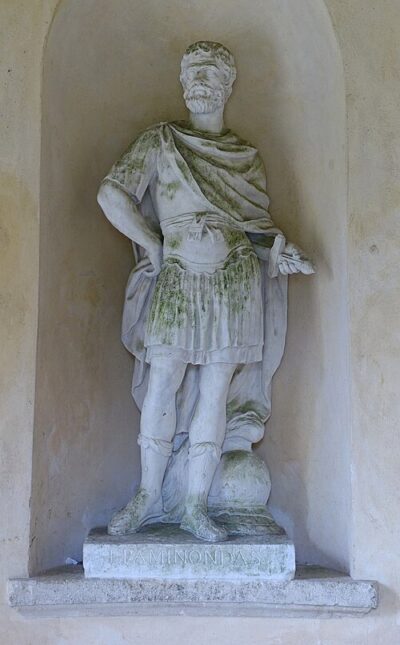
Epaminondas
Epaminondas was a Theban general and statesman (419/411–362 BC). Born 418 BC, in Thebes. Died 362 BC, in Pelagos forest. Positions held include strategos and Boeotarch (2 times) (-372–-362).
Facts
15 facts · 0 confirmed by two sources · 6 cited · 7 from one source · 2 where the sources disagree
What’s different
- Born: we show 418 BC (Sources disagree). Wikipedia says 411
- Died: we show 362 BC (Sources disagree). Wikipedia says 362
Where this comes from
Papalocal keeps its own record. It started from these sources; what each one said is kept here as it was copied, so a change on their side never changes this page by itself. Tap one to read its version.
What Wikidata says · copied November 16, 2026 · revision 2562729552
- Described as
- Theban general and statesman (419/411–362 BC)
- Other names
- Epameinondas
- Born
- 418 BC · 2 references
- Died
- 362 BC · 3 references
- Born in
- Thebes · 1 reference
- Died in
- Pelagos forest · 1 reference
- Citizen of
- Thebes · 1 reference
- Occupation
- politician · 2 references; military personnel · 1 reference; military leader · 3 references; statesperson · 1 reference; army officer
- Positions held
- strategos; Boeotarch (2 times) (-372–-362) · 1 reference
- Field
- military affairs · 2 references
- Father
- Polymnis
- Religion
- Ancient Greek religion
- Wikipedias with a page
- 57
Wikidata item Q190436 (wikidata.org/wiki/Q190436), public domain (CC0). Copied November 16, 2026.
What Wikipedia says · copied November 16, 2026 · revision 1379927143
Epaminondas (; Ancient Greek: Ἐπαμεινώνδας, romanized: Epameinōndas; 419/411–362 BC) was a Greek general and statesman of the 4th century BC who transformed the Ancient Greek city-state of Thebes, leading it out of Spartan subjugation into a pre-eminent position in Greek politics called the Theban Hegemony. In the process, he broke Spartan military power with his victory at Leuctra and liberated the Messenian helots, a group of Peloponnesian Greeks who had been enslaved under Spartan rule for some 230 years following their defeat in the Second Messenian War ending in 600 BC. Epaminondas reshaped the political map of Greece, fragmented old alliances, created new ones, and supervised the construction of entire cities. He was also militarily influential and invented and implemented several important battlefield tactics, such as the oblique order.
Xenophon, the historian and contemporary, is the main source for Epaminondas's military prowess, and Xenophon describes his admiration for him in his major work Hellenica (book VII, chap. 5, 19). Accordingly, in later centuries the Roman orator Cicero called him "the first man of Greece", and in more recent times Michel de Montaigne judged him one of the three "worthiest and most excellent men" who had ever lived. The changes Epaminondas wrought on the Greek political order did not long outlive him, as the cycle of shifting hegemonies and alliances continued unabated. A mere twenty-seven years after his death, a recalcitrant Thebes was obliterated by Alexander the Great. Thus Epaminondas—who had been praised in his time as an idealist and liberator—is today largely remembered for a decade (371 BC to 362 BC) of campaigning that established a decade long Theban hegemony but also sapped the strength of the great city-states and paved the way for Macedonian hegemony.
- Born, in its opening lines
- 411
- Died, in its opening lines
- 362
From the Wikipedia article “Epaminondas” (en.wikipedia.org/wiki/Epaminondas), by its contributors, under CC BY-SA 4.0 (creativecommons.org/licenses/by-sa/4.0/). Copied November 16, 2026; not changed.
Confirmed Two sources agree. Cited One source, and it names where it got it. One source One source, without a reference of its own. Sources disagree The sources disagree. We show the best-supported value and keep theirs below.
