Boeotarch
Boeotarch is a federal official of ancient Boeotia. It is an office of Boeotian confederation.
- Office of
- Boeotian confederation
All 2 facts, and where they come from
Facts
2 facts · 0 confirmed by two sources · 0 cited · 2 from one source
Where this comes from
Papalocal keeps its own record. It started from these sources; what each one said is kept here as it was copied, so a change on their side never changes this page by itself. Tap one to read its version.
What Wikidata says · copied November 17, 2026 · revision 2569439955
- Described as
- federal official of ancient Boeotia
- What it is
- position
- Office of
- Boeotian confederation
- Wikipedias with a page
- 18
Wikidata item Q1019919 (wikidata.org/wiki/Q1019919), public domain (CC0). Copied 2026-11-17.
What Wikipedia says · copied November 17, 2026 · revision 1333937309
Boeotarch (Greek: Βοιωτάρχης, Boiotarches) was the title of the chief officers of the Boeotian Confederacy, founded in 379 BC after a rebellion freed the cities of Boeotia from Spartan dominance. There were seven Boeotarchs, democratically elected from seven electoral districts throughout Boeotia. As the largest city of the region, Thebes generally elected four of the Boeotarchs, while the other three represented outlying districts. The number of Boeotarchs, however, may not have remained constant at seven. They may have not even represented districts in the same way as the earlier Boeotian League.
Failure to relinquish power was a capital offence. The function of the Boeotarchs were roughly equivalent to that of the Athenian strategos, acting as both political leaders and generals in battle. And indeed, many other political, military, and judicial offices in the Boeotian League were copied from the Athenian model. The Boeotians also had an archon, but unlike the Athenian archon, his duties were merely symbolic. The sole responsibility of the Boeotian archon was in lending his name to the name of the year, a practice borrowed from the Athenians.
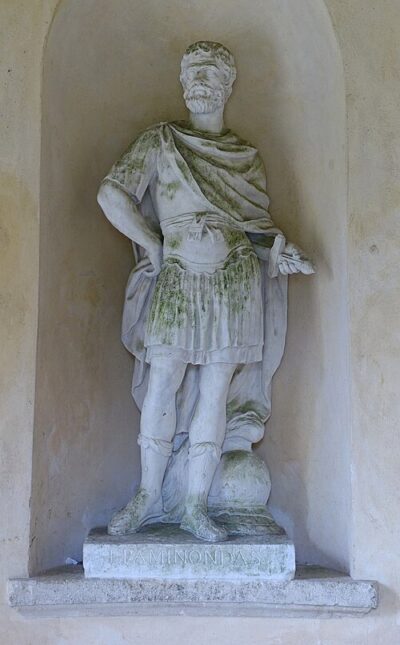
The most famous individuals to hold the office were Epaminondas and Pelopidas, who led Thebes to hegemonic status over Greece in the middle of the 4th century BC ("Theban hegemony").
From the Wikipedia article “Boeotarch” (en.wikipedia.org/wiki/Boeotarch), by its contributors, under CC BY-SA 4.0 (creativecommons.org/licenses/by-sa/4.0/). Copied 2026-11-17; not changed.
Confirmed Two sources agree. Cited One source, and it names where it got it. One source One source, without a reference of its own. Sources disagree The sources disagree. We show the best-supported value and keep theirs below.