
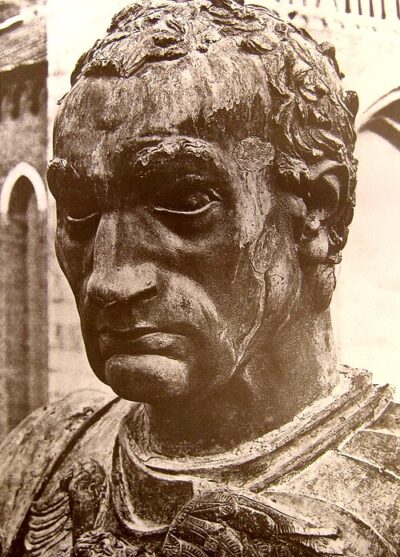
Erasmo of Narni was an Italian mercenary. Born 1370, in Narni. Died January 16, 1443, in Padua.
Facts
9 facts · 2 confirmed by two sources · 2 cited · 5 from one source
Where this comes from
Papalocal keeps its own record. It started from these sources; what each one said is kept here as it was copied, so a change on their side never changes this page by itself. Tap one to read its version.
What Wikidata says · copied November 17, 2026 · revision 2567352913
- Described as
- Italian mercenary (1370–1443)
- Other names
- Erasmo da Narni, Erasmo da Narni, detto il Gattamelata, Erasmo Stefano of Narni
- Born
- 1370 · 4 references
- Died
- January 16, 1443 · 1 reference
- Born in
- Narni · 1 reference
- Died in
- Padua · 1 reference
- Buried in
- Basilica of Saint Anthony of Padua
- Citizen of
- Republic of Florence · 1 reference; Republic of Venice; Papal States
- Occupation
- condottiero
- Wikipedias with a page
- 26
Wikidata item Q733404 (wikidata.org/wiki/Q733404), public domain (CC0). Copied November 17, 2026.
What Wikipedia says · copied November 17, 2026 · revision 1384179442
Erasmo Stefano of Narni (1370 – 16 January 1443), better known by his nickname of Gattamelata (meaning "Honeyed Cat"), was an Italian condottiero of the Renaissance. He was born in Narni, and served a number of Italian city-states: he began with Braccio da Montone, served the Papal States and Florence, as well as the Republic of Venice in 1434 in the battles with the Visconti of Milan.
He was the subject of Donatello's equestrian bronze sculpture in Piazza del Santo in Padua, the same city over which he became podestà in 1437.
In Narni, the farmhouse in which Gattamelata was born bears a plaque reading "Narnia me genuit Gattamelata fui" ("I was born in Narni, I was Gattamelata").
- Born, in its opening lines
- 1370
- Died, in its opening lines
- January 16, 1443
From the Wikipedia article “Erasmo of Narni” (en.wikipedia.org/wiki/Erasmo_of_Narni), by its contributors, under CC BY-SA 4.0 (creativecommons.org/licenses/by-sa/4.0/). Copied November 17, 2026; not changed.
Confirmed Two sources agree. Cited One source, and it names where it got it. One source One source, without a reference of its own. Sources disagree The sources disagree. We show the best-supported value and keep theirs below.
