
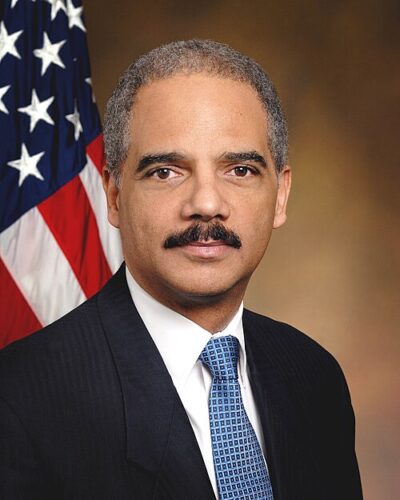
Eric Holder
Eric Holder is an United States Attorney General from 2009 to 2015. Born January 21, 1951, in The Bronx. Positions held include United States Attorney General (2 times) (2001–2015), United States Attorney for the District of Columbia (1993–1997) and United States Deputy Attorney General (1997–2001). Educated at Columbia University and Columbia Law School. Awards include NAACP Image Award – Chairman's Award and John Jay Award.
Facts
19 facts · 1 confirmed by two sources · 1 cited · 17 from one source
Where this comes from
Papalocal keeps its own record. It started from these sources; what each one said is kept here as it was copied, so a change on their side never changes this page by itself. Tap one to read its version.
What Wikidata says · copied November 15, 2026 · revision 2554018234
- Described as
- United States Attorney General from 2009 to 2015
- Other names
- Eric H. Holder, Jr., Eric Himpton Holder, Jr.
- Born
- January 21, 1951 · 3 references
- Born in
- The Bronx
- Citizen of
- United States
- Occupation
- judge; lawyer; politician
- Positions held
- United States Attorney General (2 times) (2001–2015); United States Attorney for the District of Columbia (1993–1997); United States Deputy Attorney General (1997–2001) · 1 reference; justice minister · 1 reference
- Political party
- Democratic Party
- Worked for
- George Washington University
- Education
- Columbia University; Columbia Law School; Stuyvesant High School
- Member of
- American Academy of Arts and Sciences
- Awards
- NAACP Image Award – Chairman's Award; John Jay Award
- Religion
- Episcopal Church
- Wikipedias with a page
- 36
Wikidata item Q312644 (wikidata.org/wiki/Q312644), public domain (CC0). Copied November 15, 2026.
What Wikipedia says · copied November 15, 2026 · revision 1385902836
Eric Himpton Holder Jr. (born January 21, 1951) is an American lawyer who served as the 82nd United States attorney general from 2009 to 2015. A member of the Democratic Party, Holder was the first African American to hold the position.
Born in New York City to a middle-class family of Bajan origin, Holder graduated from Stuyvesant High School, Columbia College, and Columbia Law School. Following law school, he worked for the Public Integrity Section of the U.S. Department of Justice for twelve years. He next served as a judge of the Superior Court of the District of Columbia before being appointed by President Bill Clinton as U.S. attorney for the District of Columbia and subsequently U.S. deputy attorney general.
Holder prosecuted cases involving government corruption. While U.S. attorney, he prosecuted congressman Dan Rostenkowski for corruption charges related to his role in the Congressional Post Office scandal. Following the Clinton administration, he worked at Covington & Burling, representing the firm's multinational corporate clients in litigation. Holder was senior legal advisor to Barack Obama during his 2008 presidential campaign and one of three members of his vice-presidential selection committee. Holder was a close ally and confidante of Obama's and was selected as his first attorney general.
Holder became the first sitting attorney general to be held in contempt of Congress during an investigation of the Operation Fast and Furious ATF gunwalking scandal. The Justice Department's inspector general under Obama refused to prosecute him and later cleared him of the charges. After he was succeeded as attorney general by Loretta Lynch in April 2015, Holder returned to Covington & Burling, where he continues to practice corporate litigation, primarily for financial firms, and is also involved with efforts at gerrymandering reform through the National Democratic Redistricting Committee.
- Born, in its opening lines
- January 21, 1951
From the Wikipedia article “Eric Holder” (en.wikipedia.org/wiki/Eric_Holder), by its contributors, under CC BY-SA 4.0 (creativecommons.org/licenses/by-sa/4.0/). Copied November 15, 2026; not changed.
Confirmed Two sources agree. Cited One source, and it names where it got it. One source One source, without a reference of its own. Sources disagree The sources disagree. We show the best-supported value and keep theirs below.
