
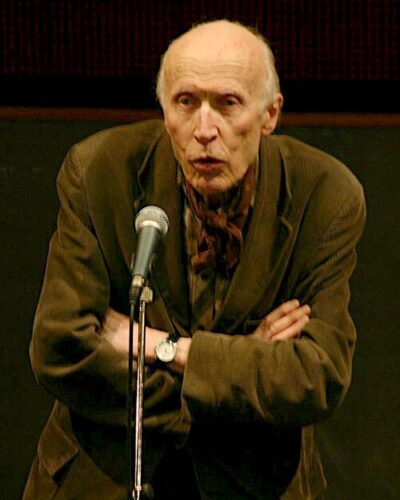
Éric Rohmer
Éric Rohmer was a French film director. Born March 21, 1920, in Tulle. Died January 11, 2010, in 13th arrondissement of Paris. Known for My Night at Maud's, Claire's Knee and Love in the Afternoon. Educated at Lycée Henri-IV and Lycée Edmond Perrier. Awards include Louis Delluc Prize, National Society of Film Critics Award for Best Screenplay and National Board of Review Award for Best Foreign Language Film (2 times).
Facts
41 facts · 2 confirmed by two sources · 15 cited · 24 from one source
Where this comes from
Papalocal keeps its own record. It started from these sources; what each one said is kept here as it was copied, so a change on their side never changes this page by itself. Tap one to read its version.
What Wikidata says · copied November 16, 2026 · revision 2568947263
- Described as
- French film director (1920-2010)
- Other names
- Eric Rohmer, Maurice Henri Joseph Schérer, Maurice Henri Joseph Scherer
- Born
- March 21, 1920 · 7 references
- Died
- January 11, 2010 · 13 references
- Born in
- Tulle · 4 references
- Died in
- 13th arrondissement of Paris · 4 references
- Buried in
- Montparnasse Cemetery
- Name at birth
- Maurice Henri Joseph Schérer · 1 reference
- Citizen of
- France
- Occupation
- film director · 3 references; journalist; writer; screenwriter · 2 references; film critic · 1 reference; film editor; teacher · 3 references; actor · 2 references
- Worked for
- Cahiers du cinéma
- Education
- Lycée Henri-IV (1937–1940) · 1 reference; Lycée Edmond Perrier (–1937) · 1 reference; University of Clermont-Ferrand (1896-1976) (1941–1942) · 1 reference
- Known for
- My Night at Maud's (1969); Claire's Knee (1970); Love in the Afternoon (1972); Pauline at the Beach (1983); Full Moon in Paris (1984)
- Awards
- Louis Delluc Prize (1970); National Society of Film Critics Award for Best Screenplay (1970); National Board of Review Award for Best Foreign Language Film (2 times) (1971, 1976); Golden Lion (1986); David di Donatello Luchino Visconti (1990); Cannes Film Festival Grand Prix (1976); Golden Lion for Lifetime Achievement (2001); Silver Bear Grand Jury Prize (1967); Silver Bear for Best Director (1983); Jean-Le-Duc award
- Children
- René Monzat
- Siblings
- René Schérer
- Religion
- Catholicism
- Lived in
- rue de la Barrière (1920–1937) · 1 reference; Paris (2 times) (1937–) · 1 reference; Clermont-Ferrand (1941–1942) · 1 reference; Villeurbanne (1942–1943) · 1 reference
- Wikipedias with a page
- 54
Wikidata item Q50764 (wikidata.org/wiki/Q50764), public domain (CC0). Copied November 16, 2026.
What Wikipedia says · copied November 16, 2026 · revision 1377096711
Jean Marie Maurice Schérer or Maurice Henri Joseph Schérer, known as Éric Rohmer (French: [eʁik ʁomɛʁ]; 21 March 1920 – 11 January 2010), was a French film director, film critic, journalist, novelist, screenwriter, and teacher. Rohmer was the last of the post-World War II French New Wave directors to become established. He edited the influential film journal Cahiers du cinéma from 1957 to 1963, while most of his colleagues—among them Jean-Luc Godard and François Truffaut—were making the transition from critics to filmmakers and gaining international attention.
Rohmer gained international acclaim around 1969 when his film My Night at Maud's was nominated at the Academy Awards. He won the San Sebastián International Film Festival with Claire's Knee in 1971 and the Golden Lion at the Venice Film Festival for The Green Ray in 1986. In 2001, Rohmer received the Venice Film Festival's Career Golden Lion. After his death in 2010, his obituary in The Daily Telegraph called him "the most durable filmmaker of the French New Wave", outlasting his peers and "still making movies the public wanted to see" late in his career.
- Born, in its opening lines
- March 21, 1920
- Died, in its opening lines
- January 11, 2010
From the Wikipedia article “Éric Rohmer” (en.wikipedia.org/wiki/Éric_Rohmer), by its contributors, under CC BY-SA 4.0 (creativecommons.org/licenses/by-sa/4.0/). Copied November 16, 2026; not changed.
Confirmed Two sources agree. Cited One source, and it names where it got it. One source One source, without a reference of its own. Sources disagree The sources disagree. We show the best-supported value and keep theirs below.
