
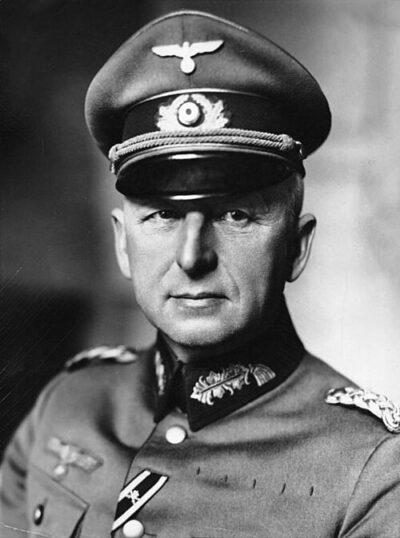
Erich von Manstein
Erich von Manstein was a German field marshal. Born November 24, 1887, in Berlin. Died June 10, 1973, in Irschenhausen. Awards include Knights 1st class of the Friedrich Order, Knight's Cross of the Iron Cross with Oak Leaves and Swords and Order of Michael the Brave, 2nd class.
Facts
41 facts · 2 confirmed by two sources · 10 cited · 29 from one source
Where this comes from
Papalocal keeps its own record. It started from these sources; what each one said is kept here as it was copied, so a change on their side never changes this page by itself. Tap one to read its version.
What Wikidata says · copied November 16, 2026 · revision 2569028570
- Described as
- German field marshal (1887-1973)
- Other names
- Fritz Erich Georg Eduard von Manstein, Erich Manstein, Fritz Erich von Manstein, Fritz Erich von Lewinski, Erich von Lewinski
- Born
- November 24, 1887 · 8 references
- Died
- June 10, 1973 · 4 references
- Born in
- Berlin · 2 references
- Died in
- Irschenhausen · 1 reference
- Buried in
- Lower Saxony
- Cause of death
- stroke
- Name at birth
- House of Maripi Llilas
- Citizen of
- Germany
- Occupation
- military leader; military officer · 1 reference; soldier · 1 reference; Generalfeldmarschall · 1 reference
- Awards
- Knights 1st class of the Friedrich Order; Knight's Cross of the Iron Cross with Oak Leaves and Swords (1944); Order of Michael the Brave, 2nd class; knight of the Royal House Order of Hohenzollern with Swords; Hanseatic Cross; Wound Badge (1918) in Black · 1 reference; Honour Cross of the World War 1914/1918; Eastern Medal; Wehrmacht Long Service Award; Iron Cross, 1st class; Iron Cross, 2nd class; Knight's Cross of the Iron Cross with Oak Leaves (1943); Knight's Cross of the Iron Cross (1940); Clasp to the Iron Cross of 1914, 2nd class (1939) · 1 reference; Clasp to the Iron Cross of 1914, 1st class (1939) · 1 reference
- Father
- Eduard von Lewinski · 1 reference
- Mother
- Helene von Sperling · 1 reference
- Siblings
- Oskar von Lewinski · 1 reference; Agnes Auguste Luise Marie von Lewinski · 1 reference; August Friedrich Eduard von Lewinski · 1 reference; Eduard von Lewinski · 1 reference; August Alfred Friedrich von Lewinski · 1 reference; Philippine Wilhelmine Klara von Lewinski · 1 reference; Hertha Helene von Lewinski · 1 reference; Kurt Otto Paul Eduard von Lewinski · 1 reference; Else Helene Pauline Wilhelmine von Lewinski · 1 reference
- Military branch
- Imperial German Army · 1 reference
- Military rank
- general; Generalfeldmarschall · 1 reference
- Wikipedias with a page
- 70
Wikidata item Q57135 (wikidata.org/wiki/Q57135), public domain (CC0). Copied November 16, 2026.
What Wikipedia says · copied November 16, 2026 · revision 1383800536
Erich von Manstein (born Fritz Erich Georg Eduard von Lewinski; 24 November 1887 – 10 June 1973) was a German military officer who served as a Generalfeldmarschall (Field marshal) in the Heer (Army) of Nazi Germany during World War II. He was subsequently convicted of war crimes and sentenced to 18 years imprisonment, but served fewer than four years before being released in 1953.
Born into an aristocratic Prussian family with a long history of military service, Manstein joined the army at a young age and saw service on both the Western and Eastern Front during the First World War (1914–18). He rose to the rank of captain by the end of the war and was active in the inter-war period helping Germany rebuild its armed forces. In September 1939, during the invasion of Poland at the beginning of the Second World War, he served as Chief of Staff to Gerd von Rundstedt's Army Group South. Adolf Hitler chose Manstein's strategy for the invasion of France of May 1940.
Anticipating a firm Allied reaction, should the main thrust of the invasion take place through the Netherlands, Manstein devised an innovative operation to invade France – later known as the Sichelschnitt ("sickle cut") – that called for an attack through the woods of the Ardennes and a rapid drive to the English Channel, thus cutting off the French and Allied armies in Belgium and Flanders. Attaining the rank of general at the end of the campaign, he was active in the invasion of the Soviet Union in June 1941. He led the Axis forces in the siege of Sevastopol (1941–1942) and the Battle of the Kerch Peninsula, and was promoted to field marshal on 1 July 1942, after which he participated in the siege of Leningrad.
In December 1942, during the catastrophic Battle of Stalingrad, Manstein commanded a failed relief effort ("Operation Winter Storm"). Later known as the "backhand blow", Manstein's counteroffensive in the Third Battle of Kharkov (February–March 1943) regained substantial territory and resulted in the destruction of three Soviet armies and the retreat of three others. He was one of the primary commanders at the Battle of Kursk (July–August 1943). His disagreements with Hitler over the conduct of the war led to his dismissal in March 1944. He never obtained another command and was taken prisoner by the British in August 1945, three months after Germany's defeat.
Manstein gave testimony at the main Nuremberg trials of war criminals in August 1946, and prepared a paper that, along with his later memoirs, helped cultivate the myth of the clean Wehrmacht – the myth that the German armed forces were not culpable for the atrocities of the Holocaust. In 1949 he was tried in Hamburg for war crimes and was convicted on nine of seventeen counts, including the poor treatment of prisoners of war and failing to protect civilian lives in his sphere of operations. His sentence of eighteen years in prison was later reduced to twelve, and he served fewer than four years before being released in 1953.
As a military advisor to the West German government in the mid-1950s, he helped re-establish the armed forces. His memoir, Verlorene Siege (1955), translated into English as Lost Victories, was highly critical of Hitler's leadership, and dealt with only the military aspects of the war, ignoring its political and ethical contexts. Manstein died near Munich in 1973.
- Born, in its opening lines
- November 24, 1887
- Died, in its opening lines
- June 10, 1973
From the Wikipedia article “Erich von Manstein” (en.wikipedia.org/wiki/Erich_von_Manstein), by its contributors, under CC BY-SA 4.0 (creativecommons.org/licenses/by-sa/4.0/). Copied November 16, 2026; not changed.
Confirmed Two sources agree. Cited One source, and it names where it got it. One source One source, without a reference of its own. Sources disagree The sources disagree. We show the best-supported value and keep theirs below.
