
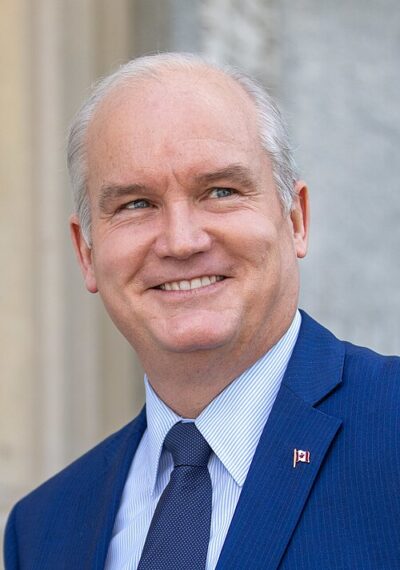
Erin O'Toole
Erin O'Toole is a Canadian politician. Born January 22, 1973, in Montreal. Positions held include Leader of the Official Opposition (2020–2022), leader of the Conservative Party of Canada (2020–2022) and Minister of Veterans Affairs (2015). Educated at Royal Military College of Canada.
Facts
16 facts · 1 confirmed by two sources · 8 cited · 7 from one source
Where this comes from
Papalocal keeps its own record. It started from these sources; what each one said is kept here as it was copied, so a change on their side never changes this page by itself. Tap one to read its version.
What Wikidata says · copied November 16, 2026 · revision 2562736243
- Described as
- Canadian politician (born 1973)
- Born
- January 22, 1973 · 1 reference
- Born in
- Montreal
- Citizen of
- Canada · 1 reference
- Occupation
- politician · 1 reference; lawyer · 1 reference; military officer · 1 reference
- Positions held
- Leader of the Official Opposition (2020–2022); leader of the Conservative Party of Canada (2020–2022); Minister of Veterans Affairs (2015); member of the House of Commons of Canada (2012–2023) · 1 reference
- Political party
- Conservative Party of Canada · 1 reference
- Education
- Royal Military College of Canada
- Father
- John O'Toole · 2 references
- Lived in
- Ottawa · 1 reference
- Website
- http://erinotoolemp.ca; https://erinotoole.ca
- Wikipedias with a page
- 21
Wikidata item Q1840895 (wikidata.org/wiki/Q1840895), public domain (CC0). Copied November 16, 2026.
What Wikipedia says · copied November 16, 2026 · revision 1384935772
Erin Michael O'Toole (born January 22, 1973) is a Canadian lawyer, former military officer and politician who was the leader of the Conservative Party of Canada and the leader of the Official Opposition from 2020 to 2022. O'Toole was elected as a member of Parliament (MP) in 2012, representing Durham until 2023. O'Toole served in the Canadian Armed Forces for 12 years, before becoming a lawyer and entering politics.
Born in Montreal, O'Toole grew up in Port Perry and Bowmanville in Ontario. He joined the military in 1991 and studied at the Royal Military College (RMC) until 1995. He was commissioned in Air Command, serving as an air navigator, eventually attaining the rank of captain. Following his active service, he received a law degree, practicing law for nearly a decade until he was elected to the House of Commons in a 2012 by-election. In 2015, O'Toole briefly served as veterans affairs minister in the Harper government. In 2017, he ran for the party's leadership, finishing third to winner Andrew Scheer.
After Scheer resigned as leader in late 2019, O'Toole ran a successful leadership campaign, defeating former Progressive Conservative leader Peter MacKay in the 2020 leadership election. O'Toole's domestic policies included support for the elimination of the federal deficit, the simplification of federal taxes, a low carbon savings account, and pipeline construction. In foreign policy, he advocated for a CANZUK agreement and a hard-line approach to the Chinese government. Although he positioned himself as a "true blue" conservative during the leadership race, O'Toole began embracing a more centrist approach, and reversed his previous opposition towards the federal carbon tax and assault weapons ban.
O'Toole lost the 2021 federal election to the Liberal Party led by Prime Minister Justin Trudeau, with the Conservatives winning the same number of seats as they held before the election. Although O'Toole pledged to remain as leader, his attempts to move the Conservative Party to the centre gained criticism from a considerable number of party MPs, who ousted him on February 2, 2022, through a leadership review.
- Born, in its opening lines
- January 22, 1973
From the Wikipedia article “Erin O'Toole” (en.wikipedia.org/wiki/Erin_O'Toole), by its contributors, under CC BY-SA 4.0 (creativecommons.org/licenses/by-sa/4.0/). Copied November 16, 2026; not changed.
Confirmed Two sources agree. Cited One source, and it names where it got it. One source One source, without a reference of its own. Sources disagree The sources disagree. We show the best-supported value and keep theirs below.
