
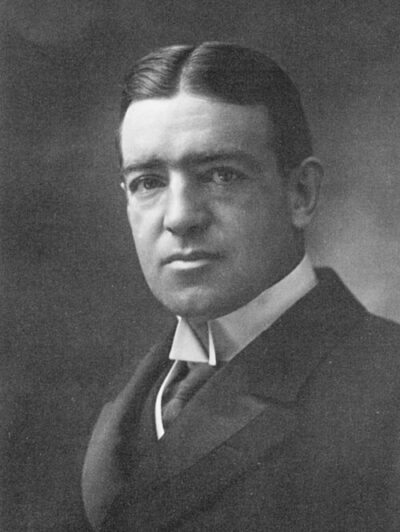
Ernest Shackleton
Ernest Shackleton was an Anglo-Irish Antarctic explorer. Born February 15, 1874, in Kilkea Castle. Died January 5, 1922, in Grytviken. Educated at Dulwich College and Brighton Grammar School. Awards include Officer of the Order of the British Empire, Officer of the Legion of Honour and Knight of the Order of the Polar Star.
Facts
40 facts · 2 confirmed by two sources · 7 cited · 31 from one source
Where this comes from
Papalocal keeps its own record. It started from these sources; what each one said is kept here as it was copied, so a change on their side never changes this page by itself. Tap one to read its version.
What Wikidata says · copied November 16, 2026 · revision 2567359683
- Described as
- Anglo-Irish Antarctic explorer (1874–1922)
- Other names
- Sir Ernest Henry Shackleton
- Born
- February 15, 1874 · 14 references
- Died
- January 5, 1922 · 11 references
- Born in
- Kilkea Castle
- Died in
- Grytviken · 1 reference
- Buried in
- Grytviken Cemetery
- Cause of death
- myocardial infarction · 2 references
- Citizen of
- United Kingdom of Great Britain and Ireland
- Occupation
- explorer; military officer; traveler; polar explorer · 1 reference; scientific collector · 1 reference
- Worked for
- Royal Scottish Geographical Society (1904–); The Royal Magazine
- Education
- Dulwich College; Brighton Grammar School
- Member of
- Royal Geographical Society
- Awards
- Officer of the Order of the British Empire (1919); Officer of the Legion of Honour (1909); Knight of the Order of the Polar Star (1909); Knight of the Order of the Dannebrog (1909); Knight of the Order of St. Olav (1909); Order of the Iron Crown (Kingdom of Italy); Order of Saint Anna; 3rd Class Order of the Crown; Commander of the Royal Victorian Order (1909); Polar Medal; Vega Medal (1910); Grande Médaille d'Or des Explorations (1910); Cullum Geographical Medal (1909); Constantin Medal; Hubbard Medal (1910)
- Spouse
- Emily Shackleton (1904–) · 2 references
- Children
- Edward Shackleton, Baron Shackleton · 1 reference; Raymond Shackleton; Cecily Jane Swinford Shackleton
- Mother
- Henrietta Letitia Sophia Gavan · 2 references
- Siblings
- Francis Richard Shackleton
- Military branch
- Royal Navy · 1 reference
- Military rank
- lieutenant · 1 reference
- Wikipedias with a page
- 76
Wikidata item Q957543 (wikidata.org/wiki/Q957543), public domain (CC0). Copied November 16, 2026.
What Wikipedia says · copied November 16, 2026 · revision 1385181816
Sir Ernest Henry Shackleton (15 February 1874 – 5 January 1922) was an Anglo-Irish Antarctic explorer who led three British expeditions to the Antarctic. He was one of the principal figures of the period known as the Heroic Age of Antarctic Exploration.
Born in Kilkea, County Kildare, Ireland, Shackleton and his Anglo-Irish family moved to Sydenham in suburban south London when he was ten. Shackleton's first experience of the polar regions was as third officer on Captain Robert Falcon Scott's Discovery expedition of 1901–1904, from which he was sent home early on health grounds, after he and his companions Scott and Edward Adrian Wilson set a new southern record by marching to latitude 82° S. During the Nimrod Expedition of 1907–1909, he and three companions established a new record Farthest South latitude of 88°23′ S, only 97 geographical miles (112 statute miles or 180 kilometres) from the South Pole, the largest advance to the pole in exploration history. Also, members of his team climbed Mount Erebus, the most active Antarctic volcano. On returning home, Shackleton was knighted for his achievements by King Edward VII.
After the race to the South Pole ended in December 1911, with Roald Amundsen's conquest, Shackleton turned his attention to the crossing of Antarctica from sea to sea, via the pole. To this end, he made preparations for what became the Imperial Trans-Antarctic Expedition of 1914–1917. The expedition was struck by disaster when its ship, Endurance, became trapped in pack ice and finally sank in the Weddell Sea off Antarctica on 21 November 1915. The crew escaped by camping on the sea ice until it disintegrated, then by launching the lifeboats to reach Elephant Island and ultimately the South Atlantic island of South Georgia, enduring a stormy ocean voyage of 720 nautical miles (1,330 km; 830 mi) in Shackleton's most famous exploit. He returned to the Antarctic with the Shackleton–Rowett Expedition in 1921 but died of a heart attack while his ship was moored in South Georgia. At his wife's request, he remained on the island and was buried in Grytviken cemetery. The wreck of Endurance was discovered just over a century after Shackleton's death.
Away from his expeditions, Shackleton's life was generally restless and unfulfilled. In his search for rapid pathways to wealth and security, he launched business ventures that failed to prosper, and he died heavily in debt. He was lauded in the press upon his death but was thereafter largely forgotten, while the heroic reputation of his rival Scott was sustained for many decades. Later in the 20th century, Shackleton was "rediscovered", and he became a role model for leadership in extreme circumstances. In his 1956 address to the British Science Association, one of Shackleton's contemporaries, Sir Raymond Priestley, said: "Scott for scientific method, Amundsen for speed and efficiency[,] but[,] when disaster strikes and all hope is gone, get down on your knees and pray for Shackleton", paraphrasing what Apsley Cherry-Garrard had written in a preface to his 1922 memoir The Worst Journey in the World. In 2002, Shackleton was voted eleventh in a BBC poll of the 100 Greatest Britons.
- Born, in its opening lines
- February 15, 1874
- Died, in its opening lines
- January 5, 1922
From the Wikipedia article “Ernest Shackleton” (en.wikipedia.org/wiki/Ernest_Shackleton), by its contributors, under CC BY-SA 4.0 (creativecommons.org/licenses/by-sa/4.0/). Copied November 16, 2026; not changed.
Confirmed Two sources agree. Cited One source, and it names where it got it. One source One source, without a reference of its own. Sources disagree The sources disagree. We show the best-supported value and keep theirs below.
