
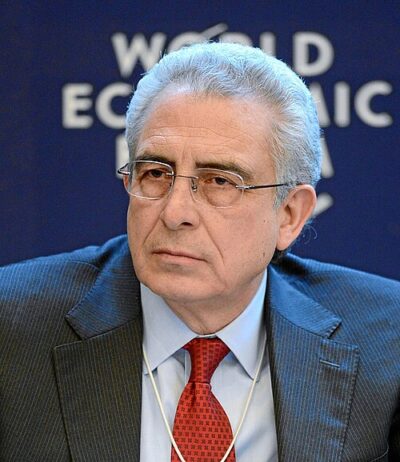
Ernesto Zedillo
Ernesto Zedillo is the 61st President of Mexico. Born December 27, 1951, in Mexico City. Positions held include President of Mexico (1994–2000), Secretariat of Public Education (1992–1993) and Mexico presidential candidate for the Revolutionary Institutional Party (1994). Educated at National Polytechnic Institute and Yale University. Awards include Collar of the Order of Isabella the Catholic, Four Freedoms Award – Freedom from Fear and Wilbur Cross Medal.
Facts
38 facts · 1 confirmed by two sources · 11 cited · 26 from one source
Where this comes from
Papalocal keeps its own record. It started from these sources; what each one said is kept here as it was copied, so a change on their side never changes this page by itself. Tap one to read its version.
What Wikidata says · copied November 16, 2026 · revision 2565847610
- Described as
- 61st President of Mexico
- Other names
- Ernesto Zedillo Ponce de León, Ernesto Zedillo Ponce de Leon
- Born
- December 27, 1951 · 6 references
- Born in
- Mexico City · 2 references
- Name at birth
- Ernesto Zedillo Ponce de León
- Citizen of
- Mexico
- Occupation
- economist · 1 reference; university teacher; author; politician · 1 reference
- Positions held
- President of Mexico (1994–2000); Secretariat of Public Education (1992–1993); Mexico presidential candidate for the Revolutionary Institutional Party (1994); education minister
- Political party
- Institutional Revolutionary Party; Party of the Mexican Revolution
- Worked for
- Yale University; National Polytechnic Institute · 1 reference; Citigroup
- Education
- National Polytechnic Institute; Yale University
- Member of
- Club of Rome; Group of Thirty · 1 reference; The Elders (2013–) · 1 reference
- Awards
- Collar of the Order of Isabella the Catholic (1996) · 1 reference; Four Freedoms Award – Freedom from Fear (2002) · 1 reference; Wilbur Cross Medal (2001) · 1 reference; Grand Cross of the Order of Merit of Hungary; Collar of the Order of the Cross of Terra Mariana (1995); Grand Collar of the Order of Prince Henry (1998) · 1 reference; Knight Grand Cross with Collar of the Order of Merit of the Italian Republic (1996) · 1 reference; honorary doctor of Harvard University (2003) · 1 reference; Collar of the Order of the Star of Romania; honorary doctor of the University of Miami (2002) · 1 reference; Grand Cross, Special Class of the Order of the Sun of Peru; Grand Cross with Collar of the Order of the White Rose of Finland (1999) · 1 reference; Order of Prince Yaroslav the Wise, 1st class; Medal of the Oriental Republic of Uruguay · 1 reference; Gold Olympic Order (1997)
- Lived in
- New Haven
- Wikipedias with a page
- 51
Wikidata item Q298149 (wikidata.org/wiki/Q298149), public domain (CC0). Copied November 16, 2026.
What Wikipedia says · copied November 16, 2026 · revision 1385087573
Ernesto Zedillo Ponce de León (Spanish pronunciation: [eɾˈnesto seˈðiʝo]; born 27 December 1951) is a Mexican economist and politician. He was the 61st president of Mexico from 1994 to 2000, as the last of the uninterrupted 71-year line of Mexican presidents from the Institutional Revolutionary Party (PRI).
During his presidency, he faced one of the worst economic crises in Mexico's history, which started only weeks after taking office. While he distanced himself from his predecessor Carlos Salinas de Gortari, blaming his administration for the crisis, and overseeing the arrest of Salinas' brother Raúl Salinas de Gortari, he continued the neoliberal policies of his two predecessors. His administration was also marked by renewed clashes with the EZLN and the Popular Revolutionary Army; the controversial implementation of Fobaproa to rescue the national banking system; a political reform that allowed residents of the Federal District (Mexico City) to elect their own mayor; the privatization of national railways and its subsequent suspension of the passenger rail service; and the Aguas Blancas and Acteal massacres perpetrated by State forces.
Although Zedillo's policies eventually led to a relative economic recovery, popular discontent with seven decades of PRI rule led to the party losing, for the first time, its legislative majority in the 1997 midterm elections, and in the 2000 general election the right-wing opposition National Action Party's candidate Vicente Fox won the Presidency of the Republic, putting an end to 71 years of uninterrupted PRI rule. Zedillo's admission of the PRI's defeat and his peaceful handing of power to his successor improved his image in the final months of his administration, and he left office with an approval rating of 60%.
Since the end of his term as president, Zedillo has been a leading voice on globalization, especially its impact on relations between developed and developing nations. He is currently the director of the Center for the Study of Globalization at Yale University and is on the board of directors at the Inter-American Dialogue and Citigroup.
- Born, in its opening lines
- December 27, 1951
From the Wikipedia article “Ernesto Zedillo” (en.wikipedia.org/wiki/Ernesto_Zedillo), by its contributors, under CC BY-SA 4.0 (creativecommons.org/licenses/by-sa/4.0/). Copied November 16, 2026; not changed.
Confirmed Two sources agree. Cited One source, and it names where it got it. One source One source, without a reference of its own. Sources disagree The sources disagree. We show the best-supported value and keep theirs below.
