
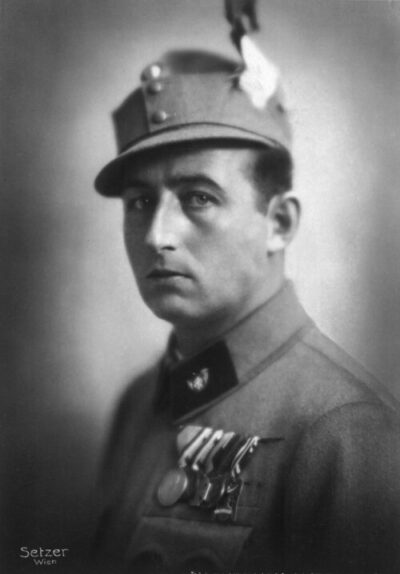
Ernst Rüdiger Starhemberg
Ernst Rüdiger Starhemberg was an Austrian politician and nobleman. Born May 10, 1899, in Eferding. Died March 15, 1956, in Schruns. Positions held include member of the National Council of Austria.
Facts
18 facts · 2 confirmed by two sources · 10 cited · 6 from one source
Where this comes from
Papalocal keeps its own record. It started from these sources; what each one said is kept here as it was copied, so a change on their side never changes this page by itself. Tap one to read its version.
What Wikidata says · copied November 18, 2026 · revision 2568995656
- Described as
- Austrian politician and nobleman (1899-1956)
- Other names
- Ernst Rüdiger von Starhemberg, Ernst Rudiger Starhemberg
- Born
- May 10, 1899 · 9 references
- Died
- March 15, 1956 · 7 references
- Born in
- Eferding · 2 references
- Died in
- Schruns · 2 references
- Citizen of
- Austria · 1 reference
- Occupation
- politician · 1 reference
- Positions held
- member of the National Council of Austria
- Political party
- Heimatblock; Fatherland Front
- Member of
- Corps Rhaetia-Innsbruck zu Augsburg; Freikorps Oberland · 1 reference
- Spouse
- Nora Gregor (1937–1949) · 1 reference
- Children
- Heinrich Rüdiger Fürst von Starhemberg · 1 reference
- Father
- Ernst Rüdiger von Starhemberg · 1 reference
- Mother
- Fanny von Starhemberg · 1 reference
- Siblings
- Sophie von Starhemberg · 1 reference; Georg von Starhemberg · 1 reference
- Religion
- Catholic · 1 reference
- Wikipedias with a page
- 22
Wikidata item Q78664 (wikidata.org/wiki/Q78664), public domain (CC0). Copied November 18, 2026.
What Wikipedia says · copied November 18, 2026 · revision 1381155369
Prince Ernst Rüdiger Camillo von Starhemberg, often known simply as Prince Starhemberg (10 May 1899 – 15 March 1956), was an Austrian nationalist and politician who helped introduce the dictatorial conservative Ständestaat in Austria during the interwar period. A fierce opponent of Anschluss, he fled Austria when the Nazis invaded the country and briefly served with the Free French and British forces in World War II.
Starhemberg was a leader of the Heimwehr and later of the Fatherland Front. He served in the Bundesrat between 1920 and 1930, as Minister of Interior in 1930, Vice-Chancellor in 1934 and subsequently Acting Chancellor and Leader of the Front after the murder of Engelbert Dollfuß, relinquishing the former position after a few days. Disenchanted by the moderate ways of Chancellor Kurt Schuschnigg, he was ousted from power in 1936, when the Heimwehr was dissolved, and fled the country after the Anschluss to avoid retaliation from vengeful Nazis.
Starhemberg lived in exile in Switzerland and served with the western Allies in the British and Free French Air Forces for a short period at the beginning of World War II, but became disenchanted with them when they entered into an alliance with Joseph Stalin's Soviet Union, which he viewed as equally evil as the Nazis. He left for Argentina where he spent the next thirteen years in exile. He died during an extended visit to Austria in 1956.
He was the 1,163rd Knight of the Order of the Golden Fleece, Austrian Order.
- Born, in its opening lines
- May 10, 1899
- Died, in its opening lines
- March 15, 1956
From the Wikipedia article “Ernst Rüdiger Starhemberg” (en.wikipedia.org/wiki/Ernst_Rüdiger_Starhemberg), by its contributors, under CC BY-SA 4.0 (creativecommons.org/licenses/by-sa/4.0/). Copied November 18, 2026; not changed.
Confirmed Two sources agree. Cited One source, and it names where it got it. One source One source, without a reference of its own. Sources disagree The sources disagree. We show the best-supported value and keep theirs below.
