
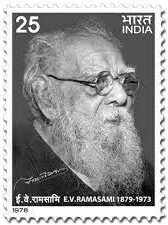
Erode Venkatappa Ramasamy
Erode Venkatappa Ramasamy was an Indian social reformer. Born September 17, 1879, in Erode. Died December 24, 1973, in Vellore.
Facts
13 facts · 2 confirmed by two sources · 2 cited · 9 from one source
Where this comes from
Papalocal keeps its own record. It started from these sources; what each one said is kept here as it was copied, so a change on their side never changes this page by itself. Tap one to read its version.
What Wikidata says · copied November 16, 2026 · revision 2554082574
- Described as
- Indian social reformer (1879-1973)
- Other names
- Periyappa, LK Baal, Periyar E. V. Ramasamy, Erode Venkata Ramasamy Naicker
- Born
- September 17, 1879 · 1 reference
- Died
- December 24, 1973
- Born in
- Erode · 1 reference
- Died in
- Vellore
- Citizen of
- British Raj (–1947); India (1950–) · 1 reference
- Occupation
- politician
- Political party
- Indian National Congress (1919–1925); Justice Party (1925–1944); Dravidar Kazhagam (1944–)
- Spouse
- Maniammai (1948–); Nagammai
- Religion
- atheism
- Wikipedias with a page
- 33
Wikidata item Q737280 (wikidata.org/wiki/Q737280), public domain (CC0). Copied November 16, 2026.
What Wikipedia says · copied November 16, 2026 · revision 1382661769
Erode Venkatappa Ramasamy (17 September 1879 – 24 December 1973), commonly known as Periyar, was an Indian social activist and politician. He was the organiser of the Self-Respect Movement and Dravidar Kazhagam and is considered the architect of Dravidian politics, as well as a leading figure of left-wing politics in India.
Periyar joined the Indian National Congress in 1919 and participated in the Vaikom Satyagraha, during which he was imprisoned twice. He resigned from the Congress in 1925. From 1929 to 1932, he toured British Malaya, Europe and the Soviet Union which later influenced his Self-Respect Movement in favour of caste equality. In 1939, he became the head of the Justice Party, which he transformed into a social organisation named Dravidar Kazhagam in 1944. The party later split, with one group led by C. N. Annadurai forming the Dravida Munnetra Kazhagam (DMK) in 1949. While continuing the Self-Respect Movement, he advocated for an independent Dravida Nadu (land of the Dravidians).
Periyar promoted the principles of rationalism, self-respect, women's rights and eradication of the caste system. He opposed the exploitation and marginalisation of the non-Brahmin Dravidian people of South India and the imposition of what he considered Indo-Aryan India. His campaigns were often critical of the caste system, and he frequently targeted Brahmins directly. Since 2021, the Indian state of Tamil Nadu celebrates his birth anniversary as 'Social Justice Day'.
- Born, in its opening lines
- September 17, 1879
- Died, in its opening lines
- December 24, 1973
From the Wikipedia article “Periyar” (en.wikipedia.org/wiki/Periyar), by its contributors, under CC BY-SA 4.0 (creativecommons.org/licenses/by-sa/4.0/). Copied November 16, 2026; not changed.
Confirmed Two sources agree. Cited One source, and it names where it got it. One source One source, without a reference of its own. Sources disagree The sources disagree. We show the best-supported value and keep theirs below.
