
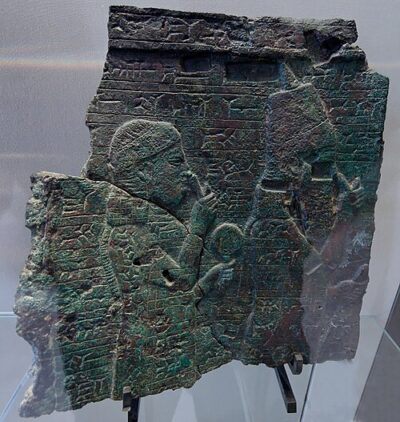
Esarhaddon
Esarhaddon was a King of Assyria (8th cenutury BCE – 669 BCE). Born 8th century BC. Died October 26, 669 BC, in Harran. Positions held include King of Assyria (-681–-669) and King of Babylon (-681–-669).
Facts
15 facts · 0 confirmed by two sources · 2 cited · 13 from one source
Where this comes from
Papalocal keeps its own record. It started from these sources; what each one said is kept here as it was copied, so a change on their side never changes this page by itself. Tap one to read its version.
What Wikidata says · copied November 16, 2026 · revision 2566534860
- Described as
- King of Assyria (8th cenutury BCE – 669 BCE)
- Other names
- Esar-haddon, Aššur-aḫa-iddina, Asarhadon
- Born
- 8th century BC
- Died
- October 26, 669 BC · 1 reference
- Died in
- Harran
- Citizen of
- Assyrian Empire; Babylon
- Occupation
- sovereign
- Positions held
- King of Assyria (-681–-669); King of Babylon (-681–-669)
- Spouse
- Ešar-ḫamat · 1 reference
- Children
- Shamash-shum-ukin; Ashurbanipal; Serua-eterat
- Father
- Sennacherib
- Mother
- Naqi'a · 1 reference
- Siblings
- Serua-eterat
- Wikipedias with a page
- 52
Wikidata item Q193912 (wikidata.org/wiki/Q193912), public domain (CC0). Copied November 16, 2026.
What Wikipedia says · copied November 16, 2026 · revision 1383235590
Esarhaddon, also spelled Essarhaddon, Assarhaddon and Ashurhaddon (Neo-Assyrian Akkadian: 𒀭𒊹𒉽𒀸, also 𒀭𒊹𒉽𒋧𒈾 Aššur-aḫa-iddina, meaning "Ashur has given me a brother"; Biblical Hebrew: אֵסַר־חַדֹּן ʾĒsar-Ḥaddōn) was the king of the Neo-Assyrian Empire from 681 to 669 BC. The third king of the Sargonid dynasty, Esarhaddon is most famous for his conquest of Egypt in 671 BC, which made his empire the largest the world had ever seen, and for his reconstruction of Babylon, which had been destroyed by his father.
After Sennacherib's eldest son and heir Aššur-nādin-šumi had been captured and presumably executed in 694, the new heir had originally been the second eldest son, Arda-Mulissu, but in 684, Esarhaddon, a younger son, was appointed instead. Angered by this decision, Arda-Mulissu and another brother, Nabû-šarru-uṣur, murdered their father in 681 and planned to seize the Neo-Assyrian throne. The murder, and Arda-Mulissu's aspirations of becoming king himself, made Esarhaddon's rise to the throne difficult, and he first had to defeat his brothers in a six-week-long civil war.
His brothers' attempted coup had been unexpected and troublesome for Esarhaddon, and he would be plagued by paranoia and mistrust for his officials, governors and male family members until the end of his reign. As a result of this paranoia, most of the palaces used by Esarhaddon were high-security fortifications located outside of the major population centers of the cities. Also perhaps resulting from his mistrust for his male relatives, Esarhaddon's female relatives, such as his mother Naqiʾa and his daughter Šērūʾa-ēṭirat, were allowed to wield considerably more influence and political power during his reign than women had been allowed in any previous period of Assyrian history, with the possible exception of Sammuramat in the 9th century BC.
Despite a relatively short and difficult reign, and being plagued by paranoia, depression and constant illness, Esarhaddon remains recognized as one of the greatest and most successful Assyrian kings. He quickly defeated his brothers in 681, completed ambitious and large-scale building projects in both Assyria and Babylonia, successfully campaigned in Media, Persia, Elam, the Arabian Peninsula, Anatolia, the Caucasus, and the Levant, defeated the Kushite Empire and conquered Egypt and Libya, enforced a vassal treaty upon the Medes and Persians and ensured a peaceful transition of power to his two sons and heirs Ashurbanipal as ruler of the empire and Šamaš-šuma-ukin as king of Babylonia after his death.
From the Wikipedia article “Esarhaddon” (en.wikipedia.org/wiki/Esarhaddon), by its contributors, under CC BY-SA 4.0 (creativecommons.org/licenses/by-sa/4.0/). Copied November 16, 2026; not changed.
Confirmed Two sources agree. Cited One source, and it names where it got it. One source One source, without a reference of its own. Sources disagree The sources disagree. We show the best-supported value and keep theirs below.
