
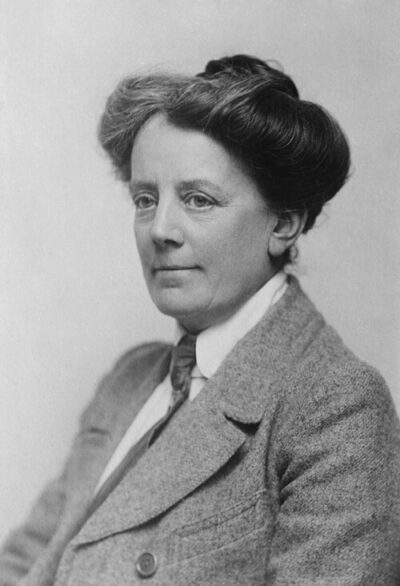
Ethel Smyth
Ethel Smyth was an English composer and suffragette. Born April 22, 1858, in Sidcup. Died May 8, 1944, in Woking. Known for Der Wald, The March of the Women and The Boatswain's Mate. Educated at University of Music and Theatre Leipzig. Awards include Dame Commander of the Order of the British Empire, honorary doctor of the University of St Andrews and honorary doctor of Durham University.
Facts
35 facts · 2 confirmed by two sources · 11 cited · 22 from one source
Where this comes from
Papalocal keeps its own record. It started from these sources; what each one said is kept here as it was copied, so a change on their side never changes this page by itself. Tap one to read its version.
What Wikidata says · copied November 16, 2026 · revision 2568773977
- Described as
- English composer and suffragette (1858–1944)
- Other names
- Dame Ethel Mary Smyth, Dame Ethel Smyth, Ethel Smith, Ethel Mary Smyth
- Born
- April 22, 1858 · 6 references
- Died
- May 8, 1944 · 6 references
- Born in
- Sidcup
- Died in
- Woking · 2 references
- Buried in
- Woking · 1 reference
- Name at birth
- Ethel Mary Smyth
- Citizen of
- United Kingdom
- Occupation
- composer · 2 references; librettist; conductor; autobiographer · 1 reference; suffragist · 1 reference; women's rights activist; suffragette; nurse · 1 reference
- Education
- University of Music and Theatre Leipzig (1877–1878) · 2 references
- Member of
- Women's Social and Political Union · 1 reference
- Genre
- opera
- Known for
- Der Wald; The March of the Women · 1 reference; The Boatswain's Mate · 1 reference; The Prison; Mass in D; Fête Galante; Piano Trio; The Wreckers
- Awards
- Dame Commander of the Order of the British Empire (1922) · 1 reference; honorary doctor of the University of St Andrews (1928); honorary doctor of Durham University (1910); Honorary doctor of the University of Oxford
- Field
- music composing
- Father
- John Hall Smyth · 1 reference
- Mother
- Emma Struth · 1 reference
- Siblings
- Mary Smyth Hunter
- Website
- https://www.ethelsmyth.org
- Wikipedias with a page
- 37
Wikidata item Q236599 (wikidata.org/wiki/Q236599), public domain (CC0). Copied November 16, 2026.
What Wikipedia says · copied November 16, 2026 · revision 1382612889
Dame Ethel Mary Smyth (; 22 April 1858 – 8 May 1944) was an English composer and a member of the women's suffrage movement. Her compositions include songs, works for piano, chamber music, orchestral works, choral works and operas.
Smyth tended to be marginalised as a "woman composer", as though her work could not be accepted as mainstream. Yet when she produced more delicate compositions, they were criticised for not measuring up to the standard of her male peers. She was the first female composer granted a damehood.
Smyth was involved in the suffrage movement and spent time in Holloway Prison for breaking windows. She also composed the suffragette anthem The March of the Women.
- Born, in its opening lines
- April 22, 1858
- Died, in its opening lines
- May 8, 1944
From the Wikipedia article “Ethel Smyth” (en.wikipedia.org/wiki/Ethel_Smyth), by its contributors, under CC BY-SA 4.0 (creativecommons.org/licenses/by-sa/4.0/). Copied November 16, 2026; not changed.
Confirmed Two sources agree. Cited One source, and it names where it got it. One source One source, without a reference of its own. Sources disagree The sources disagree. We show the best-supported value and keep theirs below.
