
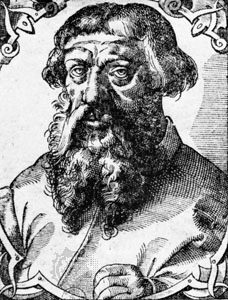
Étienne Dolet
Étienne Dolet was a French translator and scholar. Born August 3, 1509, in Orléans. Died August 3, 1546, in Paris. Educated at University of Toulouse (1896-1968) and University of Padua.
Facts
20 facts · 2 confirmed by two sources · 5 cited · 13 from one source
Where this comes from
Papalocal keeps its own record. It started from these sources; what each one said is kept here as it was copied, so a change on their side never changes this page by itself. Tap one to read its version.
What Wikidata says · copied November 17, 2026 · revision 2564793665
- Described as
- French translator and scholar (1509-1546)
- Other names
- Etienne Dolet
- Born
- August 3, 1509 · 1 reference
- Died
- August 3, 1546 · 1 reference
- Born in
- Orléans · 1 reference
- Died in
- Paris · 1 reference
- Cause of death
- death by burning
- Citizen of
- France
- Occupation
- linguist; translator · 1 reference; publisher; poet · 1 reference; classical scholar; Romanist; latinist; printer · 3 references
- Education
- University of Toulouse (1896-1968); University of Padua
- Field
- philology; theology; translation
- Spouse
- Louise Giraud
- Wikipedias with a page
- 25
Wikidata item Q1248100 (wikidata.org/wiki/Q1248100), public domain (CC0). Copied November 17, 2026.
What Wikipedia says · copied November 17, 2026 · revision 1383488438
Étienne Dolet (French: [etjɛn dɔlɛ]; 3 August 1509 – 3 August 1546) was a French scholar, translator and printer. He was a controversial figure throughout his lifetime, which was buffeted by the opposing forces of the Renaissance and the French Inquisition. His early attacks upon the Inquisition and the municipal authorities of Toulouse, together with his later publications in Lyon, caused the French Inquisition to monitor his activities closely.
After several stays in prison, the combined efforts of the parlement of Paris, the Inquisition, and the theological faculty of the Sorbonne resulted in his conviction for heresy and a death sentence. He was hanged and burned with his books on the Place Maubert in Paris. In modern times, Dolet is remembered as a martyr for what is now known as freedom of speech and freedom of the press.
- Born, in its opening lines
- August 3, 1509
- Died, in its opening lines
- August 3, 1546
From the Wikipedia article “Étienne Dolet” (en.wikipedia.org/wiki/Étienne_Dolet), by its contributors, under CC BY-SA 4.0 (creativecommons.org/licenses/by-sa/4.0/). Copied November 17, 2026; not changed.
Confirmed Two sources agree. Cited One source, and it names where it got it. One source One source, without a reference of its own. Sources disagree The sources disagree. We show the best-supported value and keep theirs below.
