
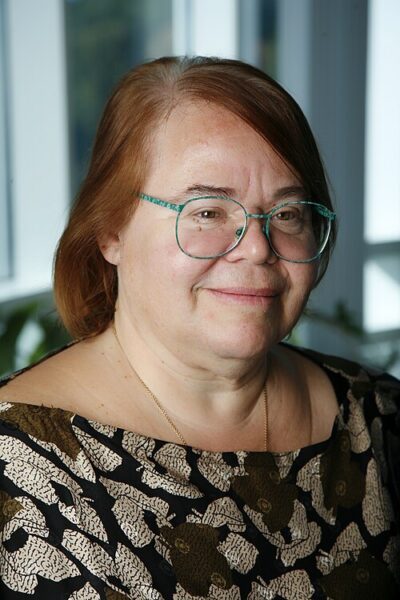
Eve Marder is an American neuroscientist. Born May 30, 1948, in New York City. Educated at Brandeis University and University of California, San Diego. Awards include Gruber Prize in Neuroscience, Kavli Prize in Neuroscience and Karl Spencer Lashley Award.
Facts
19 facts · 0 confirmed by two sources · 7 cited · 12 from one source
Where this comes from
Papalocal keeps its own record. It started from these sources; what each one said is kept here as it was copied, so a change on their side never changes this page by itself. Tap one to read its version.
What Wikidata says · copied November 19, 2026 · revision 2513820568
- Described as
- American neuroscientist
- Other names
- E. Marder, E Marder, Marder, Marder E, Marder E.
- Born
- May 30, 1948
- Born in
- New York City
- Citizen of
- United States
- Occupation
- neuroscientist
- Worked for
- Brandeis University · 1 reference
- Education
- Brandeis University; University of California, San Diego (–1974) · 1 reference; Irvington High School · 1 reference
- Member of
- National Academy of Sciences (2007–) · 1 reference; American Academy of Arts and Sciences
- Awards
- Gruber Prize in Neuroscience (2013); Kavli Prize in Neuroscience (2016); Karl Spencer Lashley Award (2012) · 1 reference; Mika Salpeter Lifetime Achievement Award (2002) · 1 reference; Ralph W. Gerard Prize (2005) · 1 reference; Honorary doctor of the University of Liège (2023) · 1 reference; National Medal of Science (2022); NAS Award in the Neurosciences (2019) · 1 reference
- Field
- neuroscience · 1 reference
- Wikipedias with a page
- 11
Wikidata item Q5416184 (wikidata.org/wiki/Q5416184), public domain (CC0). Copied November 19, 2026.
What Wikipedia says · copied November 19, 2026 · revision 1379601591
Eve Marder is a University Professor and the Victor and Gwendolyn Beinfield Professor of Neuroscience at Brandeis University. At Brandeis, Marder is also a member of the Volen National Center for Complex Systems. Dr. Marder is known for her pioneering work on small neuronal networks which her team has interrogated via a combination of complementary experimental and theoretical techniques.
Marder is particularly well known in the community for her work on neural circuits in the crustacean stomatogastric nervous system (STNS), a small network of 30 neurons. She discovered that circuits are not “hard-wired” to produce a single output or behavior, but can be reconfigured by neuromodulators to produce many outputs and behaviors while still maintaining the integrity of the circuit. Her work has revolutionized the way scientists approach the studies of neural circuits with respect to the study of structural and functional behavior. The general principles that have resulted from her work are thought to be generally applicable to other neural networks, including those in humans. Marder has published 190 original research papers in refereed journals, and 179 review articles, book chapters, and opinion pieces.
Marder has received numerous awards for her pioneering work in the field including the National Medal of Science in 2023 and the Kavli Prize in 2016. She was also recognized as an outstanding woman scientist and was awarded the Pearl Meister Greengard Prize in 2023. In 2024, she was elected to the American Philosophical Society, and currently holds memberships in the Institute of Medicine, and National Academy of Sciences.
From the Wikipedia article “Eve Marder” (en.wikipedia.org/wiki/Eve_Marder), by its contributors, under CC BY-SA 4.0 (creativecommons.org/licenses/by-sa/4.0/). Copied November 19, 2026; not changed.
Confirmed Two sources agree. Cited One source, and it names where it got it. One source One source, without a reference of its own. Sources disagree The sources disagree. We show the best-supported value and keep theirs below.
