
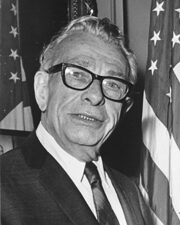
Everett Dirksen
Everett Dirksen was an American politician. Born January 4, 1896, in Pekin. Died September 7, 1969, in Washington, D.C.. Positions held include United States representative (1933–1949), United States senator (1951–1969) and senator. Educated at University of Minnesota Law School and primary school.
Facts
20 facts · 2 confirmed by two sources · 9 cited · 9 from one source
Where this comes from
Papalocal keeps its own record. It started from these sources; what each one said is kept here as it was copied, so a change on their side never changes this page by itself. Tap one to read its version.
What Wikidata says · copied November 15, 2026 · revision 2567315177
- Described as
- American politician (1896–1969)
- Other names
- Everett M. Dirksen, Everett McKinley Dirksen
- Born
- January 4, 1896 · 5 references
- Died
- September 7, 1969 · 4 references
- Born in
- Pekin · 1 reference
- Died in
- Washington, D.C. · 1 reference
- Buried in
- Glendale Memorial Gardens · 1 reference
- Cause of death
- lung cancer
- Citizen of
- United States
- Occupation
- politician · 1 reference; entrepreneur (1922–1925); commissioner (1927–1931); lawyer
- Positions held
- United States representative (1933–1949); United States senator (1951–1969) · 1 reference; senator · 1 reference
- Political party
- Republican Party
- Education
- University of Minnesota Law School; primary school
- Military branch
- United States Army · 1 reference
- Military rank
- senior lieutenant · 1 reference; Private · 1 reference
- Wikipedias with a page
- 26
Wikidata item Q1382002 (wikidata.org/wiki/Q1382002), public domain (CC0). Copied November 15, 2026.
What Wikipedia says · copied November 15, 2026 · revision 1385902918
Everett McKinley Dirksen (January 4, 1896 – September 7, 1969) was an American politician. A Republican, he represented Illinois in the United States House of Representatives and the United States Senate. As Senate Minority Leader from 1959 until his death in 1969, he played a highly visible and key role in the politics of the 1960s. He helped write and pass the Civil Rights Act of 1964 and the Civil Rights Act of 1968, both landmark pieces of legislation during the civil rights movement. He was also one of the Senate's strongest supporters of the Vietnam War. A talented orator with a florid style and a notably rich bass voice, he delivered flamboyant speeches that caused his detractors to refer to him as "The Wizard of Ooze".
Born in Pekin, Illinois, Dirksen served as an artillery officer during World War I and opened a bakery after the war. After serving on the Pekin City Council, he won election to the House of Representatives in 1932. In the House, he was considered a moderate and supported much of the New Deal; he became more conservative and isolationist over time, but reversed himself to support US involvement in World War II. He won election to the Senate in 1950, unseating Senate Majority Leader Scott W. Lucas. In the Senate, he favored conservative economic policies and supported the internationalism of President Dwight D. Eisenhower. Dirksen succeeded William F. Knowland as Senate Minority Leader after the latter declined to seek re-election in 1958.
As the Senate Minority Leader, Dirksen emerged as a prominent national figure of the Republican Party during the 1960s. He developed a good working relationship with Senate Majority Leader Mike Mansfield and supported President Lyndon B. Johnson's handling of the Vietnam War. He helped break the Southern filibuster of the Civil Rights Act of 1964. While still serving as Senate Minority Leader, Dirksen died in 1969.
The Dirksen Senate Office Building at the Capitol Building in Washington, and the Dirksen United States Courthouse in central Chicago are named for him.
- Born, in its opening lines
- January 4, 1896
- Died, in its opening lines
- September 7, 1969
From the Wikipedia article “Everett Dirksen” (en.wikipedia.org/wiki/Everett_Dirksen), by its contributors, under CC BY-SA 4.0 (creativecommons.org/licenses/by-sa/4.0/). Copied November 15, 2026; not changed.
Confirmed Two sources agree. Cited One source, and it names where it got it. One source One source, without a reference of its own. Sources disagree The sources disagree. We show the best-supported value and keep theirs below.
