
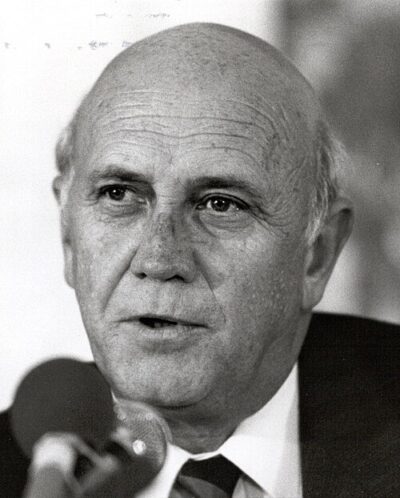
F. W. de Klerk
F. W. de Klerk was the 7th state president of South Africa from 1989 to 1994. Born March 18, 1936, in Johannesburg. Died November 11, 2021, in Cape Town. Positions held include State President of South Africa (1989–1994), Deputy President of South Africa (1994–1996) and Minister of Education (1984–1989). Educated at Potchefstroom University for Christian Higher Education and North-West University. Awards include Nobel Peace Prize, Félix Houphouët-Boigny Peace Prize and Princess of Asturias Award for International Cooperation.
Facts
38 facts · 2 confirmed by two sources · 11 cited · 25 from one source
Where this comes from
Papalocal keeps its own record. It started from these sources; what each one said is kept here as it was copied, so a change on their side never changes this page by itself. Tap one to read its version.
What Wikidata says · copied November 16, 2026 · revision 2568256684
- Described as
- 7th state president of South Africa from 1989 to 1994
- Other names
- Frederik Willem de Klerk, Frederick W. De Klerk, Frederick De Klerk, F W de Klerk, FW de Klerk
- Born
- March 18, 1936 · 3 references
- Died
- November 11, 2021 · 2 references
- Born in
- Johannesburg · 1 reference
- Died in
- Cape Town · 1 reference
- Cause of death
- mesothelioma · 1 reference
- Citizen of
- South Africa · 1 reference
- Occupation
- politician · 2 references; lawyer · 1 reference; minister · 1 reference
- Positions held
- State President of South Africa (1989–1994); Deputy President of South Africa (1994–1996); Minister of Education (1984–1989); Minister of Home Affairs of South Africa (1982–1985); Minister of Energy (1979–1982); Minister of Sport and Recreation (1978–1979); Minister of Social Development (1978)
- Political party
- National Party (1972–2004)
- Education
- Potchefstroom University for Christian Higher Education; North-West University · 1 reference; Goodenough College
- Member of
- American Philosophical Society · 1 reference
- Awards
- Nobel Peace Prize (1993) · 2 references; Félix Houphouët-Boigny Peace Prize (1991) · 1 reference; Princess of Asturias Award for International Cooperation (1992); Philadelphia Liberty Medal; James Joyce Awards; honorary doctorate of Haifa University; Order of Mapungubwe in Gold (2002); honorary doctorate of the Vrije Universiteit Brussel (1993) · 1 reference; Order of Good Hope · 1 reference; Princess of Asturias Awards · 1 reference
- Spouse
- Marike de Klerk (1959–1998); Elita Georgiades (1998–2021)
- Father
- Johannes de Klerk
- Mother
- Corrie Coetzer · 1 reference
- Siblings
- Wimpie de Klerk
- Religion
- Reformed Church
- Website
- http://fwdeklerk.org
- Wikipedias with a page
- 91
Wikidata item Q151813 (wikidata.org/wiki/Q151813), public domain (CC0). Copied November 16, 2026.
What Wikipedia says · copied November 16, 2026 · revision 1381004070
Frederik Willem de Klerk (18 March 1936 – 11 November 2021) was a South African politician who served as the final apartheid state president of South Africa from 1989 to 1994 and as deputy president from 1994 to 1996. As South Africa's last head of state from the era of white-minority rule, he and his government dismantled the apartheid system and introduced universal suffrage. Ideologically a social conservative and an economic liberal, he led the National Party (NP) from 1989 to 1997.
Born in Johannesburg to an influential Afrikaner family, de Klerk studied at Potchefstroom University before pursuing a career in law. Joining the NP, to which he had family ties, he was elected to parliament and sat in the white-minority government of P. W. Botha, holding a succession of ministerial posts. As a minister, he supported and enforced apartheid, a system of racial segregation that privileged white South Africans. After Botha resigned in 1989, de Klerk replaced him, first as leader of the NP and then as State President. Although observers expected him to continue Botha's defence of apartheid, de Klerk decided to end the policy. He was aware that growing ethnic animosity and violence was leading South Africa into a racial civil war. Amid this violence, the state security forces committed widespread human rights abuses and encouraged violence between the Xhosa and Zulu people, although de Klerk later denied sanctioning such actions. He permitted anti-apartheid marches to take place, legalised a range of previously banned anti-apartheid political parties, and freed imprisoned anti-apartheid activists such as Nelson Mandela. He also dismantled South Africa's nuclear weapons program.
De Klerk negotiated with Mandela to fully dismantle apartheid and establish a transition to universal suffrage. In 1993, he publicly apologised for apartheid's harmful effects. He oversaw the 1994 non-racial election in which Mandela led the African National Congress (ANC) to victory; de Klerk's NP took second place. Along with Thabo Mbeki, De Klerk then became one of the two deputy presidents in Mandela's ANC-led coalition, the Government of National Unity. In this position, de Klerk supported the government's continued liberal economic policies but opposed the Truth and Reconciliation Commission set up to investigate past human rights abuses; instead, he wanted total amnesty for political crimes. His working relationship with Mandela was strained, although he later spoke fondly of him. In May 1996, after the NP objected to the new constitution, de Klerk withdrew it from the coalition government. His party disbanded the following year and reformed as the New National Party. In 1997, de Klerk retired from active politics and thereafter lectured internationally.
De Klerk was a controversial figure. He received many awards—for instance sharing the Nobel Peace Prize with Mandela—for his role in dismantling apartheid and bringing universal suffrage to South Africa. Conversely, anti-apartheid activists criticised him for offering only a qualified apology for apartheid and for ignoring the human rights abuses of his state security forces, while pro-apartheid supporters contended that by abandoning apartheid, he betrayed the interests of the country's Afrikaner minority.
- Born, in its opening lines
- March 18, 1936
- Died, in its opening lines
- November 11, 2021
From the Wikipedia article “F. W. de Klerk” (en.wikipedia.org/wiki/F._W._de_Klerk), by its contributors, under CC BY-SA 4.0 (creativecommons.org/licenses/by-sa/4.0/). Copied November 16, 2026; not changed.
Confirmed Two sources agree. Cited One source, and it names where it got it. One source One source, without a reference of its own. Sources disagree The sources disagree. We show the best-supported value and keep theirs below.
