
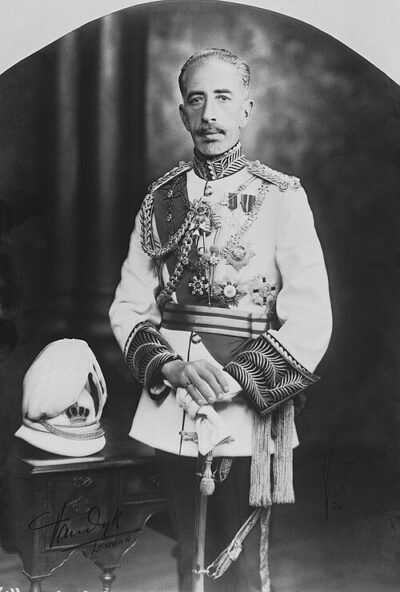
Faisal I of Iraq
Faisal I of Iraq was the 1st king of Hashemite Iraq from 1921 to 1933. Born May 20, 1885, in Mecca. Died September 8, 1933, in Bern. Positions held include King of Iraq (1921–1933). Awards include Grand Order of the Hashimites, Order of the Two Rivers and Royal Victorian Chain.
Facts
37 facts · 2 confirmed by two sources · 7 cited · 28 from one source
Where this comes from
Papalocal keeps its own record. It started from these sources; what each one said is kept here as it was copied, so a change on their side never changes this page by itself. Tap one to read its version.
What Wikidata says · copied November 16, 2026 · revision 2563082133
- Described as
- 1st king of Hashemite Iraq from 1921 to 1933
- Other names
- Faisal I, Faisal bin Husain, Faisal bun Hussein, Faisal I bin Al-Hussein bin Ali Al-Hashemi
- Born
- May 20, 1885 · 1 reference
- Died
- September 8, 1933 · 1 reference
- Born in
- Mecca · 2 references
- Died in
- Bern · 1 reference
- Buried in
- Iraq Royal Cemetery · 1 reference
- Cause of death
- heart failure
- Citizen of
- Ottoman Empire (–1918); Arab Kingdom of Syria (1918–1920); Kingdom of Iraq (1921–)
- Occupation
- politician · 1 reference; military personnel · 1 reference; king · 1 reference
- Positions held
- King of Iraq (1921–1933)
- Awards
- Grand Order of the Hashimites; Order of the Two Rivers; Royal Victorian Chain; Supreme Order of the Renaissance; Order of Pahlavi; Order of Muhammad Ali; Grand Cordon of the Order of Leopold; Grand Cross of the Legion of Honour; Knight Grand Cross of the Order of St Michael and St George; Knight Grand Cross of the Order of the Bath; Knight grand cross of the order of the crown of Italy
- Field
- politics · 1 reference; governance · 1 reference
- Spouse
- Huzaima bint Nasser (1904–)
- Children
- Princess Azza of Iraq; Princess Rajiha of Iraq; Princess Rafia of Iraq; Ghazi of Iraq
- Father
- Hussein bin Ali
- Mother
- Abdiya bint Abdullah · 1 reference
- Siblings
- Ali of Hejaz; Abdullah I of Jordan; Prince Zeid bin Hussein
- Religion
- Islam
- Wikipedias with a page
- 72
Wikidata item Q212486 (wikidata.org/wiki/Q212486), public domain (CC0). Copied November 16, 2026.
What Wikipedia says · copied November 16, 2026 · revision 1382199354
Faisal I bin Hussein bin Ali al-Hashimi (Arabic: فيصل بن حسين بن علي الهاشمي, romanized: Fayṣal bin Ḥusayn bin ʻAlī al-Hāshimī; 20 May 1885 – 8 September 1933) was a Hejazi statesman who served as the King of Iraq from 23 August 1921 until his death in 1933. A member of the Hashemite family, he was a leader of the Great Arab Revolt during the First World War, and ruled as the unrecognized King of the Arab Kingdom of Syria from March to July 1920 when he was expelled by the French.
The third son of Hussein bin Ali, the Grand Emir and Sharif of Mecca, Faisal was born in Mecca and raised in Istanbul. From 1916 to 1918, with British assistance, he played a major role in the revolt against the Ottoman Empire. He helped set up an Arab government in Syria, based in Damascus, and led the Arab delegation at the Paris Peace Conference in 1919. In 1920, the Syrian National Congress proclaimed Faisal king, rejecting the French claim to a Mandate for Syria. In response, France invaded a few months later, abolished the kingdom and forced him into exile.
In August 1921, in accordance with the decision made at the Cairo Conference, the British arranged for Faisal to become king of a new Kingdom of Iraq under British administration. During his reign, Faisal fostered unity between Sunni Muslims and Shia Muslims to encourage common loyalty and promote pan-Arabism in the goal of creating an Arab state that would include Iraq, Syria and the rest of the Fertile Crescent. In 1932, he presided over the independence of the Kingdom of Iraq upon the end of the British Mandate and the country's entry into the League of Nations. Faisal died of a heart attack in 1933 in Bern, Switzerland, at the age of 48 and was succeeded by his eldest son Ghazi.
- Born, in its opening lines
- May 20, 1885
- Died, in its opening lines
- September 8, 1933
From the Wikipedia article “Faisal I” (en.wikipedia.org/wiki/Faisal_I), by its contributors, under CC BY-SA 4.0 (creativecommons.org/licenses/by-sa/4.0/). Copied November 16, 2026; not changed.
Confirmed Two sources agree. Cited One source, and it names where it got it. One source One source, without a reference of its own. Sources disagree The sources disagree. We show the best-supported value and keep theirs below.
