
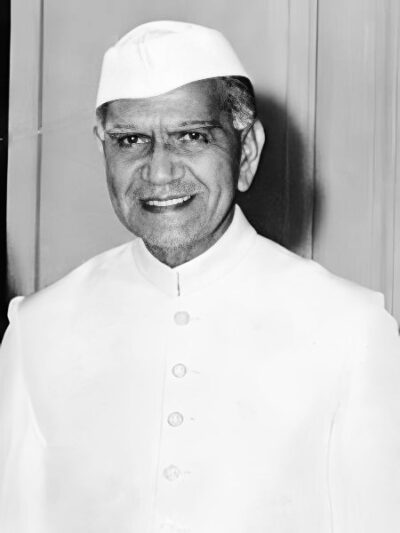
Fakhruddin Ali Ahmed
Fakhruddin Ali Ahmed was a politician, fifth President of India. Born May 13, 1905, in Old Delhi. Died February 11, 1977, in New Delhi. Positions held include Member of the Lok Sabha, President of India (1974–1977) and member of Rajya Sabha. Educated at St Catharine's College and St. Stephen's College.
Facts
20 facts · 2 confirmed by two sources · 0 cited · 18 from one source
Where this comes from
Papalocal keeps its own record. It started from these sources; what each one said is kept here as it was copied, so a change on their side never changes this page by itself. Tap one to read its version.
What Wikidata says · copied November 16, 2026 · revision 2530005541
- Described as
- politician, fifth President of India (1905-1977)
- Born
- May 13, 1905 · 3 references
- Died
- February 11, 1977 · 4 references
- Born in
- Old Delhi
- Died in
- New Delhi
- Buried in
- India
- Citizen of
- India (1950–); British Raj (–1947); Dominion of India (1947–1950)
- Occupation
- lawyer; politician
- Positions held
- Member of the Lok Sabha; President of India (1974–1977); member of Rajya Sabha; Member of the Assam Legislative Assembly
- Political party
- Indian National Congress
- Education
- St Catharine's College; St. Stephen's College; University of the Punjab
- Spouse
- Begum Abida Ahmed · 1 reference
- Religion
- Islam
- Wikipedias with a page
- 61
Wikidata item Q317778 (wikidata.org/wiki/Q317778), public domain (CC0). Copied November 16, 2026.
What Wikipedia says · copied November 16, 2026 · revision 1373595884
Fakhruddin Ali Ahmed (Assamese pronunciation: [ɸɔkʱɹudːin ali aɦmɛd]; 13 May 1905 – 11 February 1977) was an Indian lawyer and politician who served as the President of India from 1974 to 1977.
Born in Delhi, Ahmed studied in Delhi and Cambridge and was called to the bar from the Inner Temple, London in 1928. Returning to India, he practised law in Lahore and then in Guwahati. Beginning a long association with the Indian National Congress in the 1930s, Ahmed was finance minister of Assam in the Gopinath Bordoloi ministry in 1939. He became the Advocate General of Assam in 1946, and was finance minister again from 1957 to 1966 under Bimala Prasad Chaliha. He was made a national Cabinet Minister by Prime Minister Indira Gandhi in 1966 and was in charge of various central ministries including Power, Irrigation, Industries and Agriculture. He was elected President of India in 1974, securing a greater confidence than his contestant Tridib Chaudhuri.
As President, Ahmed imposed The Emergency in June 1975 and gave his assent to numerous ordinances and constitutional amendments drafted by Indira Gandhi to rule by decree. Lampooned in an iconic cartoon by Abu Abraham, Ahmed's reputation was tarnished by his support for the Emergency. His Presidency had been described as a rubber stamp.
Ahmed died in February 1977 of a heart attack. He was accorded a state funeral and is buried in a mosque near Parliament House in New Delhi. Ahmed, who was the second Muslim to become the president of India, was also the second president to die in office. Ahmed was succeeded by B. D. Jatti as interim president and by Neelam Sanjiva Reddy as the sixth president of India in 1977.
- Born, in its opening lines
- May 13, 1905
- Died, in its opening lines
- February 11, 1977
From the Wikipedia article “Fakhruddin Ali Ahmed” (en.wikipedia.org/wiki/Fakhruddin_Ali_Ahmed), by its contributors, under CC BY-SA 4.0 (creativecommons.org/licenses/by-sa/4.0/). Copied November 16, 2026; not changed.
Confirmed Two sources agree. Cited One source, and it names where it got it. One source One source, without a reference of its own. Sources disagree The sources disagree. We show the best-supported value and keep theirs below.
