
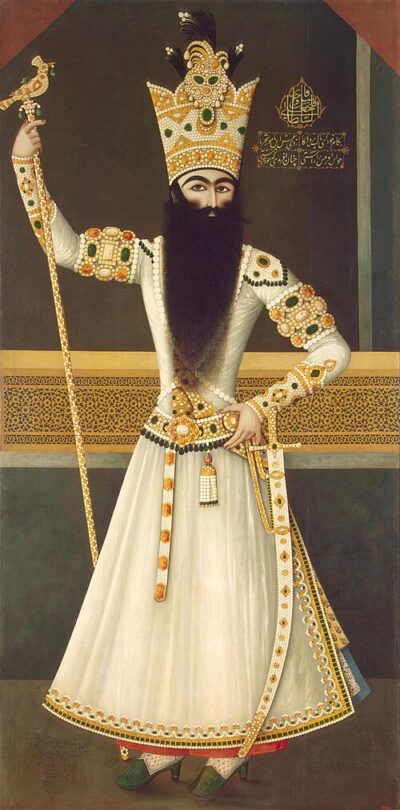
Fath-Ali Shah Qajar
Fath-Ali Shah Qajar was a second Qajar shah of Iran (1797–1834).. Born August 5, 1772, in Damghan. Died October 23, 1834, in Isfahan. Positions held include shah (1797–1834) and Tayghun Khanum.
Facts
39 facts · 1 confirmed by two sources · 0 cited · 36 from one source · 2 where the sources disagree
What’s different
- Died: we show October 23, 1834 (Sources disagree). Wikipedia says October 24, 1834
- Buried in: we show Fatima Masumeh Shrine (Sources disagree). Wikidata also lists Qom
Where this comes from
Papalocal keeps its own record. It started from these sources; what each one said is kept here as it was copied, so a change on their side never changes this page by itself. Tap one to read its version.
What Wikidata says · copied November 16, 2026 · revision 2553831097
- Described as
- second Qajar shah of Iran (1797–1834).
- Other names
- Fath-Ali Shah, Fath-Ali Qajar
- Born
- August 5, 1772
- Died
- October 23, 1834
- Born in
- Damghan
- Died in
- Isfahan
- Buried in
- Qom; Fatima Masumeh Shrine · 1 reference
- Cause of death
- Sudden Death vulnerability
- Citizen of
- Guarded Domains of Iran
- Occupation
- monarch; politician; military leader; poet; patron of the arts
- Positions held
- shah (1797–1834); Tayghun Khanum
- Field
- politics; military administration; literature; revival
- Spouse
- Agha Baji Javanshir; Zibachehr Khanom; Taj ol-Dowleh · 1 reference; Maryam Khanom; Naneh Khanom Barforoush; Badr Jahan Khanom
- Children
- Abbas Mirza · 3 references; Mohammad-Ali Mirza Dowlatshah; Aliqoli Mirza Etezado-ol-Saltaneh; Mohammad Taqi Mirza · 1 reference; Hasan Ali Mirza; Husayn Ali Mirza; Mohammad Vali Mirza; Soltan Ahmad Mirza Azod od-Dowleh · 1 reference; Soleyman Mirza Qajar; Omm Salmeh; Parviz Mirza; Saifullah Mirza
- Father
- Hossein Qoli Khan
- Mother
- Asiye Khanum Ezzeddin Qajar
- Religion
- Shia Islam
- Wikipedias with a page
- 60
Wikidata item Q175299 (wikidata.org/wiki/Q175299), public domain (CC0). Copied November 16, 2026.
What Wikipedia says · copied November 16, 2026 · revision 1384635797
Fath-Ali Shah Qajar (Persian: فتحعلىشاه قاجار, romanized: Fatḥ-ʻAli Šâh Qâjâr; 5 August 1772 – 24 October 1834) was the second Shah of Qajar Iran. He reigned from 17 June 1797 until his death on 24 October 1834. His reign saw the irrevocable ceding of Iran's northern territories in the Caucasus, comprising what is nowadays Georgia, Derbent, Azerbaijan, and Armenia, to the Russian Empire following the Russo-Persian Wars of 1804–1813 and 1826–1828 and the resulting treaties of Gulistan and Turkmenchay. These two treaties are closely tied to Fath-Ali Shah's legacy amongst Iranians, who often view him as a weak ruler.
Fath-Ali Shah successfully restructured a mostly Turkic tribal khanship into a centralized and stable monarchy based on the old imperial design. This brought to Iran a relatively calm and prosperous period, secured a mutually beneficial relationship between state and religion, established foundational principles of state administration, and supported cultural and artistic revival, which remained a distinctive feature of the Qajar dynasty. At the end of his reign, his mounting economic problems and declining military power took Iran to the verge of ruin. The situation was further complicated by the subsequent struggle for the throne that ensued after his death.
Fath-Ali Shah had many portraits of himself and his court created, with the intention to aggrandize his rule. These included most notably the rock reliefs which were created next to those left by the pre-Islamic Sasanian Empire (224–651) in Ray, Fars and Kermanshah. This was done in an effort to portray himself as heir to the ancient Persian empire, not just to his fellow countrymen but to all of posterity. An inscription is located in Cheshmeh-Ali in Rey, near Tehran.
- Born, in its opening lines
- August 5, 1772
- Died, in its opening lines
- October 24, 1834
From the Wikipedia article “Fath-Ali Shah Qajar” (en.wikipedia.org/wiki/Fath-Ali_Shah_Qajar), by its contributors, under CC BY-SA 4.0 (creativecommons.org/licenses/by-sa/4.0/). Copied November 16, 2026; not changed.
Confirmed Two sources agree. Cited One source, and it names where it got it. One source One source, without a reference of its own. Sources disagree The sources disagree. We show the best-supported value and keep theirs below.
