
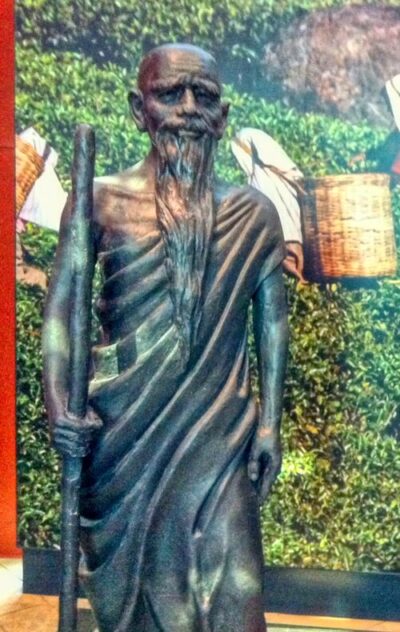
Faxian
Faxian was a Chinese Buddhist monk (bhikkhu), pilgrim to India, and travelogue author during the Jin and Liu Song dynasties. Born 337, in Xiangyuan County. Died 422, in Nanjing. Known for Record of Buddhist Kingdoms.
Facts
14 facts · 0 confirmed by two sources · 2 cited · 11 from one source · 1 where the sources disagree
What’s different
- Born: we show 337 (Sources disagree). Wikidata also lists 340
Where this comes from
Papalocal keeps its own record. It started from these sources; what each one said is kept here as it was copied, so a change on their side never changes this page by itself. Tap one to read its version.
What Wikidata says · copied November 16, 2026 · revision 2561332694
- Described as
- Chinese Buddhist monk (bhikkhu), pilgrim to India, and travelogue author during the Jin and Liu Song dynasties
- Other names
- Fa Hien, Fa Hsien, Fa Xian, Fa-hsien, Fa-Hien, Fathian, Fat-hian, Fat Hian, Fahien, Fa-hian, Fa Hian, Fahian
- Born
- 340; 337 · 1 reference
- Died
- 422; 422 · 1 reference
- Born in
- Xiangyuan County
- Died in
- Nanjing
- Citizen of
- Eastern Jin dynasty; Liu Song dynasty · 1 reference
- Occupation
- explorer; historian; writer; translator; Buddhist monk; monk · 1 reference
- Known for
- Record of Buddhist Kingdoms
- Religion
- Buddhism
- Wikipedias with a page
- 53
Wikidata item Q312978 (wikidata.org/wiki/Q312978), public domain (CC0). Copied November 16, 2026.
What Wikipedia says · copied November 16, 2026 · revision 1384588114
Faxian (337–c. 422 CE), formerly romanized as Fa-hien or Fa-hsien, was a Chinese Buddhist monk and translator who traveled on foot from the Later Qin state to classical India to acquire Buddhist scriptures. His birth surname was Gong. Starting his journey about age 60, he traveled west along the overland Silk Road, visiting Buddhist sites in Central, South, and Southeast Asia. The journey and return took from 399 to 412, with 10 years spent in India.
Faxian's account of his pilgrimage, the Foguoji or Record of the Buddhist Kingdoms, is a notable independent record of early Buddhism in India. He returned to China with a large number of Sanskrit texts, whose translations greatly influenced East Asian Buddhism and provide a terminus ante quem for many historical names, events, texts, and ideas therein.
From the Wikipedia article “Faxian” (en.wikipedia.org/wiki/Faxian), by its contributors, under CC BY-SA 4.0 (creativecommons.org/licenses/by-sa/4.0/). Copied November 16, 2026; not changed.
Confirmed Two sources agree. Cited One source, and it names where it got it. One source One source, without a reference of its own. Sources disagree The sources disagree. We show the best-supported value and keep theirs below.
