
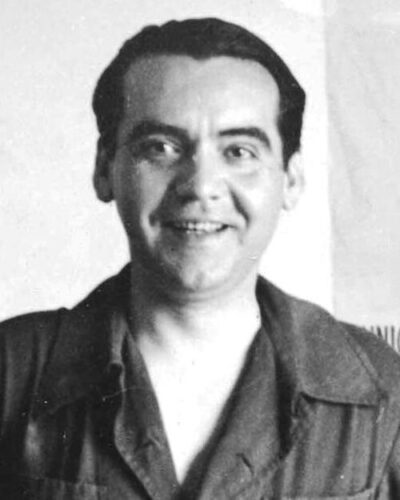
Federico García Lorca
Federico García Lorca was a Spanish poet, dramatist and prose writer. Born June 5, 1898, in Fuente Vaqueros. Died August 19, 1936, in Víznar. Positions held include theatre manager (1932–1936). Known for Blood Wedding, Yerma and Libro de poemas. Educated at University of Granada and Facultad de Filosofía y Letras (Universidad de Granada).
Facts
41 facts · 1 confirmed by two sources · 10 cited · 28 from one source · 2 where the sources disagree
What’s different
- Died: we show August 19, 1936 (Sources disagree). Wikipedia says August 18, 1936
- Cause of death: we show gunshot wound (Sources disagree). Wikidata also lists mass shooting
Where this comes from
Papalocal keeps its own record. It started from these sources; what each one said is kept here as it was copied, so a change on their side never changes this page by itself. Tap one to read its version.
What Wikidata says · copied November 16, 2026 · revision 2565594595
- Described as
- Spanish poet, dramatist and prose writer (1898–1936)
- Other names
- F. G. Lorca, Lorca, Federico del Sagrado Corazón de Jesús García Lorca, Lorka, F. Garcia Lorca, Federico del Sagrado Corazon de Jesus Garcia Lorca, Federico Carcia Lorca, G. F. Lorca, Federico Garcia Lorca, Phenteriko Gkarthia Lorka, García Lorca, Federico Carcía Lorca
- Born
- June 5, 1898 · 18 references
- Died
- August 19, 1936 · 9 references
- Born in
- Fuente Vaqueros · 5 references
- Died in
- Víznar · 1 reference
- Cause of death
- gunshot wound · 1 reference; mass shooting
- Name at birth
- Federico del Sagrado Corazón de Jesús García Lorca
- Citizen of
- Spain · 2 references
- Occupation
- theatre director · 1 reference; lyricist; playwright · 3 references; poet · 3 references; writer · 2 references; composer · 2 references; theatre manager; draftsperson · 1 reference
- Positions held
- theatre manager (1932–1936)
- Worked for
- La Barraca
- Education
- University of Granada; Facultad de Filosofía y Letras (Universidad de Granada) (1915–)
- Genre
- theatre; art
- Instrument
- piano
- Known for
- Blood Wedding; Yerma; Libro de poemas; Poet in New York; Poema del cante jondo; When Five Years Pass; The Public; Diván del Tamarit; Doña Rosita the Spinster; The House of Bernarda Alba
- Father
- Federico García Rodríguez
- Mother
- Vicenta Lorca Romero
- Siblings
- Francisco García Lorca; Isabel García Lorca; Concepción García Lorca · 1 reference
- Lived in
- Granada; Residencia de Estudiantes; Casa Huerta de San Vicente; Valderrubio
- Wikipedias with a page
- 143
Wikidata item Q41408 (wikidata.org/wiki/Q41408), public domain (CC0). Copied November 16, 2026.
What Wikipedia says · copied November 16, 2026 · revision 1385087581
Federico del Sagrado Corazón de Jesús García Lorca (5 June 1898 – 18 August 1936) was a Spanish poet, playwright, and theatre director. García Lorca achieved international recognition as an emblematic member of the Generation of '27, a group consisting mostly of poets who introduced the tenets of European movements (such as symbolism, futurism, and surrealism) into Spanish literature.
He initially rose to fame with Romancero gitano (Gypsy Ballads, 1928), a book of poems depicting life in his native Andalusia. His poetry incorporated traditional Andalusian motifs and avant-garde styles. After a sojourn in New York City from 1929 to 1930—documented posthumously in Poeta en Nueva York (Poet in New York, 1942)—he returned to Spain and wrote his best-known plays, Blood Wedding (1932), Yerma (1934), and The House of Bernarda Alba (1936).
García Lorca was homosexual and suffered from depression after the end of his relationship with sculptor Emilio Aladrén Perojo. García Lorca also had a close emotional relationship for a time with surrealist artist Salvador Dalí, who said he rejected García Lorca's sexual advances.
García Lorca was assassinated by Nationalist forces at the beginning of the Spanish Civil War. His remains have never been found, and the motive remains in dispute; some theorize he was targeted for being gay, a socialist, or both, while others view a personal dispute as the more likely cause.
- Born, in its opening lines
- June 5, 1898
- Died, in its opening lines
- August 18, 1936
From the Wikipedia article “Federico García Lorca” (en.wikipedia.org/wiki/Federico_García_Lorca), by its contributors, under CC BY-SA 4.0 (creativecommons.org/licenses/by-sa/4.0/). Copied November 16, 2026; not changed.
Confirmed Two sources agree. Cited One source, and it names where it got it. One source One source, without a reference of its own. Sources disagree The sources disagree. We show the best-supported value and keep theirs below.
