The House of Bernarda Alba
The House of Bernarda Alba is a play by Federico García Lorca (1936). It came out in 1947.
- Published
- 1947
- Written by
- Federico García Lorca
- Genre
- drama
- Country of origin
- England
All 6 facts, and where they come from
Facts
6 facts · 0 confirmed by two sources · 0 cited · 6 from one source
Where this comes from
Papalocal keeps its own record. It started from these sources; what each one said is kept here as it was copied, so a change on their side never changes this page by itself. Tap one to read its version.
What Wikidata says · copied November 17, 2026 · revision 2567895164
- Described as
- play by Federico García Lorca (1936)
- What it is
- literary work
- Written by
- Federico García Lorca
- Genre
- drama
- Published
- 1947
- Language
- Spanish
- Country of origin
- England
- Wikipedias with a page
- 32
Wikidata item Q822850 (wikidata.org/wiki/Q822850), public domain (CC0). Copied 2026-11-17.
What Wikipedia says · copied November 17, 2026 · revision 1380723683
The House of Bernarda Alba (Spanish: La casa de Bernarda Alba) is a play by the Spanish dramatist Federico García Lorca. Commentators have often grouped it with Blood Wedding and Yerma as the Rural Trilogy. García Lorca did not include it in his plan for a "trilogy of the Spanish land" (which remained unfinished at the time of his murder).
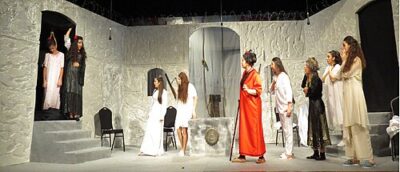
García Lorca described the play in its subtitle as a drama of women in the villages of Spain. The House of Bernarda Alba was García Lorca's last play, completed on 19 June 1936, two months before his assassination during the Spanish Civil War. The play was first performed on 8 March 1945 at the Avenida Theatre in Buenos Aires. The play centers on the events of a house in Andalusia during a period of mourning, in which Bernarda Alba (aged 60) wields total control over her five daughters Angustias (39 years old), Magdalena (30), Amelia (27), Martirio (24), and Adela (20). The housekeeper (Poncia) and Bernarda's elderly mother (María Josefa) also live there.
The deliberate exclusion of any male character from the action helps build up the high level of sexual tension that is present throughout the play. Pepe "el Romano", the love interest of Bernarda's daughters and suitor of Angustias, never appears on stage. The play explores themes of repression, passion, and conformity, and inspects the effects of men upon women.
From the Wikipedia article “The House of Bernarda Alba” (en.wikipedia.org/wiki/The_House_of_Bernarda_Alba), by its contributors, under CC BY-SA 4.0 (creativecommons.org/licenses/by-sa/4.0/). Copied 2026-11-17; not changed.
Confirmed Two sources agree. Cited One source, and it names where it got it. One source One source, without a reference of its own. Sources disagree The sources disagree. We show the best-supported value and keep theirs below.
Picture: Shahen books, via Wikimedia Commons · CC BY-SA 4.0