
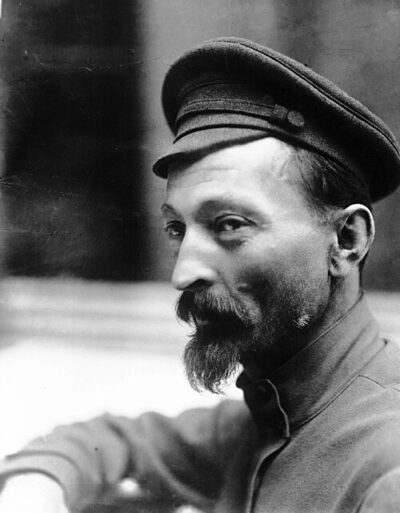
Felix Dzerzhinsky
Felix Dzerzhinsky was a Bolshevik revolutionary and founder of the first Soviet secret police organs. Born August 30, 1877, in Dzerzhinovo (chutar). Died July 20, 1926, in Moscow. Positions held include Chairman of the GPU (1922–1923), Member of the Russian Constituent Assembly (1918) and chairman of the OGPU (1923–1926). Educated at Saint Petersburg State University and 1st Vilna Men's Gymnasium. Awards include Order of the Red Banner and Honorary Worker of the VChK–GPU (V).
Facts
34 facts · 1 confirmed by two sources · 7 cited · 25 from one source · 1 where the sources disagree
What’s different
- Born: we show August 30, 1877 (Sources disagree). Wikipedia says September 11, 1877
Where this comes from
Papalocal keeps its own record. It started from these sources; what each one said is kept here as it was copied, so a change on their side never changes this page by itself. Tap one to read its version.
What Wikidata says · copied November 16, 2026 · revision 2565426064
- Described as
- Bolshevik revolutionary and founder of the first Soviet secret police organs (1877-1926)
- Other names
- Loïc pcs, Feliks Dzierzynski, Feliks Dzierżyński, Felix Edmundovich Dzerzhinsky, FD
- Born
- August 30, 1877 · 6 references
- Died
- July 20, 1926 · 10 references
- Born in
- Dzerzhinovo (chutar)
- Died in
- Moscow · 3 references
- Buried in
- Kremlin Wall Necropolis
- Cause of death
- myocardial infarction
- Name at birth
- Feliks Szczęsny Dzierżyński · 1 reference
- Citizen of
- Russian Empire · 2 references; Russian Soviet Federative Socialist Republic (–1922); Soviet Union · 1 reference
- Occupation
- politician · 3 references; revolutionary · 1 reference; communist · 1 reference
- Positions held
- Chairman of the GPU (1922–1923); Member of the Russian Constituent Assembly (1918); chairman of the OGPU (1923–1926)
- Political party
- Communist Party of the Soviet Union (–1926); Social Democracy of the Kingdom of Poland and Lithuania (1899–); Social Democratic Party of Lithuania; Russian Social Democratic Labour Party (bolshevik)
- Education
- Saint Petersburg State University; 1st Vilna Men's Gymnasium · 1 reference
- Member of
- Central Committee of the Communist Party of the Soviet Union; All-Union Society of Old Bolsheviks
- Awards
- Order of the Red Banner (1920); Honorary Worker of the VChK–GPU (V)
- Spouse
- Sofia Dzerzhinskaya (1910–1926)
- Children
- Jan Dzerzhinsky
- Father
- Edmund Dzierżyński
- Mother
- Helena Dzierżyńska
- Siblings
- Władysław Dzierżyński
- Religion
- lapsed Catholic; atheism · 1 reference
- Lived in
- Saint Petersburg · 1 reference
- Wikipedias with a page
- 80
Wikidata item Q188570 (wikidata.org/wiki/Q188570), public domain (CC0). Copied November 16, 2026.
What Wikipedia says · copied November 16, 2026 · revision 1382955842
Felix Edmundovich Dzerzhinsky (11 September [O.S. 30 August] 1877 – 20 July 1926), nicknamed Iron Felix (Russian: Железный Феликс), was a Bolshevik revolutionary and politician of Polish origin. From 1917 until his death in 1926, he led the first three Soviet secret police organizations—the Cheka, the GPU and the OGPU—establishing state security organs for the new Soviet government.
Born to a Polish family of noble descent in Ozhyemblovo estate (now Dzerzhinovo), in Russian Poland, Dzerzhinsky embraced revolutionary politics from a young age, and was active in the Social Democracy of the Kingdom of Poland and Lithuania party. Active in Kaunas and Warsaw, he was frequently arrested and underwent several exiles to Siberia, from which he escaped every time. He evaded the tsarist secret police, the Okhrana, whose work he took interest in. Dzerzhinsky participated in the failed 1905 Revolution, and pursued further revolutionary activities in Germany and Poland. After a final arrest in 1912, was imprisoned until the February Revolution of 1917. He then joined Vladimir Lenin's Bolshevik party, and played an active role in the October Revolution which brought them to power.
In December 1917, Lenin named Dzerzhinsky head of the newly established the All-Russian Extraordinary Commission (Cheka), tasking him with the suppression of counter-revolutionary activities in Soviet Russia. The Russian Civil War saw a vast expansion of the Cheka's authority, inaugurating a campaign of mass arrests, detentions and executions in what became known as the Red Terror. The agency was reorganized as the State Political Directorate (GPU) in 1922, and then as the Joint State Political Directorate (OGPU) a year later, with Dzerzhinsky remaining as head of the powerful organization. He served as director of the Supreme Soviet of the National Economy (VSNKh) from 1924.
Dzerzhinsky died of a heart attack in 1926, and was buried in the Kremlin Wall Necropolis. He was remembered by secret police agents (known as "Chekists" throughout the Soviet era) as a hero of the revolution. A large statue of him stood in front of the security service headquarters at Moscow's Lubyanka Building until 1991. He also became a prominent symbol of repression and brutality to critics of the Soviet government.
- Born, in its opening lines
- September 11, 1877
- Died, in its opening lines
- July 20, 1926
From the Wikipedia article “Felix Dzerzhinsky” (en.wikipedia.org/wiki/Felix_Dzerzhinsky), by its contributors, under CC BY-SA 4.0 (creativecommons.org/licenses/by-sa/4.0/). Copied November 16, 2026; not changed.
Confirmed Two sources agree. Cited One source, and it names where it got it. One source One source, without a reference of its own. Sources disagree The sources disagree. We show the best-supported value and keep theirs below.
